
Hackaday Links: Sunday, November 29

Sometimes we wonder if we’re making good choices with PCB layout when using EagleCAD. Watch how the pros do it with a video of an hour-long Adafruit PCB layout session compressed into seven minutes.

[Elijah] documented his RepStrap build. This is a chicken-or-egg project in that RepStrap machines are built without the assistance of an already existing RepRap.

Here’s an ASUS concept from CeBIT this year for a laptop that has two touch screens and no physical keyboard. Isn’t this just the DS project we saw this week but in a nice case?

[James] conjured up a physical realization of the Spinning Wheel of Death for an art exhibit. We can’t stop smiling when looking at this artful hack.

I’m sure nobody will raise an eyebrow when you pop out that roll of duct-tape and affix your phone to the airplane window. That’s what [floe] did to make this airline flight time-lapse video with an Android phone. Aren’t you supposed to turn off all electronics for takeoff?
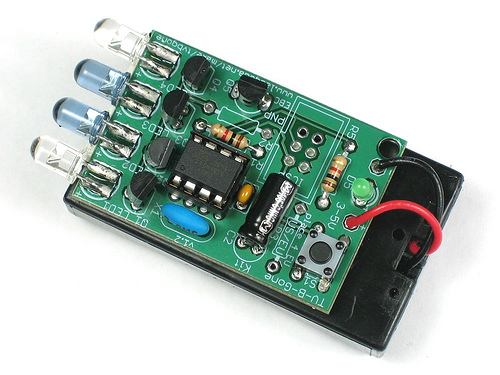
Adafruit Releases New TV-B-Gone Kit

Recently, our friends over at Adafruit released a new version of their popular TV-B-Gone kit. Built in cooperation with [Mitch Altman], the inventor of the TV-B-Gone, the new kit sports four high power IR LEDs, two wide beam and two narrow beam. The four LEDs give the new TV-B-Gone increased range, with a maximum distance of over 150ft. One of the most impressive features of the kit is the fact that the new TV-B-Gone is universal and can now work in Europe and Asia in addition to the US. Users are able to select which region they want to use during the build process by soldering a resistor into the board at their region’s corresponding spot as seen in the picture above. The new TV-B-Gone kit is now available in the Adafruit store for $19.95 plus shipping.

Adjustable Breadboard Supply

breadboardpowersupply

adafruit industries’ latest product is an adjustable breadboard power supply kit. We’ve seen breadboard supplies before, but like most of adafruit’s kits, this is the best design you’re going to encounter. It uses an MIC2941 voltage regulator instead of the more commonplace LM317. It has a very low dropout which means your output voltage can be much closer to the input voltage. Their example is using 3AAA or a Li-Ion battery for an output of 3.3V. Input can be through a barrel jack or terminal blocks. There is a selection switch for 3.3, 5, and adjustable voltage. Using the adjustment pot you can select an output voltage anywhere from 1.3V to within .5V of the 20V maximum input. The adjusted output voltage will remain the same even if you increase the input voltage. Like all of their kits, you can find schematics, assembly and usage instructions, on their project site.

SparkFun Open-sources Latest Kits

09205-5

SparkFun has started to release some of their kits as open-source hardware. Projects such as ClockIt, a simple alarm clock, have their schematics, board designs, and source code released under the CC-by-sa license. Although most of their widgets and projects already had example code and schematics available, they are now using an open-source license. They are joining adafruit and EMSL and others in pushing OSH, but it is interesting to see an established company turn to this. Normally, startups do this to encourage early adoption.

[via adafruit]

Adafruit Introduces The Sensor Pack 900

adafruit

Our friends over [adafruit] recently released the Sensor Pack 900, a collection of parts for anyone who is interested in using analog sensors with their projects. The pack includes 9 sensors. They range from simple thermistors and hall effect sensors to sharp distance sensors. Also included in the pack are 3 unidentified components that can be used to interface with the analog sensors in the pack. At only $30, the Sensor Pack 900 seems to offer a great set of introductory components for anyone prototyping a new device.

Business Cards At Maker Faire

business_card

[John Park] has managed to snag a couple interesting business cards at Maker Faire. The first is Adafruit’s laser cut Spirograph card. The other is a ATtiny2313 prototyping board from Evil Mad Science; it looks to be the same style as their well-known AVR target board. We’ve also heard rumors that [Jérôme Demers] has bunch of resistor bending cards.

For more business card nonsense, check out: [Goodspeed]’s smart card emulator, [Mayer]’s embedded gears, and our web server business card.









