IOIO Controller Replacement For An RC Truck

This RC truck can be controlled with the tip of your thumb or the tilt of a wrist. That’s thanks to the IOIO which was inserted in place of the toy’s original controller. [Exanko] made the hardware changes in order to use his Android phone as the controller. The white circle is a software joystick that acts as throttle when your thumb moves along the Y axis, and steering when it moves along the X axis. But while he was at it he also included accelerometer input as an alternative control option.

The IOIO board has a Bluetooth dongle connected to its USB port as a means of wireless communication. The dongle was hacked to accept an external antenna, thereby increasing the truck’s range. There is also some on-board flair like LEDs for lights and even a laser diode for… well we’re not sure what that’s for. Get a better look at the hardware internals in the clip after the break.

Continue reading “IOIO Controller Replacement For An RC Truck”

Tank Router Defends Your Pets?

The guys over at Section9 Hackerspace in Springfield, Missouri just finished building this treaded robot. Despite the juxtaposition of the cat, it really doesn’t defend anything. The project is a reconnaissance robot controlled over the network with video feedback.

The team started off with some lofty goals. They wanted to the robot to be able to climb stairs and to feature a detachable flying portion in order to get a better look at hard to reach places. Cost and complexity are cited as the reasons they ditched the idea of the flyer. The rest of the features came out much as planned. The motor controller for the treads is connected to an Arduino. This uses an Ethernet shield to connect to the WRT54G router which is also coming along for the ride. This seems a bit over-powered but it makes it easy to connect the webcam on the front (also via Ethernet).

On the software side they wrote an Android app. It controls the movement of the robot, as well as that of the camera. Of course you need to see where you’re going so they went the extra mile to include video from the webcam. Check out their show-and-tell video after the break.

Continue reading “Tank Router Defends Your Pets?”

Recreating [Phillip K. Dick] In Android Form… And Losing His Head

Yes, that’s an android of [Phillip K. Dick]. While you don’t necessarily need to be familir with [Phillip K. Dick] to find this story amusing, we highly recommend that you take a few minutes to learn about him if you don’t recognize the name. [Phillip K. Dick], or [PKD] was a science fiction author and created many of the ideas and even base stereotypes for the science fiction movies you are probably very familiar with.

Most of that, however, isn’t completely relevant to the story here. Someone decided to build an android [Phillip K. Dick]. A move that generally results in expeditions deep into the uncanny valley and causes people to want to keep their distance. In this case, however, the fancy android head of [P.K.D] was left in an overhead compartment in an airplane for a short time by accident. During this short time, someone took it and it has not been seen since.

The story of the entire build and design process is actually quite intriguing. Not only did they sculpt a likeness of [P.K.D.] and add some motion to it, they compiled a database of his essays and writings from which it will create answers that are at least tinted with his thoughts. A method very similar to something he himself wrote about back in 1964.

Android Controlled Robot Extravaganza

We have no idea why, but since we featured Botiful, the Android-powered telepresence robot a few days ago, the tip line has been awash in robot/Android mashups. Here’s a few of the cool ones.

Using an Android as a remote control

[Stef] used a Samsung Galaxy S3 to control an old rc tank. The Android sends accelerometer and gyro data over Bluetooth to an Android where it powers a pair of H-bridges to turn the wheels.

Turning Android into a Robotic Operating System

ROS, or the Robot Operating System, provides a bunch of utilities for any type of robot such as point-cloud mapping to multi-joint arm control. [Lentin] sent in a guide on installing ROS on Android. So far, he can get accelerometer data, stills from the on-board camera, have the robot speak and use the small vibrator motor. Here’s a (somewhat limited) demo of [Lentin] playing with ROS in a terminal.

“Just a quick procrastination project”

Last May, [Josh] wrote in asking if a tread-based robot controlled through Skype would be a cool idea. We said ‘hell yeah’ and [Josh] scurried off to his workshop for a few months. He’s back with his tank-based robot. One really interesting bit is the robot responds to DTMF tones, allowing it to be controlled through Skype without any additional hardware. That’s damn clever. You can see a video of the SkypeRobot after the break.

Continue reading “Android Controlled Robot Extravaganza”

Another Android Controlled Roving Robot

[Sam] has been working on a cellphone controlled robot for a while now and with the launch of a few similar Kickstarter campaigns he thought it would be good to share his progress so far.

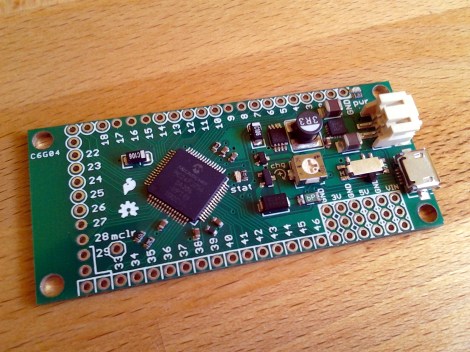
[Sam]’s robot is controlled by an Android device with the help of an IOIO dev board. This setup provides more than enough computational power to send a robot on its merry way, and has the bonus of allowing [Sam] to connect additional sensors.

The case is designed to put the headers on the IOIO board on the outside, just above a little shelf perfect for holding a breadboard or two. With the right hardware and software setup, [Sam]’s bot can rove around the neighborhood collecting data and sending it to a server in real time.

If you’re wondering why a tiny Android/IOIO powered sounds so familiar, it might be because of the Botiful robot we posted a few days ago. Unlike Botiful, [Sam] can only control his treaded Android bot through Bluetooth as the whole ‘programming a web interface’ is a bit over his head. Hopefully [Sam] will meet an enthusiastic coder when he brings his Arduino tank to Dorkbots Boston this evening.

You can check out a prototype of [Sam]’s bot in action after the break.

Continue reading “Another Android Controlled Roving Robot”

Ouya, A $100 Game Console For Indie Developers

With the explosion of mobile gaming (due in no small part to the egg-bombing Angry Birds), the Ouya was bound to happen. It’s a $100 game console powered by Android that puts indie games right into your living room.

The specs for the Ouya means this cube of games isn’t a slouch: the console comes loaded with an NVIDIA Terga3 quad-core processor, 1 GB of RAM, 8 Gigs of flash storage, HDMI, WiFi, Bluetooth, and Android 4.0. A requirement for publishing games on the Ouya is making at least some of the game free to play, a la TF2 or LoL. In addition to being a video game console, Ouya will also pull down Twitch.TV streams allowing you to watch Starcraft championships and other e-sports on your big-screen TV.

Not only does the Ouya play games, its designers made the device easily hackable. There aren’t enough details to know exactly what this means, but we’re sure we’ll see a full-blown Linux distro running on the Ouya within a week of release.

As of this writing, the Ouya Kickstarter has already met their funding goal of $950,000 by taking in two million a freaking ton of money with 29 days left. This might become the most successful Kickstarter to date, and we can’t wait to see all the neat stuff and hacks for the Ouya in the near future.

Emulating Mac System 7 On An Android Device

Over on the 68kmla forums, a website dedicated to old Macs built before 1994, [zydeco] released his Android port of Mini vMac, a Macintosh Plus emulator that puts the power of a Motorola MC68000 processor and System 7 on any computer.

Unlike the original Macintosh, or the subsequent revision that bumped the RAM up to 512 kilobytes, the Mac Plus was actually useful. With the addition of a SCSI port and support for 4 Megabytes of RAM, it’s not only possible to browse the Internet, but also act as a server. There’s a reason [Sprite_tm] chose to rebuild one of these classic, all-in-one machines to act as a home server; they really do epitomize the elegant computers from a more civilized age.

68kmla user [FlyingToaster] even went so far as to put a Mac Plus in his nook touch. With this, he’s got a full-blown installation of System 7 running on an e-ink screen, complete with LemmingsGauntlet, and Tetris.

It should be possible to plug this emulated box into the Internet. Unfortunately, experience tells us it won’t be a very pleasant browsing experience outside Hackaday’s retro edition.