Minecraft Clock Radio Puts A Creeper Head Next To Your Bed

minecraft-alarm-clock

This clock radio plays tunes from Minecraft and it’s decorated to look just like a creeper head. In the game mob heads are available as decoration and [Young_Maker] liked to spice up his virtual bedside table with a creeper head. But we think it looks just as good in its physical form.

The main part of the clock is an Arduino with a character LCD screen. A DS1307 real-time clock makes sure the device is accurate. We called this a clock radio in the title of the post, but it’s more of a clock MP3 player. The uMp3 board is used to play random music from the game. We would categorize the soundtrack as minimalism, which is a reasonable way to gently wake in the morning. But if time runs out the boom of an exploding creeper is played to make sure you’re not late for work.

We’ve embedded [Young_Maker’s] demo video after the jump.

Continue reading “Minecraft Clock Radio Puts A Creeper Head Next To Your Bed”

Guitar Foot Controller Uses DSP For Audio Effects

guitar-pedal-dsp1

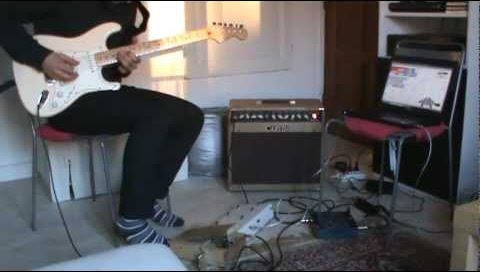
This a screenshot taken from [Pierre’s] demonstration of an electric guitar effects pedal combined with DSP and Pure Data. He pulls this off by connecting the guitar directly to the computer, then feeds the computer’s audio output to the guitar amp.

The foot controls include a pedal and eight buttons, all monitored by an Arduino. Pure Data, a visual programming language, interprets the input coming from the Arduino over USB and alters the incoming audio using digital signal processing. [Pierre] manages the audio connection using the JACK Audio Connection Kit software package.

In the video after the break he’s using a laptop for most of the work, but he has also managed to pull this off with a Raspberry Pi. There’s no audio input on the RPi board, but he’s been using a USB sound card anyway. The other USB port connects the Arduino and he’s in business.

Continue reading “Guitar Foot Controller Uses DSP For Audio Effects”

Coin-op Sega Rally Used To Race RC Cars

Head to head video game action can’t even compare to this use of a coin-op Sega Rally game to race actual RC vehicles. Take a close look at those screens and you’ll see there are no computer graphics, just a feed for a camera on each of the toy cars.

The project was conceived for the Sapo Codebits VI conference in Portugal. The arcade cabinets had their controls connected to an Arduino, but getting video up and running wasn’t nearly as easy. After fruitless attempts to get the original CRTs to work the team ended up replacing them with functioning CRT units of the same size. The cars themselves have two camera, one on top of the vehicle’s cab and one mounted on a boom for a perspective that was above and behind the vehicle. The drivers can switch between either view. The cars were set loose in the room serving as the event’s retro gaming area and players were free to race each other wherever they pleased. Don’t miss the video clip after the break which shows off all of the fun. Continue reading “Coin-op Sega Rally Used To Race RC Cars”

MariaMole – An Alternate Arduino IDE Aimed At Advanced Users

[Alex] has been working with Arduino for some time now, but always thought it lacked some features which advanced users would really find useful. He decided to devote some free time to fixing the problem and ended up coding an Arduino IDE for more advanced users. A screenshot of his work — called MariaMole — can be seen above. It is obviously different from the standard IDE, bot not so much as to scare off new users.

This is meant to complement the original IDE, so it actually uses those configuration settings as dependencies. Once running, the program allows you to have multiple projects open at once. These are managed with the tree in the left hand column and a series of tabs along the top of the code window. When it comes time to compile and load the sketch you can click one button like normal, or use the program to fine tune your compiler flags, libraries includes, and the like. It also allows for interaction through one or more serial terminal windows. We haven’t tried it ourselves, so please leave a comment with your thoughts after having given it a go.

thanks for the tip [Rodrigo].

Burglar Suspected Of Using Arduino-Onity Hack To Rob Hotel Rooms

Can anyone argue against this being the least-secure hotel room lock on the market? Regular readers will recognize it as an Onity key card lock. A few months back a glaring flaw in the security was exposed that allows these locks to be opened electronically in less than a second. So we are not surprised to hear that a series of hotel room robberies in Houston are suspected to have been performed using this technique.

The image above is from a demonstration video we saw back in October. That hack used an Arduino-compatible chip inside of a dry erase marker as an end-run around the lock’s electronics. It reinforced the warning sound by [Cody Brocious] when he presented the exploit at this year’s Blackhat conference. The barrel jack on the outside of the door lock doubles as a 1-wire communications port and that is how an attacker can gain access. Investigators can find no other means of entry for these thefts.

We applaud one of the victims in this story. At the end of the article she is asked if the information about the Onity flaw should have been kept secret. She said that if there’s a vulnerability that’s not being fixed people have a right to know about it. Bravo [Janet Wolf]!

[Thanks Andrew]

Internet Radio Occupies An 80-year-old Radio Case

[Florian Amrhein] made use of some old hardware to build his own internet radio in a 1930’s radio case.

The original hardware is a tube-amplified radio which he picked up on eBay. There’s tons of room in there once he removed the original electronics and that’s a good thing because he crammed a lot of new parts into the build. The main one being an old laptop he had on hand. It’s got a 10″ screen which is too large for the opening, but that ended up being okay. He coded an interface with C and SDL which give him a visual representation of his favorite online streams. The knob to the right moves the red line when turned and causes the Debian box to change to the new stream using the Music Player Daemon. Two potentiometers control the tuning and volume, and there is also a rotary encoder which is not yet in use. All three are connected to the laptop via an Arduino.

Check out the finished product in the video after the break. It sounds quite good thanks to the small automotive speaker and amplifier also crammed into the old case.

If you don’t have a laptop lying around to use in a project like this consider a microcontroller and character LCD based system.

Continue reading “Internet Radio Occupies An 80-year-old Radio Case”

Glockentar: A Guitar + Glockenspiel Mashup

This unique electronic instrument combines a chopped up guitar and a hacked apart glockenspiel with an Arduino. [Aaron]’s Glockentar consists of guitar hardware and glockenspiel keys mounted to a wood body. Solenoids placed above the keys actuate metal rods to play a note.

Under the hood, an Arduino connects the pieces. The conductive pick closes a circuit, which is a digital input into the Arduino. This actuates the corresponding solenoid to play the glockenspiel key, and sends a character to a computer over serial.

On the computer, an openFrameworks based program creates lighting that is projected onto each string. MadMapper is used for projection mapping, which maps the openFrameworks output to each string. Video is passed between applications using the Syphon framework.

[Aaron] has provided a write up that goes into details, including the Arduino and openFrameworks source for the project. There’s also a video overview and demo of the Glockentar after the break.

Continue reading “Glockentar: A Guitar + Glockenspiel Mashup”