
Tea-bagging An Arduino

tea-bagging-arduino

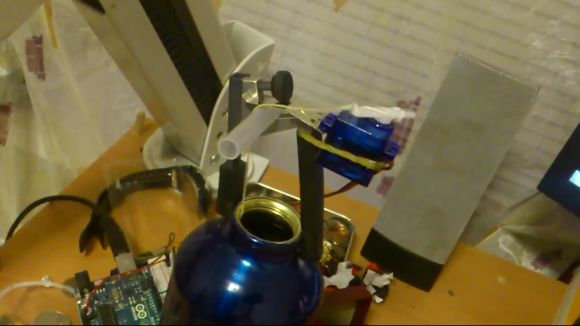
[Dmitry Narkevich] likes a strong cup of tea and his method of getting there is to oscillate the tea bag as it steeps. But why take the time to do this when you can make an Arduino brew your tea for you. As you can see, he rigged up a system to move the tea bag as it steeps in his metal bottle.

The motion is provided by a hobby servo connected to an Arduino. This makes timing the process very simple and we’d imaging it’s only a matter of time before he adds an alarm so he’ll know when it’s ready. But the real hack comes in the apparatus that connects the servo to the bottle. Since he’ll be drinking out of it the assembly needs to be easy to remove and should be able to stand up to the abuse of being clamped on and taken off a few times each day.

The base of the device is a guitar capo. This is meant to gently clamp to the finger board of a guitar using spring tension so it is already covered in rubber which gives it a firm grip on the bottle’s opening. The servo is connected to a metal part from a stapler, and the string drapes over the body of a disposable pen. Don’t miss this in action in the clip after the break.

If you don’t have a servo on hand you could try using the sled from an optical drive.

Continue reading “Tea-bagging An Arduino”

Solving A Rubick’s Cube With LEGO And Popsicle Sticks

solver

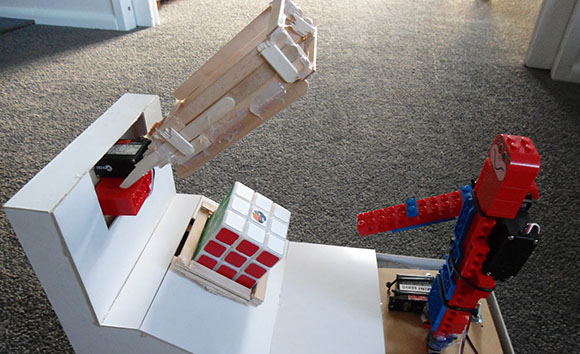
We’ve seen automated Rubick’s Cube solvers before, but never one that has garnered as many awards as [James]’ popsicle stick and LEGO Rubick’s Cube solver.\

To keep the project complexity down, [James] opted not to use a webcam to detect the color pattern on each face of the cube. Instead, he wrote a little Python app to manually enter the pattern on each face before letting his algorithm loose on the cube and calculating how to solve it.

So far, [James] has seen a huge amount of success from his project. He entered it in the New Zealand Brightsparks competition netting him $1000. This competition led to a win in the Realize the Dream science competition where he won a major prize and an entry into the International Taiwan Science Fair held early next year. An awesome accomplishment from a budding hacker, and we can’t wait to see what he comes up with next.

You can check out a video of [James]’ cube solver after the break.

Continue reading “Solving A Rubick’s Cube With LEGO And Popsicle Sticks”

Self-balancing Unicycle Using Arduino And Sparkfun IMU

Raptor-Bike-self-balancing-unicycle

Here’s proof that you can build cool stuff with simple tools. This self-balancing unicycle uses an Arduino and a five degree of freedom IMU from Sparkfun to keep the rider upright. Well, it’ll keep you upright as long as you have good side-to-side balance. But that’s true of any unicycle, right?

The Raptor was built by [Nick Thatcker] who is no stranger to self-balancing transportation. A few years back he built a Segway clone and the same type of geared motor used in that project also went into this one. I connects to the wheel with a chain, allowing him to keep the motor hidden in the saddle. He gets between 90 and 120 minutes of used on one charge with a top speed of 10 MPH. The motor could move you along faster but he has limited this in firmware to ensure it has enough power to ‘catch up’ if you lean too far forward.

Don’t miss the demo after the break. If you like this unicycle there are several others worth looking at.

Continue reading “Self-balancing Unicycle Using Arduino And Sparkfun IMU”

Webmote: Control Anything With Web-based Remote

control-anything-from-the-web

We’ve seen a lot of projects that let you control all of your devices from a smartphone. But this universal web-based remote control system looks like the most versatile we’ve seen yet. The project is called Webmote as the controls are served up as a web interface so that you’re not limited to say an Android device. The UI can be customized by choosing what buttons you will use and where to place them on the display. You can get a good feel for this by viewing this G+ album. Setup is made a bit easier thanks to an add-on system that has predefined layouts for common things like controlling XBMC.

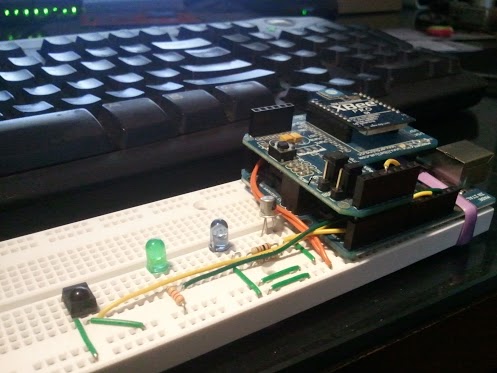
The hardware seen above is the business end of Webmote. It’s an Arduino with an IR receiver, IR LED, and an XBee module. For your common home entertainment devices you can teach the system your codes using the IR receiver. The IR LED is used to transmit those codes back, and the Xbee gives you the ability to control X10 (home automation) devices. Right now the setup requires the hardware be connected to a server via USB, but it shouldn’t be hard to set up some type of wireless alternative.

Twitter Radio

twitter-radio

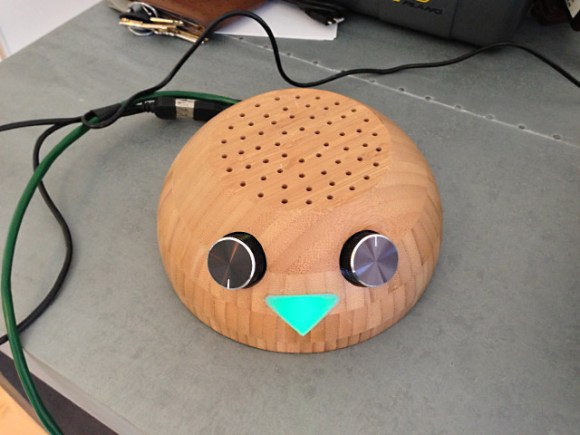
This anthropomorphized wood bowl will read Tweets out loud. It was built by [William Lindmeier] as part of his graduate work in the Interactive Telecommunications Program (ITP) at New York University. View the clip after the break to see and hear a list from his Twitter feed read in rather pleasant text-to-speech voices.

The electronics involved are rather convoluted. Inside the upturned bowl you’ll find both an Arduino and a Raspberry Pi. But that’s not the only thing that goes into this. The best sounding text-to-speech program [William] could find was for OSX, so there is a remote computer involved as well. But we think what makes this special is the concept and execution, not the level of hardware inefficiency.

The knob to the left sets the volume and is also responsible for powering down the device. The knob of the right lets you select from various Twitter lists. Each turn of the knob is responded to with a different LED color in the nose and a spoken menu label. You can get a quick overview of the project from this summary post.

Continue reading “Twitter Radio”

Arduino Esplora Makes A Great Controller

duino

The folks at Arduino seem to be stepping up their game. With the new Arduino Leonardo board able to emulate USB keyboards and mice right out of the box, it seems the perfect time for Arduino designers to come up with a proper video game controller. This new board is called the Arduino Esplora and packs enough buttons and sensors inside to capture just about any user input you can imagine.

On board the Esplora is the same ATMega 32U4 microcontroller found in the newest Arduino boards. For input, the designers included an analog joystick, four tact switches, a linear pot, a microphone, and light sensor. The Esplora also includes a three-axis accelerometer, RGB LED, buzzer, and a breakout for an SPI-controlled TFT LCD display, lest you would want to recreate something like the new Wii U controller on your own.

You can check out everything the Esplora can do over on the official Arduino site for the Esplora library.

Christmas Light Controller Is Its Own Percussion Section

clicking-christmas-tree-controller

[Jason] and his father took advantage of a week off of work over Thanksgiving to design and build a Christmas light decoration that can flash fancy patterns. He calls it the Uno Christmas Tree. It’s sixteen strands of lights draped between a pole and the ground to form the shape of a tree. The main controller is an Arduino UNO, but what really makes this work is a mechanical relay board with sixteen channels.

Using trigonometry they figured out that the decoration would be fifteen feet tall and have a five-foot radius at the base. A pipe was installed to act as the trunk, with an old toilet flange at the top and stakes at the bottom to anchor the lights. They all make their connections at the controller box using extension cords that were labelled with channel numbers. You can see the final product in the video after the break. But you’ll also want to watch the clip on [Jason’s] blog which shares the sonic symphony created when the mechanical relays really start working.

Continue reading “Christmas Light Controller Is Its Own Percussion Section”