Arduino Can Program PIC Too!

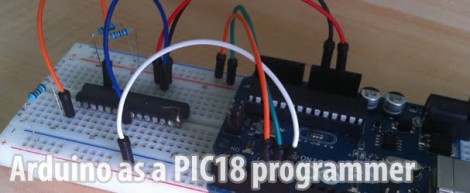
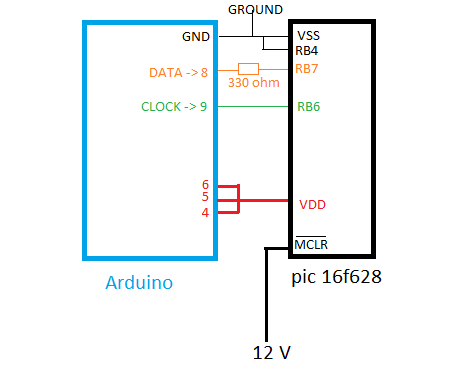
This is a wiring diagram that [Soranne] put together when developing a method of programming PIC microcontrollers using an Arduino board. You can see that he takes care of the 12V issue by connecting the Master Clear (MCLR) pin to an external source. This comes with one warning that the Arduino should always be reset just before making that connection.

He’s tested this with a 16F628 and is happy to report that he can successfully flash the program memory, but hasn’t implemented a way to write to the EEPROM as of yet. This should work for any of the 16F family of chips, but we’d bet this will be extended if some knowledgeable folks decide to lend a hand.

On the PC side of things [Soraane] has been working on a program to push code to the Arduino via the USB connection. He’s developing it in C# and even has a GUI worked up for the project. You can get your hands on the software in the second post of the thread linked above but you’ll have to be logged into the Arduino forum to see the download link.

We think the 12V issue is why we don’t see more roll-your-own programmers for PIC. But there are a few solutions out there like this ATmega8 version.

Sun-powered Stirling Engine With Automatic Tracking

Check out this solar-powered Stirling engine (translated). The build is part of a high school class and they packed in some really nice features. The first is the parabolic mirror which focuses the sun’s rays on the chamber of the engine. The heat is what makes it go, and the video after the breaks shows it doing just that.

But the concept behind the mirror makes for an interesting challenge. The light energy is focused at a narrow point. When the sun moves in the sky that point will no longer be at an efficient position to power the engine. This issue is solved by a pair of stepper motors which can reposition the dish. It’s done automatically by an Arduino Uno which makes readings from four LDR (photoresistors) in that cardboard tube mounted at the top of the dish. If the light intensity is the same for all four, then the tube is pointed at the sun. If not, the motors are tweaked to get the best angle possible.

Continue reading “Sun-powered Stirling Engine With Automatic Tracking”

Surround Sound System Controller Replacement Includes Home Automation

[Neoxy] always wanted surround sound for his computer, and one day he managed to get a hold of a dead 5.1 system. Why buy one when you can repair someone’s rubbish, right? That turned out to be easier said than done, but after several false-starts he managed to resurrect the audio system by replacing the microcontroller.

We find his trouble-shooting technique interesting. The amp would power up without a hitch but no sound would come out of it. So he took a headphone cable and used the L and R conductors as probes. That cable was fed from an MP3 player, and by touching the probes to the audio inputs for the pre-amp and amplifier circuits he could get great sound out of the speakers. Reasonably certain that those boards were working fine he narrowed down the troubles to three chips that mix, select inputs, and control the system.

A lot of prototyping with an ATmega328 and an Arduino led him to the functionality you see in the video after the break. Not only did he get the system working, but he’s using the Arduino to add Internet control for the device.

Continue reading “Surround Sound System Controller Replacement Includes Home Automation”

LED Matrix Shield Starts With A Very Loud Snap

We see a lot of LED matrix projects. They’re fun, and you can learn a lot of basic lessons during the build. But this one is out of the ordinary. [Rtty21] built an oddly sized, and sound controlled matrix shield for his Arduino. That’s it right there, the shield is the large chunk of protoboard but you can just see the Arduino peeking up over the top of it.

Now we say oddly sized because a 9×9 matrix doesn’t make much sense with an 8-bit micro controller. There’s no schematic but in the clip after the break he mentions that the columns and rows are driven by a decade counter and shift register and that’s what makes it possible to drive nine bits easily. Also of note on the board is that washer above and to the right of the matrix. It’s a touch-sensitive reset button. But the main control mechanism is a Clapper clone circuit. Just snap your fingers and it turns the project on or off. [Rtty21] based the design on this step-by-step sound input build.

Continue reading “LED Matrix Shield Starts With A Very Loud Snap”

Arduino BASIC Interpreter Using LCD, Keyboard, And SD

This Arduino BASIC interpreter will make a really fun one-day project if you’ve already got the parts on hand. [Usmar A. Padow] put together an Arduino Uno, SD card, four line character LCD, and PS/2 keyboard. but he’s also included alternative options to go without an LCD screen by using a computer terminal, or without the SD card by using only the Uno’s RAM. As you can see in his demo after the break, this simple input/output is all you need to experiment with some ancient computing.

It’s hard for us to watch this and not think back to an orange or green monochrome display. Just like decades past, this implementation of BASIC has you start each line of code with a line number, and doesn’t allow for character editing once the line has been input. The example programs that [Usmar] shows off are simple to understand but cover enough to get you started if you’ve never worked with BASIC before.

Last August we saw another hack which ported Tiny BASIC to the Arduino. You may want to take a gander at that one as well.

Continue reading “Arduino BASIC Interpreter Using LCD, Keyboard, And SD”

Electronic Table Top Catapult

[Unusualtravis] came up with this fairly slick electronic catapult. This easy to construct and moderately cheap rig has an arduino as the brains and controls for 3 servos. One is the release, another controls tension, and the third controls the angle. Both the circuit and the construction are very simple making this a perfect weekend project. He would have preferred it to be a bit smaller, so shoot him your design if you manage to shrink it.

We’ve always been rather fond of catapults of whatever complexity, so feel free to send in any variations you’ve worked on.

Continue reading “Electronic Table Top Catapult”

Quick And Easy Wildlife Camera

This wildlife camera is really easy to put together. You should keep it in mind if you’re ever tying to figure out what’s eating the heads off of all of your tulips. [Revoltlab] put it together, and although there’s one fatal flaw in this particular system, the concept is quite sound.

The build uses a camera, paired with an ultrasonic range finder. When something passes within the pre-set distance for the sensor, a servo motor clicks the shutter button on the camera. It’s all driven by an Arduino and powered from a 9V battery.

If you watch the video after the break you’ll discover the flaw we mentioned. This is a disposable film camera and requires winding between pictures. That hasn’t been implemented yet. But we’ve got an old digital camera with a broken LCD screen which would be perfect for the job. We’d have to do a bit more work to turn the camera on before taking the picture though.

There are a couple of possible upgrades to the idea. [Revoltlab] mentions removing the IR filter from the camera and adding an infrared flash for night-vision shots. But we would also recommend ditching the servo motor for a simple remote shutter solution as a way to avoid scaring the wildlife with the motor noise.

Continue reading “Quick And Easy Wildlife Camera”