One Really Big Quadcopter That Is Following In The Steps Of The Spruce Goose

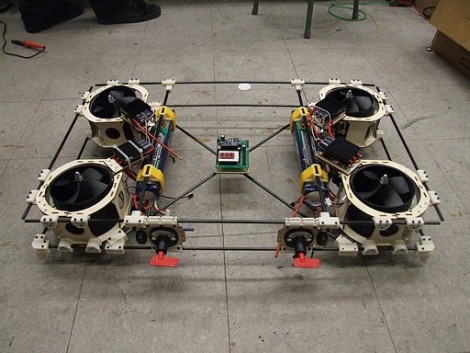
Behold the Land-Bear-Shark, a quadcopter on a rather grand scale. At a full eight kilograms it’s an easy target to compare the [Howard Hughes] behemoth, but in addition to the weight, this still has yet to make its first flight.

To give you some scale to the image above, the board at the center is an Arduino. It controls the beast, along with the help of a SparkFun IMU board which rides atop. Really, if any quadcopter of this size has a chance of working, this should be the one. The construction is beautiful, making use of carbon fiber rod along with 3D-printed connectors to assemble the frame. A lot of thought has gone into small things like conserving weight used on the landing gear, which are incorporated into the bottom corner brackets. The batteries are connected in a manner that makes them easy to adjust, acting as ballast for balancing the craft.

We’re keeping our fingers crossed that this will be more than the tongue-in-cheek title of the post which calls it a Quadrotor-shaped sculpture.

[via Adafruit]

word_clouds_from_broacast_television

Analyzing TV’s Talking Heads With Processing

[Michael] from Nootropic Design wrote in to share an interesting and fun project he put together using one of the products his company sells. The gadget in question is their “Video Experimenter” shield which was designed for the Arduino. It is typically used to allow the manipulation of composite video streams via overlays and the like, but it can also serve as a video analyzer as well.

When used for video analysis, the board lets you decode closed captioning data, which is exactly what [Michael] did here. He decided it would be fun to scrape the closed captioning information from various shows and commercials to do a little bit of content analysis.

Using a Processing sketch on his Arduino, he reads the closed captioning feed from his cable box, keeping a count of every word mentioned in the broadcast. As the show progresses, his sketch dynamically constructs a cloud that shows the most commonly used words in the video feed.

The results he gets are quite interesting, especially when he watches the nightly news, or some other broadcast with a specific target audience. We think it would be cool to run this application during a political debate or perhaps during a Hollywood awards ceremony to discover which set of speakers is the most vapid.

if you’re interested in learning more about the decoding process, [Michael] has put together a detailed explanation of how the closed captioning data can be pulled from a video stream. For those of you who just want to see the decoder in action, keep reading to see a quick video demonstration.

Continue reading “Analyzing TV’s Talking Heads With Processing”

IPhone To Arduino Communications Sans Jailbreak

iphone_to_arduino

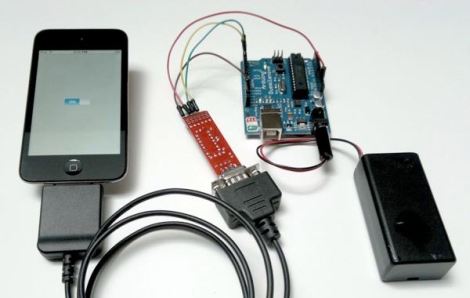
When Google released their ADK allowing Android smart phones to interact with Arduino-based devices, we’re sure there were at least one or two iPhone users who felt left out. Thanks to the folks over at Redpark, those people can now interact with an Arduino without having to jailbreak their phone.

For anyone looking to do any sort of iPhone/Arduino interaction, this is a good thing – except for the price. The 30-pin to serial cable is currently available over at Make for $59, which honestly seems pretty steep to us. When we first saw this announced, our initial thoughts were that we would see an open-source version in no time.

Unfortunately, that idea was short-lived, as we were quickly reminded of Apple’s MFI program. If you are not familiar, MFI (aka Made for iStuff) program limits what can be connected to an iDevice via licensing fees and a boatload of legal agreements. While we won’t be picking up this dongle any time soon, we’re all ears if someone has done any reverse-engineering of those pesky MFI chips.

DIY Robot Remote Control

[Patrick] wanted a remote control to control some of the robots he’s built. He also wanted to get some data back from his robots, so an inexpensive off-the-shelf solution wouldn’t be up to the task. Like all good geeks, [Patrick] decided to build what he needed.

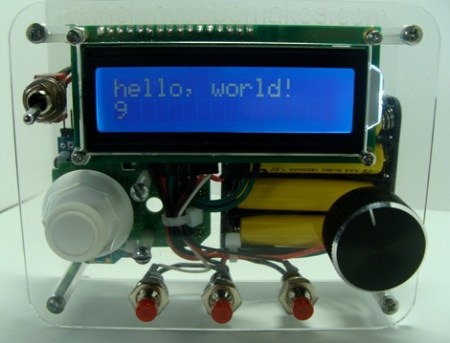
For analog control, [Patrick] decided to use a Wiimote nunchuck. This turned out to be a very good choice – the nunchuck has a 2-axis joystick and 3-axis accelerometer in one small, easy to interface package . The wireless radio is taken care of with an XBee module. For the microcontroller, custom “lcd backpack” was created that provides an I2C port for the nunchuck, inputs for the buttons and the single pot, and 2 serial ports for the FTDI and XBee.

Continue reading “DIY Robot Remote Control”

FPGA Arduino Shield Uses Kickstarter As A Preorder System

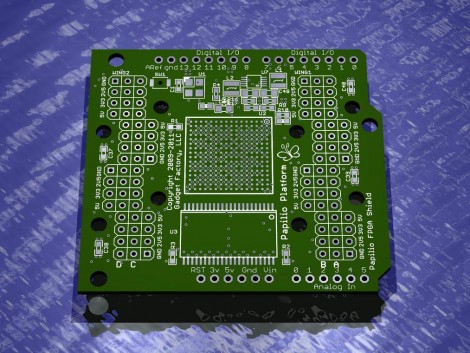
[ Jack Gassett] is working on an FPGA shield for the Arduino. At first the idea of this expansion board seemed a little silly. But [Jack] mentions that the FPGA board can be quite useful for adding higher-order electronic complexity like HDMI capabilities to an Arduino. We’re not totally sold on the idea, but he’s not making the board solely for use with an Arduino either.

The plan is to use a Xilinx Spartan 3A FPGA which comes in a ball-grid array package. And that is the reason [Jack] decided to use Kickstarter for this project. He shared some of his issues with BGA components in a home manufacturing process a while back. To get these working reliably you need to have them professionally assembled, and that requires a sizable upfront investment. But as we read through his proposal it struck us that he’s actually using Kickstarter as a preorder system. You can get a base model with just the FPGA soldered on the board for $55. Not bad considering the chip will cost you at least $20 without assembly. Each level up includes a few more components like SRAM or add-on PCBs.

We get a lot of tips pointing to Kickstarter proposals but this is one of the few that seems right on the mark for supporting open and innovative development. Great work [Jack]!

[Thanks Simon]

Megavallometer Camera Trigger

megavallometer_camera_trigger

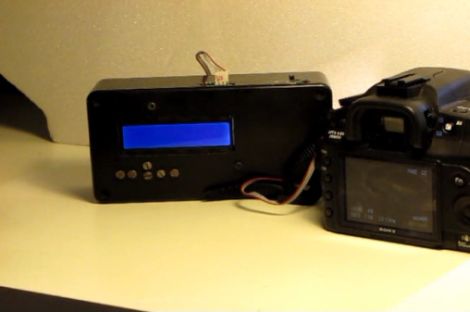
[Tobe] has an intervalometer for his camera, but he wanted a device that could trigger the shutter using several different methods, not just time. He calls his creation the Megavallometer, which can utilize any one of three distinct criteria.

He recently purchased an Arduino and a couple of shields, so he figured this would be a perfect project in which to use them. He hooked up a microphone and a photodiode to the Arduino, allowing him to use both sound and light to trigger his camera, depending on which mode he selects. Of course, the Megavallometer still incorporates the functionality of a standard intervalometer as well.

Once connected to his camera he selects one of the three trigger programs, and the Arduino handles the rest. If either the light or sound triggers are selected, the respective sensors measure the ambient levels upon selection, allowing for accurate results in any setting.

While the Megavallometer is a bit larger than other intervalometers we have seen, it looks incredibly useful and can likely be strapped to a tripod or similar if need be.

If you have a minute, be sure to check out the video on his site for a sneak peak if his Megavallometer in action.

Android Controlled T-shirt Cannon

Every year, Qualcomm hosts the “Battle of the Schools.” This year the goal was to build homemade contraptions that would be judged on how cool they are. [Doug DeCarme], [Shaver Deyerle], and [Zach Rattner] – three Qualcomm employees at Virginia Tech – built an Android controlled t-shirt cannon for this event and ended up tying with Michigan State for first place.

The cannon is built around an Arduino Uno and a BlueSMiRF Bluetooth modem. [Doug DeCarme], the Android developer of the group, put together an app that would fire each barrel independently. The valves for the cannon are just 150 PSI inline sprinkler valves, bought from the local Home Depot. From the project breakdown, the team spent less than $150 on entire project.

From the video, we see that they’re getting some pretty good distance firing t-shirts at 160 PSI. Although we question the wisdom of using PVC as a pressure vessel holding 160 PSI, changing the PVC to a proper air reservoir wouldn’t be that hard.