Shutter Remote For RICOH Cameras

[Toby] wanted to have a remote shutter trigger for his RICOH GR III camera. This brand doesn’t have a dedicated port for remote operation but a bit of research allowed him to build his own trigger. The camera’s USB port is used for triggering but not using the USB protocol. Instead, a pulse pattern on the 5V line identifies the half-press, full-press, and release states of the shutter button. From there it was just a matter of wiring up a circuit centering around an Arduino that leaves room for a lot of expansion into realms likeĀ photo automation.

Tardis Tree Topper

If your holiday tradition means waiting until Christmas to decorate the tree, it’s not too late. Build yourself Dr. Who’s Tardis as a tree topper. [Hybrid Blue] just finished the project, with includes illumination which you can see in the video after the break. The structure is made from balsa wood, painted, then filled with Arduino driven RGB LEDs. It’s sure to please the time lord in your family.

Continue reading “Tardis Tree Topper”

Hackaday Unleashes A Troll Sniffing Rat

Sometimes we like to take a few minutes away from Hackaday to spend time with our families. But just when you take your eyes off of the incoming comments, Trolls are bound to strike. Well, [Caleb] and I found a solution to the problem in the form of a troll sniffing rat. This beady-eyed vermin sits on my desk and waits. When a trolling comment is detected its eyes glow red and an alarm is sounded. Join us after the break for more about this silly project.

Continue reading “Hackaday Unleashes A Troll Sniffing Rat”

Garage Monitor Has An Extra Arduino

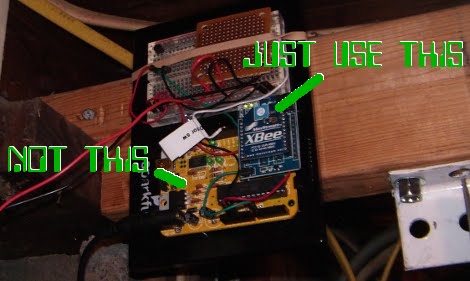
[Jody] wanted to know when his garage door was open. He details his setup which uses a temperature sensor read by an Arduino to send over XBee radio to a computer running a Windows Service. We have seen this twice before, and is noteworthy as a lesson. The XBee radios have the ability to read analog data, relay digital signals, and a lot more. This means the Arduino is completely unnecessary. For example, the Tweet-a-Watt uses two of an XBee’s ADCs to measure voltage and current in a Kill-a-Watt power meter. Programming an XBee is really simple, with the help of tutorials from SparkFun and Adafruit. A bit of programming and soldering should get [Jody] back his Arduino. We hope this note will help you find more creative uses of XBees without microcontrollers.

[Via Make]

Automated Chicken Coop Door Is Solar-powered

[Fileark] has been busy with the hacks lately. This time around he’s built a solar-powered chicken coop door that opens in the morning, and closes at night. A single motor slides the door open and closed using a loop of spring-loaded string. There are limiting switches on either side of the door jamb to ensure proper positioning. The grey box seen above houses the hardware; a regulator for the solar panels perched atop the roof line, a battery from a broken UPS, and the driver board itself. An AVR chip running the Arduino bootloader monitors a phototransistor to detect sunup and sundown, driving the door motor appropriately using a pair of relays.

Check out the demonstration and hardware overview after the break. [Fileark] was inspired to build his after seeing the alarm-clock coop door. We don’t know if he got a chance to look at the vertical coop door, but we think his less mechanically-complicated solution is just as elegant.

Continue reading “Automated Chicken Coop Door Is Solar-powered”

Hopefully Detect Trolls Before They Devour You

In the cold and mysterious wilderness of Norway, it pays to be ready for anything–especially heavy-walking trolls. The team at [nullohm] decided to prepare thoroughly for their trek into the woods to witness the Leonids meteor shower by putting together an Arduino-based “troll detector”.

The device is based on the superstition of hammering a steel spike into a tree to keep trolls away from camp. This goes one step further by including an accelerometer and LED indicators so that you can tell exactly what type of troll is just about to feast upon your tender human flesh.

When the detector is installed into a nearby tree, it takes an average seismic measurement and then looks for telltale footfalls. Even if you’re not concerned with perpetuating superstitions, you might find a use for the source code for simple seismic activity monitoring at home to supplement your miniature seismic reflector.

Building A Bandwidth Meter

Here’s an analog bandwidth meter made to look like an old pressure gauge. It’s actually new, but the paper showing the graduated scale was stained in a bath of black tea, then dried in an oven to give it an aged appearance. We think it’s quite effective.

The dial itself is a volt meter driven by an Arduino in much the same way as the multimeter clock. Bandwidth data is pulled from a Linux router, filtered down to the target data using ‘grep’, and sent over the serial connection by a Perl script. Since the meter itself is just waiting for serial data, alterations to the router’s scripting make it easy to represent a count of unread emails, tweets, or whatever data your code can scrape.

[Thanks Ben]