Lolo’s (perfect Moment) Alarm Clock

[youtube http://www.youtube.com/watch?v=CphsgESZGcE&feature=player_embedded%5D

It seems everybody has a different interpretation of the perfect alarm clock. [Loic Royer’s] alarm clock is not the loudest, or the smartest, but does have some interesting features. By monitoring several environmental factors like temperature, air quality, humidity, dew point, and your own sleep patterns, this alarm clock can determine the best moment in the morning to wake you up.

The main sensor is a wireless accelerometer with the theory being: the more you move in your sleep, the closer you are to a conscious state. The other sensors assist in picking the perfect moment, and awaken you with the sound of birds chirping.

For now all we have is the source code and the list of hardware, but for anyone wanting to try, a circuit diagram wouldn’t be too hard to figure out on your own. Check after the rift for some more videos. Continue reading “Lolo’s (perfect Moment) Alarm Clock”

Panoramic And Spheric Tripod Rig

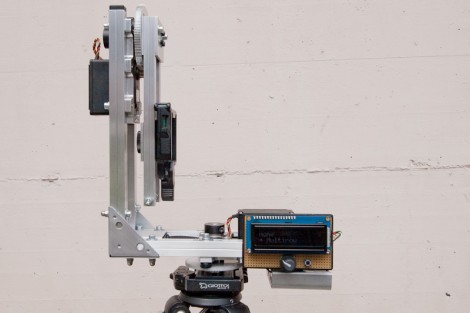
This simple yet precise build takes your camera for a spin in order to take spherical and multi-row panorama photographs. The rig mounts to a tripod, using two servo motors for motion, producing images that can be stitched together perfectly. An Arduino handles the hardware with an LCD interface for dialing in the settings.It’s not the cheapest way to get 360 degree shots but the example images are amazing.

[Thanks Juan]

Electric Mountainboard With Wireless Control

[youtube=http://www.youtube.com/watch?v=AkhjeEDaagQ]

[Andres Guzman] is chauffuering himself around the University of Illinois campus thanks to his wirelessly controlled mountainboard. He added a brushless motor to drive the rear axel with the help of a chain. Power is provided by a Lithium Iron Phosphate battery which we’ve seen used in other electric vehicles due to its lightweight properties. A wireless PlayStation 2 controller operates the motor but steering remains a lean-to-turn system.

Nixie Sudoku

[John Sarik] asked himself why a project should only have a handful of Nixie tubes? Without a good answer to his query he went ahead and built this Sudoku game using 81 Nixie tubes. There’s not much of a description for his work but here’s how we think things go: The two knobs manipulate a cursor, one for rows and the other for columns, while the keypad is used to input your chosen number. The system is Arduino based and [John’s] linked to his code, schematic, and board layout files on Dropbox. He’s even written a recursive solver which can be seen in the video after the break. Would it be inappropriate to bring this to work and whip it out during some down time?

Continue reading “Nixie Sudoku”

Touch Screen Using Range Sensors

This touch screen relies on measurements from two range finders to track your finger as you press buttons. [James Alliban] put this together as his first Arduino project. We’re familiar with [James’] background because of his informative augmented reality business card. As the Arduino picks up data from the range finder it sends it to a Flash script that is running on the PC.

As we watched the video after the break a lot of questions came to mind. What kind of angle do these Ping sensors have? Will there be interference problems if they were placed perpendicular with each other? Would you get more accurate data if they were not both on the top of the screen? For now this is just a preliminary experiment, but we like the concept and may give it a try ourselves.

Continue reading “Touch Screen Using Range Sensors”

Power Laces Take Us 5 Years Into The Future

[youtube=http://www.youtube.com/watch?v=ROEZs0HpFQc]

Back to the Future Part 2 provided a glimpse of a future that included hover boards and holographic advertisements. But you don’t have to wait until 2015 to get your hands on at least some of the technology. [Blake Bevin] has produced a pair of shoes with power laces as seen in the film. Of course present day technology doesn’t allow him to make the mechanical parts disappear so you’ll have to deal with two servo motors and an Arduino hanging off of your heels.  But hey, at least you won’t have to tie your own shoes like some 20th century peasant. No word on using these for a little theme music as you walk around but maybe that’s something from the more distant future.

Wireless Presenters Easily Cracked

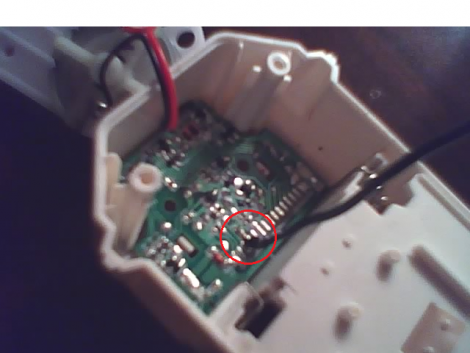
While hacking a wireless presenter doesn’t sound like something worthwhile or interesting, [Niels Teusink] demonstrates that these little devices often are a lot more powerful than we give them credit.

With an Arduino, plenty of research, and some heavy sniffing of a wireless presenter’s SPI and then wireless interface [Niels] is able to emulate an entire keyboard. Sending commands as harmless as “next slide” to the devastating “[Win+R] Format C:”. Hopefully anyone planning such a project at the next Apple or Microsoft keynote just intends some gentle fun.

Related: Wireless keyboards easily cracked.

[Thanks Dan Ransom]