Wine Cask Sensor Suite

As part of his Master’s dissertation [Salvador Faria] built a sensor suite for wine monitoring. He needed to develop a method of tracking data inside the wine cask during the vinification process. What he came up with eclipses the wine cellar temperature monitors we’ve seen before.

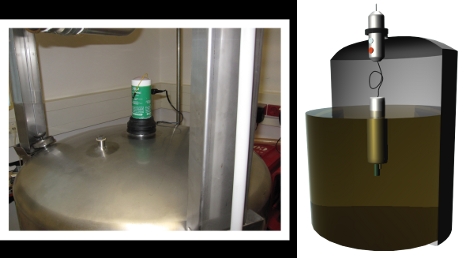
He picked up pH, temperature, carbon dioxide, alcohol, and relative humidity sensors from familiar vendors like Seeed, Parallax, and SparkFun. His original idea was to develop a floating probe that housed the entire package but he had quite a bit of trouble getting everything inside and maintaining buoyancy. The solution was a two-part probe; the stationary portion seen mounted on top of the cask houses the microcontroller, RF 433 MHz transmitter, and the gas sensors. Tethered to that is a floating probe that measures pH and temperature. Data is sent over radio frequency to an HTTP POST server every minute.

Making Home Automation Modules Talk To Each Other


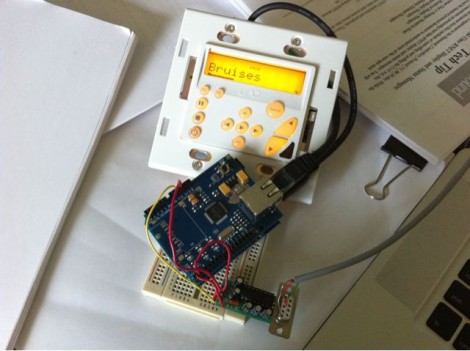
[Danny] has been working on an RNET to Sonos bridge. These are devices from two different manufacturers used to facility whole-house audio systems. Usually there’s a main controller with a large color screen and then several satellite controllers like the one above which have some of the features but at a lower cost. Normally you’re limited to using hardware from one line of devices in order to get them to talk to each other but [Danny’s] saying ‘no way’ to that restriction.

His latest post has some of the details on how he pulls this off. He used an RS232 serial connection with an Arduino to sniff out the data stream from the RNET base unit. Once he figured out the protocol he used the Arduino to parse all incoming commands, format them for the Sonos controller, and send it over the Ethernet cable to that device. He’s got everything tied together and working. Take a look at the proof in the clip after the break.

Continue reading “Making Home Automation Modules Talk To Each Other”

DIY Guided Missile (…err Model Rocket)

Hackers [Navic] and [K.o.D] have fitted an Arduino Pro Mini and an array of components into an off the shelf rocketry kit to create a guided model rocket, taking the whole idea of Arduino-based space technology to another level

The Arduino reads signals from internally mounted accelerometers, and adjusts balsa fins (via 4 micro servos) to correct the rocket’s flight path. Due to the nature of model rocketry, the active guidance is limited to the 3 seconds that the rocket is traveling upwards. A valiant effort nevertheless. Videos of the rocket’s maiden voyage, and a system check after the break. Continue reading “DIY Guided Missile (…err Model Rocket)”

Air Freshener Hacking

In an effort to improve his marital standing [Tech B] hacked an air freshener to make it Internet controllable. The main component here is a Glade Sense and Spray. It cost him $7 and is meant to spray out some sweet smells when it senses motion in the room. The unit also has a manual spray button which he patched into with the help of a relay. From there some Arduino code and an IRC bot take over, letting him unleash freshness from anywhere he has IRC access.

When reading about this we were also thinking: “motion sensing circuitry available at local stores for just $7?”. We may have to conduct an investigation into the alternative usefulness of that package.

If you have another brand of automatic freshener around it should be just as easy to hack as this one was.

Mouse Controlled Manipulator Arm

[Oleg] worked out a way to use his USB mouse to control this manipulator arm. Using a Lynxmotion AL5D (we’ve seen the AL5A previously) he drives the six servos with an Arduino servo shield. A USB host shield handles the HID end for connecting the mouse. The video after the break says it all, [Oleg] has no problem picking up that figurine quickly and accurately. Sliding the mouse controls horizontal movement in all directions. The scroll wheel moves the claw up and down. And holding the left or right buttons what using the control wheel closes or rotates the claw. All we can say is: Bigger, BIGGER!

Continue reading “Mouse Controlled Manipulator Arm”

CNC Hardware: Stream G-code To An Arduino

[Reza Naima] has been using an Arduino as the center of his CNC setup for quite some time now. It handles three stepper motors, limiting switches, e-stop, and spindle control. The sketch he’s using allows him to stream g-code to the popular prototyping platform, freeing him from needing a dedicated PC. It’s worked so well that he’s decided to clean up the code and develop a shield to help others get up and running. If you want to see his progress or lend a hand, check out the google group he started for the schematics, code, and forum discussions. There is already a CNC project for Arduino called Grbl but [Reza’s] approach uses the Arduino libraries in an effort to make the sketch more customizable for the average user.

LED Matrix With A Gross Of Pixels

This LED matrix is arranged in a 24×6 pattern for message scrolling. There’s no etched boards here, making us wonder where [Syst3mX] found protoboard this long. He’s using an Arduino to drive the demonstration (clip after the break) but you can use any microcontroller with this setup. That’s because he’s using three shift registers for column data and a decade counter for row scanning, requiring just five control pins.

While you’re going to the trouble of ordering components, maybe you should try your hand at building a touch sensitive LED matrix too.

Continue reading “LED Matrix With A Gross Of Pixels”