Flickr Photo Bike

Lifehacker’s [Gina Trapani] has one of Flickr’s photo bikes and wrote up how it works. As you ride, the bike automatically takes photographs, geotags them, and uploads them to Flickr. The handlebar unit contains a Nokia N95 cellphone. The rear is a solar powered charging unit. It has a custom python script that starts the photo taking sequence when it detects the bike is in motion using the phone’s accelerometer.

Most of the engineering seems to be for usability’s sake. We’re guessing they probably wanted to disguise that they’re bolting a $600 cellphone to a bike as well. Out of the box the Nokia N95 already does almost everything required. It has a 5 megapixel camera with an interval timer that can vary from 10 seconds to 30 minutes. It supports Flickr uploading, but with software like ShoZu you can streamline the geotagging and make all uploads automatic. Just build a solid mount for your N95 and you’ve pretty much got it, and when you park your bike you can take the phone with you.

Regenerative Bike Brakes

For their senior design project at Arizona State University, these guys built a regenerative braking system for their bike. As they brake, the system spools up to give them a push back up to speed.  They achieved 25% efficiency on one run, which isn’t too shabby.

The site has all kinds of information. You can check out their different plans and ideas from before they decided on this specific layout as well as all their data from the test runs. Be sure to look at the piece by piece breakdown of what changes were made from the initial design.

[thanks Mario Gomes]

Turn Signal Jacket How-to


[Leah Buechley], whose work we’ve been covering since way back when, has built this lovely turn signal jacket. The project photos were posted in March, but she’s just added a well illustrated project guide. The jacket is based around a LilyPad Arduino, a lightweight Arduino board with radial pads designed to be used in wearable projects. You make your connections by sewing conductive thread through the pads. The how-to covers attaching the LilyPad parts properly and then insulating the wires with fabric paint after you’ve verified they work.

The guide has an interesting discussion about placing the power supply. The 4-ply silver coated thread used has a resistance of approximately 14ohms/foot. So, if you place the power supply one foot from the LilyPad, the two wires combine for 28ohms, causing a 1.4V drop. The power supply is only 5V, which means the LilyPad will be 3.6V. A voltage of 3.3V will cause the Arduino to reset. If your resistance is too high, you’ll have to add more thread.

The power supply on this jacket is under the collar. Each cuff has a single button plus an LED. The button will make the jacket flash the direction for 15 seconds (also indicated on the sleeve LED). If you press both buttons at the same time, it switches to night mode by flashing both directions at the same time to make you more visible.

Electric Recumbent Bicycles


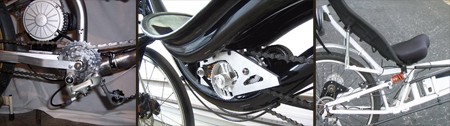
If you liked our post about bikes and skates with weed whacker engines but want more power and more challenge, we have good news. We’ve found some great instructions on adding motors to recumbent bicycles, which we’ll take you through after the break.

Continue reading “Electric Recumbent Bicycles”

Wheels And Weed Whackers


Perhaps you’ve seen this image before: a young kid tooling around on a pair of inline skates, pushed forward by a weed whacker cycle. While the instructions for this device would seem fairly obvious (attach wheel to weed whacker) the writeup appears to be nonexistent. If you have any information, do let us know, but in the meantime, enjoy these other weed whacker powered projects.

Continue reading “Wheels And Weed Whackers”