How Safe Are Old Airbags, Anyway?

Automotive airbags are key safety devices that aim to reduce injuries and mortality in the event of motor vehicle accidents. These rapidly-inflating cushions act to soften the blow of an impact, catching occupants of the vehicle and preventing them from hitting hard parts of the vehicle’s interior.

Airbags are rigorously tested to perform as faultlessly as possible under all conditions. However, no system is perfect, and every automotive component has an expected service life. The question is—how old is too old when it comes to airbags? The answer is not exactly straightforward.
Continue reading “How Safe Are Old Airbags, Anyway?”

LED Air Vent Gauges Are A Tasteful Mod For The Mazda Miata

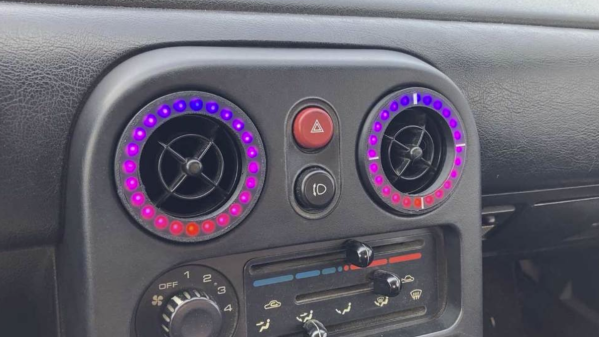
Anyone in the JDM scene can tell you, round air vents are prime real estate for round analog gauges. If you want a gauge but don’t want to block your vent, you could consider building these LED vent gauges from [ktanner] instead.

Tasteful, no?

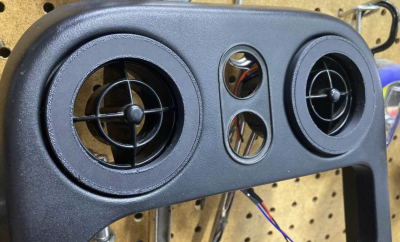
The design is simple. It relies on 3D printing a replacement bezel for the Mazda Miata’s stock round air vents. This bezel is designed to hold a NeoPixel ring from Adafruit. When built with the optional laser-cut diffuser, the parts have a near-stock look when the LEDs are turned off. It’s a classy, stealthy mod – exactly the sort of thing Miata owners need but never seem to have! (Author Note: don’t be mad, I was once one of you!)

With 24 addressable RGB LEDs, it’s possible to display all kinds of data by turning the LEDs on and off and varying the colors. For example, you could readily build a boost gauge that turns on more LEDs at higher boost pressure. It could then be set up to flash red in the event that you surpass safe thresholds. [ktanner] hasn’t specified any particular microcontroller for the setup — but just about any part you like can be used to drive NeoPixels, after all.

If you’re new to NeoPixels, you might find a simulator useful for developing your projects. Meanwhile, if you’re doing similar work on other cars, be sure to hit us up on the tipsline!

RC Car Gets F1-Style DRS Rear Wing

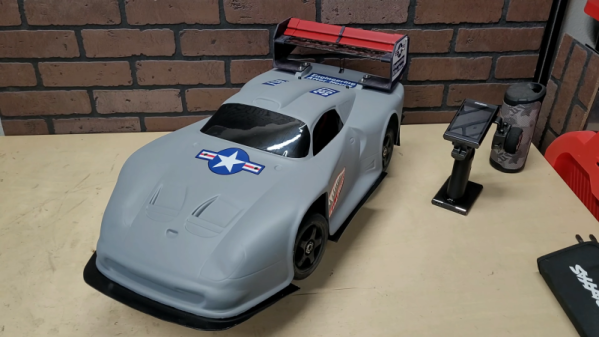
DRS, or the Drag Reduction System, has become a key part of Formula 1 in the past decade. [Engineering After Hours] decided to implement the same system on an RC car instead.

The DRS system was implemented in Formula 1 to increase passing in the series. By moving a flap in the rear wing of the race cars, drag could be reduced, allowing a car to attain a higher top speed on the straights. The racing series limited the activation of the DRS wing to only cars following closely behind another. This artificially enabled them to gain a speed boost over the car in front to aid passing.

[Engineering After Hours] wanted to see if a tiny wing on a small RC car could work the same way. It would fundamentally come down to whether moving a tiny wing element would appreciably change the car’s drag or not. Naturally, on such a small scale, attaining high speeds would be necessary to detect much difference. At lower speeds, the difference in drag would likely be too negligible to notice.

The RC-scale DRS system fundamentally does work. With DRS engaged, flattening out the rear wing elements noticably reduced downforce at the rear. With the DRS not engaged, though, the rear wing on the car was creating so much downforce that the car was squatting at the rear and occasionally flipping end over end. [Engineering After Hours] didn’t get any top speed measurements, but estimated that the wing could potentially increase top speed by up to 7 mph with the DRS enabled.

We’ve seen [Engineering After Hours] bring other fun motorsport tech to RC cars before, too, like this amazing fan car build.

Continue reading “RC Car Gets F1-Style DRS Rear Wing”

Cassette Player Cupholder Is A Useful But Risky Idea

The cup was invented in 1570 BC. Despite this, infuriatingly, the cupholder didn’t become common in the automotive world until the early 2000s. Cars built in the years PCH (pre-cupholder) typically also had tape decks. Noticing this relationship, [thephatmaster] designed this useful cassette-deck cupholder accessory.

The design is simple, consisting of a 3D printed ring with a tab that neatly slides into an automotive stereo’s cassette slot. The design does require that the tape deck be empty prior to inserting the cup holder. Given that few cassette players from that era still work, this isn’t much of a drawback. Of course, if you really do need tunes, it wouldn’t be too difficult to integrate a Bluetooth cassette adapter into the printed design.

[thephatmaster] uses the cupholder in a Mercedes W202, and has posted a special inclined version to suit this model. The creator also notes that using it on vehicles like the Mercedes W210 can be a risk. The cupholder typically places the beverage directly above the transmission lever, where any spills can damage switches or other important electronics. Also, the cupholder isn’t designed to work with vertical tape decks, though modification for this layout may be possible.

This build may look silly or pointless to some. But if you’ve ever tried to pull a U-turn in an old manual car while precariously cradling a steaming latte between your legs, you’ll clearly see the value here. It only has to save one pair of pants before it’s paid for itself.

We’ve seen some other creative cupholder hacks before too, like this nifty laptop holder. If you’ve whipped up your own nifty car hacks, send them into the tipsline.


Converting A Porsche 944 To Run A MAF

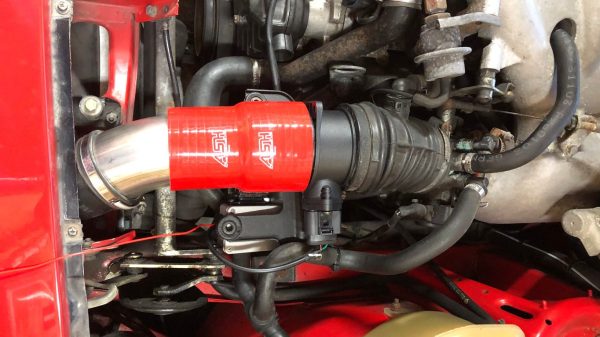
Electronic fuel injection was a big leap forward for engine control. However, early implementations often left something to be desired. This was the case for [Rob] and his Porsche 944, which had relied on an old-fashioned mechanical air flow meter (AFM). He decided to replace this with a modern mass air flow (MAF) sensor instead, and documented the process online.

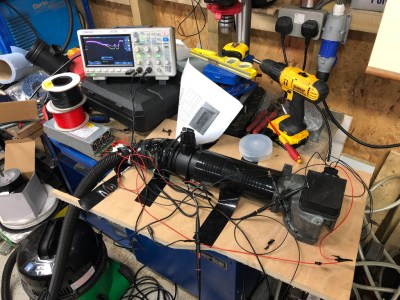
The output of the sensors was compared with a rig built using a vacuum cleaner to create air flow.

AFMs are often a target for replacement on old cars. They’re usually based on a flap that moves a potentiometer wiper across a carbon trace which wears out over the years. They can also present an air flow restriction in some cases, limiting performance. MAF sensors instead measure the amount of air flowing through with a hot wire. The amount of current required to maintain the temperature of the wire indicates the amount of air flowing through the sensor. They’re less restrictive and readily available as they’re used in many cars today.

To run a MAF in place of the AFM requires a circuit to emulate the AFM’s output. [Rob] used a STM32 Cortex-M0 to read the MAF, and then output the relevant voltage to the Porsche’s engine computer via PWM and a low pass filter. To figure out how to map the MAF’s output to match the AFM, [Rob] built a rig to blow air through both devices in series, and measuring their output on an oscilloscope. This data was used to program the STM32 to output the right emulated AFM voltage for the given MAF signal.

It’s a great piece of work from [Rob] that has his Porsche running happily on new parts. We’ve seen similar hacks done to other cars before, as well! Video after the break.

Continue reading “Converting A Porsche 944 To Run A MAF”

EV Chargers Could Be A Serious Target For Hackers

Computers! They’re in everything these days. Everything from thermostats to fridges and even window blinds are now on the Internet, and that makes them all ripe for hacking.

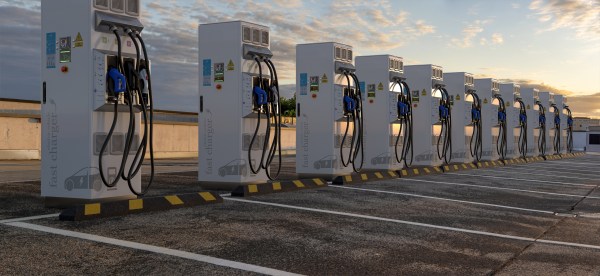
Electric vehicle chargers are becoming a part of regular life. They too are connected devices, and thus pose a security risk if not designed and maintained properly. As with so many other devices on the Internet of Things, the truth is anything but. 

Continue reading “EV Chargers Could Be A Serious Target For Hackers”

Spoofing LIDAR Could Blind Autonomous Vehicles To Obstacles

Humans manage to drive in an acceptable fashion using just two eyes and two ears to sense the world around them. Autonomous vehicles are kitted out with sensor packages altogether more complex. They typically rely on radar, lidar, ultrasonic sensors, or cameras all working in concert to detect the road conditions ahead.

While humans are pretty wily and difficult to fool, our robot driving friends are less robust. Some researchers are concerned that LiDAR sensors could be spoofed, hiding obstacles and tricking driverless cars into crashes, or worse.

Continue reading “Spoofing LIDAR Could Blind Autonomous Vehicles To Obstacles”