Encryption In The 1790s

For as long as humans have had writing, there’s been a need to send secret messages. It is easy to think that Enigma machines and their immediate predecessors are old tech, but they are much more recent than ancient systems used by the Greeks and Romans. Even Thomas Jefferson, one of the founding fathers of the United States, was interested in encryption and is often said to have invented the Jefferson Disk machine for encryption. The truth is, the device is probably older than Jefferson, but he certainly thought about using it for secret communications.

Simple but Effective

Thomas Jefferson was, apparently, a fan of secret messages

The idea is simple. We make a series of disks. Each disk has a number on it and, around the edge, all the letters of the alphabet. The placement of each wheel with the same number is the same, but, overall, the arrangement is random. That is, all disks marked #5 might start with XCBYG, but all disks marked with #10 could start with FAYQL. You take one set of disks, and I keep the other set.

When we want to send secret messages, we agree to arrange our disks on an axle in the same order. Jefferson used a 36-disk system, so we might agree to go left to right with the odd numbers first and then the even numbers, or any other setup that we could agree on.

Encryption

Once the wheels are in place, encryption is simple. There’s a bar across the device, and you line up your message using a wheel for each letter: ENEMYCOMESBYSEA, for example. Then you look at any different row, which will now read something crazy like: FSRSSXQCGAEEFOR (plus the random letters on the rest of the disks). That’s the message you send.

Continue reading “Encryption In The 1790s”

An Arduino And An Enigma All Rolled Into One

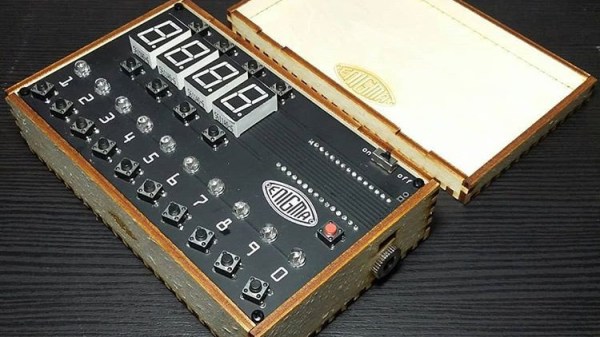
This hacker has been wanting to design an Enigma machine simulator for a while, but didn’t take the leap until they realized there was a compact Arduino with a surplus of I/O.

The logs go through all sort of variations on the machine. Everything from a plug board variation similar to the original to a 16 segment LED tester are covered. In one of the posts you can even see it decode a real U-Boat message. 

The earlier revisions are housed in very attractive laser cut cases but the latest designs employ an even more elegant casing solution. The simulator uses 16 segment displays and momentary push buttons for the keys. At its core is a 2560 Pro mini. The write-up contains a lot of detail about the code behind the Enigma and is interesting to read.  Interestingly, the PCB was designed in Fritzing, the EDA software many love to hate.

We love the craftsmanship and attention going into this project and can see it turning into a very appealing kit as it goes through its design cycles.

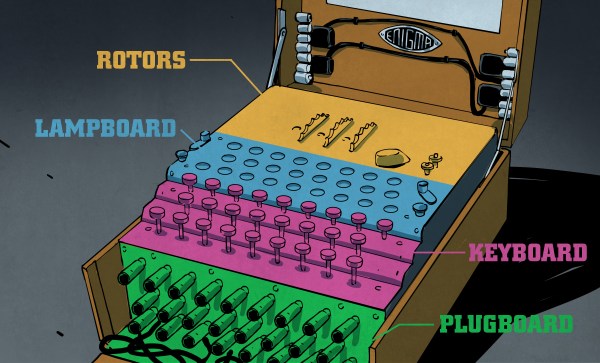
The Enigma Enigma: How The Enigma Machine Worked

To many, the Enigma machine is an enigma. But it’s really quite simple. The following is a step-by-step explanation of how it works, from the basics to the full machine.

Possibly the greatest dedicated cipher machine in human history the Enigma machine is a typewriter-sized machine, with keyboard included, that the Germans used to encrypt and decrypt messages during World War II. It’s also one of the machines that the Polish Cipher Bureau and those at Britain’s Bletchley Park figured out how to decipher, or break. Most recently the story of how it was broken was the topic of the movie The Imitation Game.

Let’s start with the basics.

Continue reading “The Enigma Enigma: How The Enigma Machine Worked”

VCF East: Enigma Machines In The Flesh

At the end of World War II, the Germans ordered all Enigma cipher machines destroyed. Around the same time, Churchill ordered all Enigma cipher machines destroyed. Add a few decades, neglect the efforts of Polish codebreakers, and make a movie about Alan Turing and an offensively historically incorrect love interest, and you have a mystique around these rare, innovative cipher machine.

At the Vintage Computer Festival East, I was privy to what is probably the largest collection of Enigma machines on the planet. The exhibit comes from [Tom] and [Dan Perera] of Enigma Museum. Right now, they’re they only place where you can go out and simply buy a real, wartime Enigma machine. The price? Well, there is a pair of million-dollar Apple I boards at VCF. The Enigmas go for about a fifth of an Apple I.

Continue reading “VCF East: Enigma Machines In The Flesh”