Power-sipping MSP430 Mini Alarm Clock

msp430_alarmclock

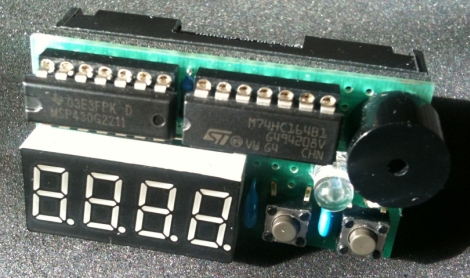
[Markus] had a TI MSP430 sitting around from the LaunchPad kit he bought a while back. He didn’t know what to do with it, but eventually decided that it would make a great miniature alarm clock.

He added a shift register to the mix in order to drive his 7-segment LCD display, using two of the MSP430’s output pins in the process. Four more pins were tied to the display’s cathodes, while the remaining two pins are connected to push buttons which register user input.

He crammed the clock’s logic as well as an alarm tune into the chip’s scant 2KB of memory space, literally occupying everything up to the last available byte. The clock is quite a power-miser, using just 2 µA in standby mode. According to [Markus’] calculations, that should enable the clock to use one set of batteries for 10+ years.

While this isn’t the first MSP430 clock we have seen, it certainly is the smallest and most simple.  Stick around to see a quick video of his clock in action.

Continue reading “Power-sipping MSP430 Mini Alarm Clock”

Hackaday Links: March 20, 2011

SNES Arcade Cabinet

arcade_cabinet

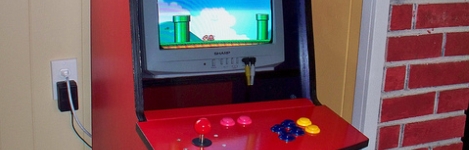
[Daniel] let us know that he finished up a SNES arcade cabinet he has been working on for awhile. It looks so good, he says that his wife has even agreed to let him keep it in the house!

DIY Overhead projector beamer

diy_beamer

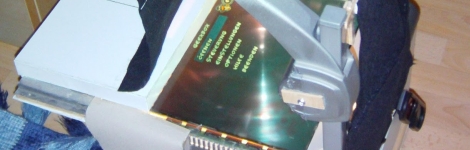
[Liquider] sent us some information about a DIY beamer he built using an overhead projector and an old LCD panel. It looks like a great way to get a big-screen wall display set up in no time.

WordClock gets a makeover

wordclock

[Doug] wrote in to share with us some progress he has made on his WordClock. You might remember our coverage of this creative timepiece a little while back. This time around, he has built a new control board, and is using vinyl stencils for a much cleaner look.

Interactive water fountain

interactive_fountain

[Gerry Chu] is well known for his water-based imagery and projects. His most recent project is a water fountain that interacts with passers by. There are no real build details as of yet, but we hope to see some soon.

Sixty Symbols explains why glass is transparent

glass

Do you think you know why glass is transparent, but a brick is not? If you looked it up via Google, you are likely mistaken. A professor from the University of Nottingham explains why the Internet is so, so wrong about this, as well as how energy gap determines if photons of light can make it through a piece of glass. [via i09]

Sleek Numitron Clock Tells The Time And Temperature

numitron_clock

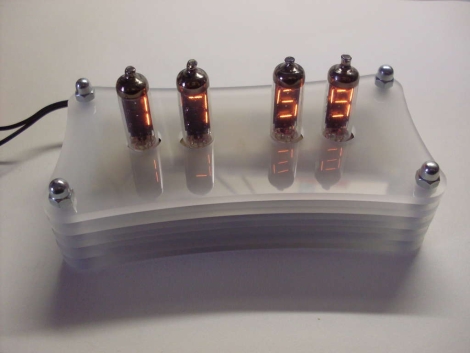
Instructables user [janw] is a big fan of nixie clocks, but he had never built one before. He decided he would rather start small and build a clock using numitron tubes first, before moving to nixies. He preferred the simpler tubes due to their much lower voltage requirements and the fact that he would not have to use any specialized power supply for his project.

His clock serves double-duty, functioning as a thermometer as well. Timekeeping is regulated with a DS12307, and temperature is monitored using a DS18B20 single wire sensor – both of which are pretty common in these sorts of projects. Both are wired to an Atmega48 MCU which serves as the brain of the clock.

The numitrons were mounted in a handsome 5-layer milled acrylate stand with a pair of buttons mounted on the bottom which allow him to set the time. It really is a spectacular looking timepiece, and a great first effort on [janw’s] part.

Be sure to stick around to see a video of the clock in action.

Continue reading “Sleek Numitron Clock Tells The Time And Temperature”

A VFD Clock That Tells The Time, Then Tells You To **** Off

sweary_vfd_clock

Clocks are relatively simple devices – they tell time, and most often sport a handful of other utilitarian features like alarms and radios. Rarely though, do you see a clock that will wake you up in the morning and also curse at you shortly thereafter. [Matt Evans] clearly thought that clocks need to pack a little more attitude, so he built his girlfriend a clock that not only tells time, but spouts off nasty phrases as well. What a lucky gal!

The clock was constructed using IV-17 VFD tubes, each bearing 16 light-able segments. It seemed wasteful to simply use the tubes to tell time, so [Matt] got busy adding other features to the clock. It has an alarm, a calendar that is always stuck on his girlfriend’s birthday, and an ambient light sensor to dim the tubes at night. It also sports a variable rudeness setting, allowing for mild insults when family members are present, and extremely foul language for when your frat brothers swing by.

He has plenty of pictures on his site, but we’re betting people will want to see schematics and some source code. After all, Mother’s Day is but a few months away!

The Interstellar Clock

[Alexander Avtanski] has put together a nice clock to meet all your interstellar travel needs. Besides being another PIC based timer, this is a neat little project because it incorporates pretty much every feature you could think of when building a clock for our solar sytem.  For example, it has 16 independent timers and alarms, it can  simultaneously give the time for multiple planets, as well as keep track of other stellar events like the eye of Jupiter or the phases of the moon. To get this project off the ground [Alex] reverse engineered an old dial up modem to serve as an enclosure and power supply and then added in a rechargeable battery so that his  his interstellar clock wasn’t tied to a wall.

[via make]

Over-engineered Clock Finds Purpose As RSS Reader

[Bob Alexander] admits that he over-engineered his clock, giving it eight control buttons, eight twelve-segment alpha-numeric display digits, a GPS module as a time source, and a beefy microcontroller to boot. But he’s found a way to get more for his money out of the device by adding RSS and weather features to it.

Since he’s using the PIC 18F4550 it’s a snap to add USB connectivity. From there he wrote a fantastic PC-side application for communicating with the display. Now he has the option of displaying time, RSS feeds, or weather by scrolling through the options with one of the buttons. Perhaps the best feature is the option to launch a browser on the PC and view the current story just by pressing a button on the display. Check out the two demos after the break; one shows the clock features and the other demonstrates the C# software.

Continue reading “Over-engineered Clock Finds Purpose As RSS Reader”

Pong Clocks Using LED Matrix Modules

We love Pong clocks because they’re showpieces. This particular offering, called the Wise Clock, is the third hardware revision of the project. The LED display is dead simple since they’re using a 32×16 bi-color module from Sure Electronics. If you don’t want to design and build your own multiplexing display this is a somewhat inexpensive and high-performance alternative.

After the break you can see that the paddle movements look very realistic. They move like a human player might, which is quite often not the case with these clocks. If you want to see how that’s done, check out the code which was originally developed by [123led] for a different project.

Continue reading “Pong Clocks Using LED Matrix Modules”