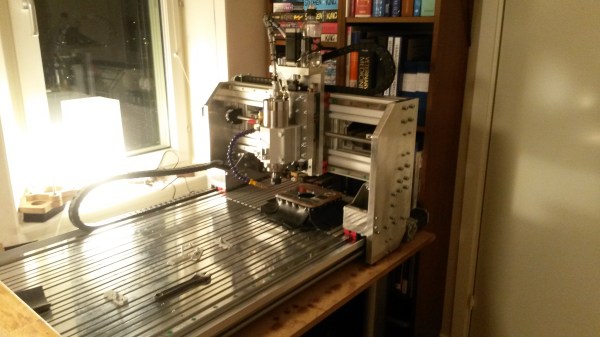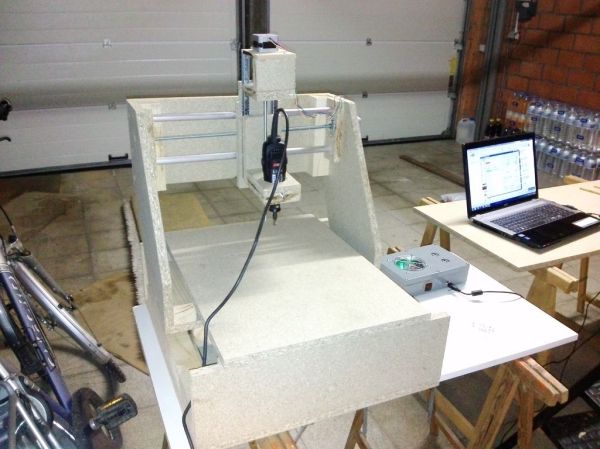
[siemen] has entered the wonderful world of Hobby CNC with his low-buck build of this gantry-style router. It embodies everything we here at HaD love: resourcefulness, perseverance and results. [siemen] has designed his frame using ideas he has found while surfing around the ‘net and is made entirely out of particle board. For linear movement, the Y and Z axes rely on ball bearing drawer slides while the X axis use a pipe and skate bearing arrangement. NEMA 17 stepper motors coupled to threaded rod move each axis.
The electronics are packaged in a nice little project box which houses an Arduino and 3 Sparkfun EasyStepper stepper motor drivers. [siemen] also cut a hole in the project box and installed a fan in order to keep those motor drivers cool. The Arduino is flashed with the CNC machine controller called GRBL. GRBL takes g-code sent from a PC to the Arduino and then in turn sends the required step and direction signals to the stepper motor drivers.
Overall, [siemen] did a great job with his first CNC project which came in at 200 Euro ($240). He’s currently working on version 2 and we are looking forward to covering it when it’s done. If you dig this project, you may also like this wooden wood router or this bolt-together one.
Continue reading “Resourceful CNC Router Built From Hardware Store Parts”