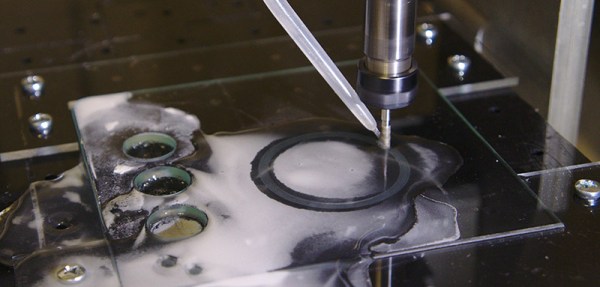
Breaking a pane of glass in half is easy – just score it, break it, and after practicing a few times, you’ll eventually get it right. What about cuts that are impossible with a normal glass cutter, like radiused corners and holes? For that, you’ll need CNC. Yes, you can cut glass on a CNC machine. All you need is a diamond burr or glass drilling bit, high speeds, low feeds, and lots and lots of coolant.
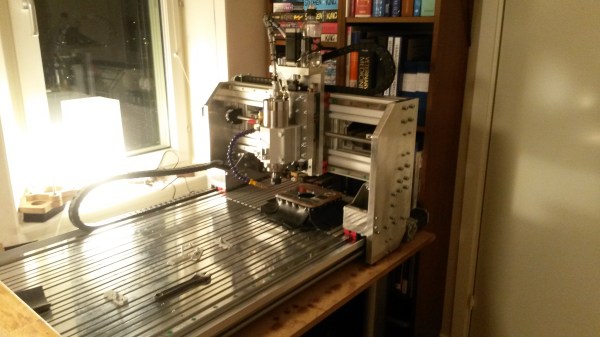
Cutting glass on a CNC machine doesn’t require any spectacularly specialist equipment. [Peter] is using an $800 Chinese mini CNC engraver for this project, but that’s not the only tool that was required. A fixture for holding a glass plate was also needed, but [Peter] quickly fabricated one out of acrylic.
Cutting glass with a CNC is something we’ve seen before. [Ben Krasnow] has been using diamond burrs, high speeds, low feeds, and lots of coolant to cut mirrors so expensive you don’t even want to guess.
While [Peter] isn’t getting the perfect finish [Ben] got a few years ago, he’s still milling holes and slots in glass. He’s wondering if it could be possible to mill an aspheric lens using this technique and a special spherical burr, something that would be very interesting to see, and could be a pretty good way to rough out telescope blanks.
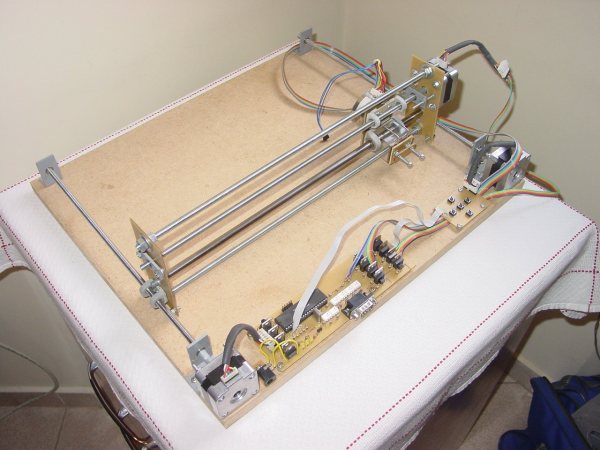
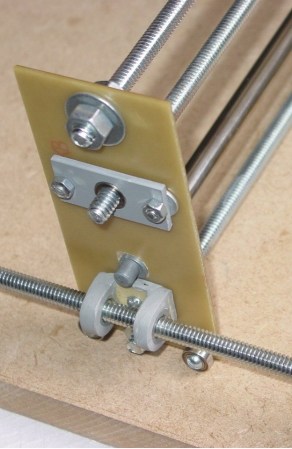 As unique as the X axis is, the Y sure gives it a run for its money. No linear rails are used, two lead screws are the only things that maintain the gantry’s position. To prevent gravity from pulling the gantry down and bending the Y axis lead screws, there are a couple of bearings on either side that ride along the bed of the machine. The frame material also hits the cheap target, it’s made from blank PCB board. A PIC16F877 microcontroller and a handful of mosfets control the motors. [msassa11] built this control circuit but admits it’s performance is not that great, it’s noisy and loses torque at high speed.
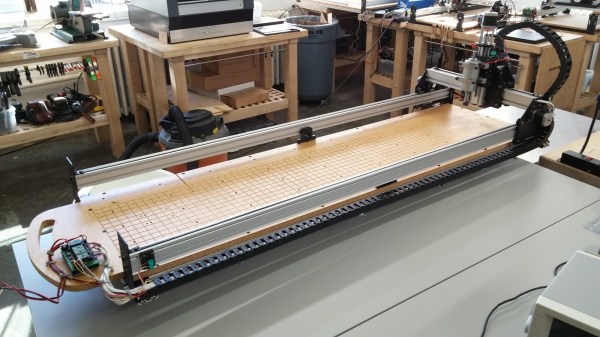
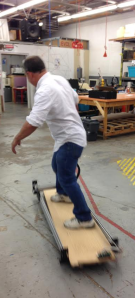 The project started off with some stock Shapeoko 2 parts. Achieving the deck-cutting size required shortening the X Axis and tripling the length of the Y Axis resulting in a 250 x 1200mm work envelope. The DC spindle used accepts ER16 collets and has a fully variable speed control. The stand alone selectable 24/48 volt power supply has a neat DIY handle to ease transportation. Even though the router itself has skateboard trucks, it also has a handle at the front so it’s easy to grab and drag behind you.