
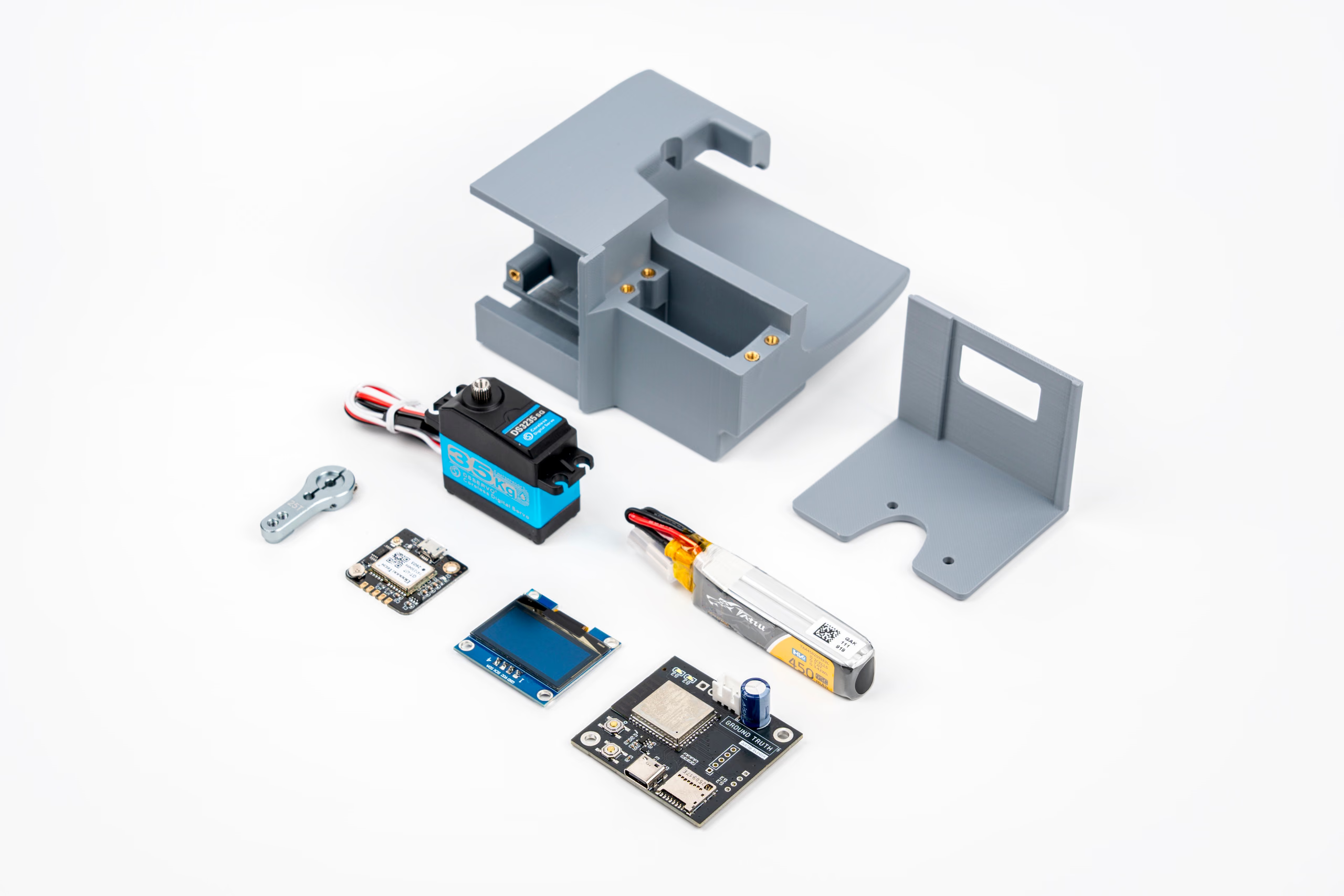
A blueish grey plastic enclosure sits next to a blue and black servo, silver Li-ion battery, a GPS module board, an LCD, a small metal lever, and ESP32S3 board.

Pedal Harder For Affordability

In the US, among other places, housing costs are skyrocketing. It can sometimes be difficult to get a feel for the scale of the issue and how it hits neighborhoods differently. [Justin Blinder] has designed a device to help people get a more visceral understanding of the problem.

In New York City, Citi Bikes are everywhere in the city’s transportation landscape. [Blinder] used a GPS module plugged into an ESP32S3 to vary the amount of resistance on one of these bikes by actuating the front brake with a servo. As a rider takes the bike through different neighborhoods, the resistance varies in proportion to the rent burden experienced there.

[Blinder] explains, “One of the main technical challenges was calibrating this relationship so that the changes were physically noticeable without feeling abrupt or unsafe.” As rent burden is merely the percentage of income taken up by rent in an area (by the block in this dataset), it is only one indicator of the additional friction a family might feel in an area, but a useful one to at least begin to convey the disparities in the urban environment. We really like how this connects abstract statistics to something more experiential.

If you’re looking for some other bike hacks, how about wireless brakes or a sleeper e-bike with a solenoid display?

via Next City

Continue reading “Pedal Harder For Affordability” →

Volume Controller Rejects Skeumorphism, Embraces The Physical

The volume slider on our virtual desktops is a skeuomorphic callback to the volume sliders on professional audio equipment on actual, physical desktops. [Maker Vibe] decided that this skeuomorphism was so last century, and made himself a physical audio control box for his PC.

Since he has three audio outputs he needs to consider, the peripheral he creates could conceivably be called a fader. It certainly has that look, anyway: each output is controlled by a volume slider — connected to a linear potentiometer — and a mute button. Seeing a linear potentiometer used for volume control threw us for a second, until we remembered this was for the computer’s volume control, not an actual volume control circuit. The computer’s volume slider already does the logarithmic conversion. A Seeed Studio Xiao ESP32S3 lives at the heart of this thing, emulating a Bluetooth gamepad using a library by LemmingDev. A trio of LEDs round out the electronics to provide an indicator for which audio channels are muted or active.

Those Bluetooth signals are interpreted by a Python script feeding a software called Voicmeeter Banana, because [Maker Vibe] uses Windows, and Redmond’s finest operating system doesn’t expose audio controls in an easily-accessible way. Voicmeeter Banana (and its attendant Python script) takes care of telling Windows what to do. 

The whole setup lives on [Maker Vibe]’s desk in a handsome 3D printed box. He used a Circuit vinyl cutter to cut out masks so he could airbrush different colours onto the print after sanding down the layer lines. That’s another one for the archive of how to make front panels.

If volume sliders aren’t doing it for you, perhaps you’d prefer to control your audio with a conductor’s baton. 

Continue reading “Volume Controller Rejects Skeumorphism, Embraces The Physical” →

Supercon 2023: Teaching Robots How To Learn

Once upon a time, machine learning was an arcane field, the preserve of a precious few researchers holed up in grand academic institutions. Progress was slow, and hard won. Today, however, just about anyone with a computer can dive into these topics and develop their own machine learning systems.

Shawn Hymel has been doing just that, in his work in developer relations and as a broader electronics educator. His current interest is reinforcement learning on a tiny scale. He came down to the 2023 Hackaday Supercon to tell us all about his work.

Continue reading “Supercon 2023: Teaching Robots How To Learn” →









