Feel Like We Do With A Bass Guitar Talk Box

dino_comes_alive

Hacker [Dino Segovis] wrote in to share the latest hack from his HackAWeek series, and this time around he has constructed a talk box for his bass guitar. Providing you are old enough, you probably remember when the talk box made its way into mainstream music, on the “Frampton Comes Alive” album.

The concept of a talk box is pretty simple. A small speaker is built into a sealed enclosure, which carries the sound from the musician’s guitar to his mouth via a plastic tube. The tube is placed in the musician’s mouth, near the microphone. When his mouth is moved, the sound from the guitar is modified and reflected into the microphone.

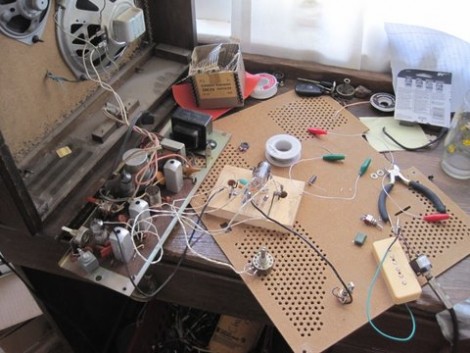
[Dino] built a similar system using his bass guitar and an amplifier hacked together from an old tape deck. He initially ran into problems with the sound not making it all the way up the tube due to the bass’ low frequency. He had an ‘Aha!’ moment and mounted the speaker on the mic rather than down on the floor, which seems to have fixed the issue.

Be sure to check out the video below to see his talk box in action.

Continue reading “Feel Like We Do With A Bass Guitar Talk Box”

NES Paul Game Controller

nes_paul_complete

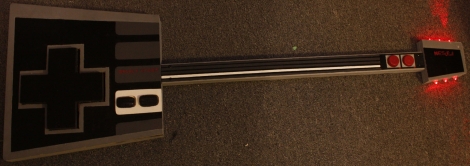
[NeoTechni] wrote in to share the new game peripheral she built, dubbed the NES Paul. The ultimate goal of the project was to build a NES-styled controller for an upcoming game she is working on, tentatively titled 8-bit Hero. The guitar is constructed primarily from wood, as well as some scrounged bits she had around the house. An Xbox 360 controller was dismantled and wired to provide input for the guitar’s buttons and D-Pad. Even the Xbox controller’s rumble packs were used in order to provide visual feedback of missed notes via LED tuning pegs on the guitar’s headstock.

The writeup is broken into several pieces as it was put together in a handful of Google Buzz posts, but it is still relatively easy to follow. We can’t wait to see how the project comes together once the game portion has been completed.

Printing Your Own Guitar Parts

The white parts that make up the body contours of this guitar have been 3D printed to meet [Bård S D’s] personal specifications. He started designing the pieces last year to add to his Zoybar guitar. Each of the three parts has its own function. The tail piece serves as a floor stand, as well as a hook for hanging the instrument upside down. The wide piece at the top gives the player a place to rest the forearm, and the piece at the bottom serves as a cradle to place on your leg, and contains the jack for the guitar’s pickup. You can see him playing the instrument in the video after the break.

We looked for more information on the Zoybar system but it’s a bit hard to get the facts from that website. We know that the 6-string kit comes standard without frets, and it’ll cost you a pretty penny at around $700. But if it performs as a quality instrument the price isn’t too far out of line.

Continue reading “Printing Your Own Guitar Parts”

LEGO Wah-wah Pedal

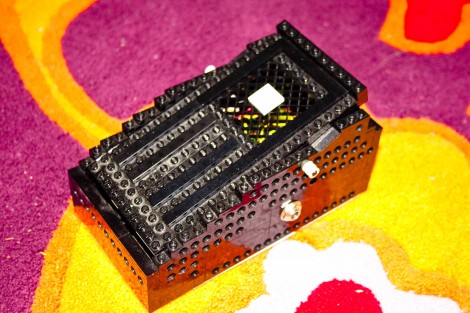
Here’s a guitar wah-wah pedal that [Christian Munk] built. Inside you’ll find a circuit board that he etched and populated based on this design but he chose to build the housing out of LEGO. The video after the break gives you an idea of what it sounds like, but for those who’ve stepped on a LEGO piece with bare feet, his pedal pounding might make you cringe!

To manipulate the sound the pedal rocks forward and backward on a center pivot shown above as a grey “nut” sticking out the side of the frame. Inside there’s a system of LEGO gears that turn a trimpot to alter the sound. This might go along nicely with that guitar amp you hacked together.

Continue reading “LEGO Wah-wah Pedal”

Guitar Tube-amp From Junk Hi-fi

[Tristan Chambers] picked up an old speaker box some friends acquired at a yard sale. It didn’t have any inputs, and there weren’t any tuning knobs like a radio would have, so it’s a mystery what this was originally used for. [Tristan] traced out the circuit and figured out where he could input audio signals which allowed him to hook up an iPod, but it was mono and not very loud. He ended building his own vacuum tube preamp from a schematic he found on the Internet so that he could use it with an electric guitar. As the video after the break shows, the box not only puts out some pretty good sound but it’s nice and loud too.

Continue reading “Guitar Tube-amp From Junk Hi-fi”

Building A Germanium Fuzz Face Guitar Pedal

Rock in the new year with a guitar pedal you built yourself. [Doug Kovach] took the time to share his project with us in the video after the break. He starts with a bit of history of the artists that have used fuzz pedals similar to this one. It seems great guitarists have been hacking since way back. [Doug’s] rendition uses the warm sounds of germanium transistors in a design that produces professional results. But if you need something a little bit less serious try the stomp-box.

Continue reading “Building A Germanium Fuzz Face Guitar Pedal”

RGB Stroboscopic Guitar Tuning

This is [Michael Ossmann’s] RGB LED stroboscopic guitar tuner. If his name is familiar that’s because we mentioned he’d be giving a talk with [Travis Goodspeed] at ToorCon. But he went to DefCon as well and spent the weekend in his hotel room trying to win the badge hacking contest.

Despite adversity he did get his tuner working. It’s built into a toy guitar that he takes on road trips with him. By adding a row of RGB LEDs between two of the frets he can use the vibration frequency of an in-tune string to flash the three different colors. If the string is not in tune the three colors will dance around but matching it with the LED frequency produces a stable color. He then uses that big yellow button to advance to the next string. See his demonstration after the break.

This is basically a built-in plectrum tuner that uses one LED package instead of two.

Continue reading “RGB Stroboscopic Guitar Tuning”