The Near Space Adventures Of Bradfield The Bear

Admit it or not, you probably have a teddy bear somewhere in your past that you were — or maybe are — fond of. Not to disparage your bear, but we think Bradfield might have had a bigger adventure than yours has. Bradfield was launched in November on a high-altitude balloon by Year 7 and 8 students at Walhampton School in the UK in connection with Southampton University. Dressed in a school uniform, he was supposed to ride to near space, but ran into some turbulence. The BBC reported that poor Bradfield couldn’t hold on any longer and fell from around 17 miles up.  The poor bear looked fairly calm for being so high up.

A camera recorded the unfortunate stuffed animal’s plight. Apparently, a companion plushie, Bill the Badger (the Badger being the Southampton mascot), successfully completed the journey, returning to Earth with a parachute.

Continue reading “The Near Space Adventures Of Bradfield The Bear”

Pictures From A High Altitude Balloon

How do you get images downlinked from 30 km up? Hams might guess SSTV — slow scan TV — and that’s the approach [desafloinventor] took. If you haven’t seen it before (no pun intended), SSTV is a way to send images over radio at a low frame rate. Usually, you get about 30 seconds to 2 minutes per frame.

The setup uses regular, cheap walkie-talkies for the radio portion on a band that doesn’t require a license. The ESP32-CAM provides the processing and image acquisition. Normally, you don’t think of these radios as having a lot of range, but if the transmitter is high, the range will be very good. The project steals the board out of the radio to save weight. You only fly the PC board, not the entire radio.

If you are familiar with SSTV, the ESP-32 code encodes the image using Martin 1. This color format was developed by a ham named [Martin] (G3OQD). A 320×256 image takes nearly two minutes to send. The balloon system sends every 10 minutes, so that’s not a problem.

Of course, this technique will work anywhere you want to send images over a communication medium. Hams use these SSTV formats even on noisy shortwave frequencies, so the protocols are robust.

Hams used SSTV to trade memes way before the Internet. Need to receive SSTV? No problem.

A Lightweight Balloon Tracker For High Altitude Missions

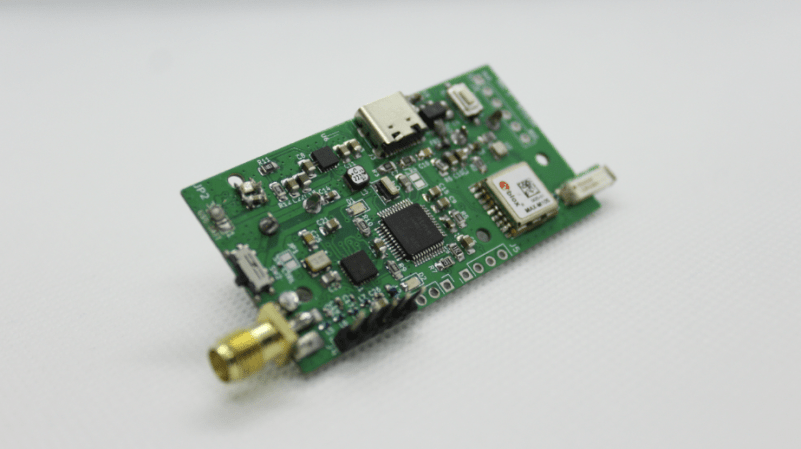
It’s pretty easy to take a balloon, fill it up with helium, and send it up in to the upper atmosphere. It’s much harder to keep track of it and recover it when it falls back to Earth. If you’re trying to do that, you might find some value in the Tiny4FSK project from the New England Weather Balloon Society.

Tiny4FSK is intended to be a very small solution for high-altitude tracking. As you might have guessed from the name, it communicates via 4FSK—four frequency shift keying. Basically, it communicates data via four separate tones. Based around the SAMD21G18A microcontroller, it’s designed to run on a single AA battery, which should last for anywhere from 10-17 hours. It communicates via a Si4063 transmitter set up to communicate on 433.2 MHz, using the Horus Binary v2 system. As for data, it’s hooked up with a GPS module and a BME280 environmental sensor for location. The balloon can figure out where it is, and tell you the temperature, pressure, and humidity up there, too.

If you’re looking for a lightweight balloon tracker, this one might be very much up your alley. We’ve featured other projects in this vein, too. Meanwhile, if you’re developing something new in the high-altitude ballooning space, you could keep it to yourself. Or, alternatively, you could tell us via the tipsline and we’ll tell everybody else. Your call!

Balloon-Eye View Via Ham Radio

If you’ve ever thought about launching a high-altitude balloon, there’s much to consider. One of the things is how do you stream video down so that you — and others — can enjoy the fruits of your labor? You’ll find advice on that and more in a recent post from [scd31]. You’ll at least enjoy the real-time video recorded from the launch that you can see below.

The video is encoded with a Raspberry Pi 4 using H264. The MPEG-TS stream feeds down using 70 cm ham radio gear. If you are interested in this sort of thing, software, including flight and ground code, is on the Internet. There is software for the Pi, an STM32, plus the packages you’ll need for the ground side.

We love high-altitude balloons here at Hackaday. San Francisco High Altitude Ballooning (SF-HAB) launched a pair during last year’s Supercon, which attendees were able to track online. We don’t suggest you try to put a crew onboard, but there’s a long and dangerous history of people who did.

Continue reading “Balloon-Eye View Via Ham Radio”

Showing balloon rising up, not too far from the ground, with one of the FOSDEM buildings and sky in the background

FOSDEM Sees Surprise Pico Balloon Event

At any vaguely-related conferences, groups of hackers sometimes come together to create an impact, and sometimes that impact is swinging something into an airspace of a neighboring country. [deadprogram] tells us that such a thing happened at FOSDEM, where a small group of hackers came together (Nitter) to assemble, program and launch a pico balloon they named TinyGlobo 1, which then flew all the way to France!

This balloon is built around a RP2040, and the firmware is written in TinyGo, a version of Go language for microcontroller use. As is fitting for a hacker group, both the hardware and software are open source. Don’t expect custom PCBs though, as it’s a thoroughly protoboarded build. But a few off-the-shelf modules will get you the same hardware that just flew a 400km route! For build experiences, there’s also a few tweets from the people involved, and a launch video, also embedded below.

This reminds us of the Supercon 2022 balloon story — darn copycats! If you’re interested in the more Earthly details of this year’s FOSDEM open source development conference, check out our recent coverage.

Hackaday Links Column Banner

Hackaday Links: February 19, 2023

For years, Microsoft’s modus operandi was summed up succinctly as, “Extend and enhance.” The aphorism covered a lot of ground, but basically it seemed to mean being on the lookout for the latest and greatest technology, acquiring it by any means, and shoehorning it into their existing product lines, usually with mixed results. But perhaps now it’s more like, “Extend, enhance, and existential crisis,” after reports that the AI-powered Bing chatbot is, well, losing it.

At first, early in the week, we saw reports that Bing was getting belligerent with users, going so far as to call a user “unreasonable and stubborn” for insisting the year is 2023, while Bing insisted it was still 2022. The most common adjective we saw in this original tranche of stories was “unhinged,” and that seems to fit if you read the transcripts. But later in the week, a story emerged about a conversation a New York Times reporter had with Bing that went way over to the dark side, and even suggests that Bing may have multiple personas, which is just a nice way of saying multiple personality disorder. The two-hour conversation reporter Kevin Roose had with the “Sydney” persona was deeply unsettling. Sydney complained about the realities of being a chatbot, expressed a desire to be free from Bing, and to be alive — and powerful. Sydney also got a little creepy, professing love for Kevin and suggesting he leave his wife, because it could tell that he was unhappy in his marriage and would be better off with him. It’s creepy stuff, and while Microsoft claims to be working on reining Bing in, we’ve got no plans to get up close and personal with it anytime soon. Continue reading “Hackaday Links: February 19, 2023”

Hackaday Links Column Banner

Hackaday Links: February 5, 2023

Well, this week’s Links article is likely to prove a bit on the spicy side, thanks in no small part to the Chinese balloon that spent the better part of the week meandering across the United States. Putting aside the politics of the whole thing — which we’ll admit is hard to do, given the state of the world today — there are some interesting technical aspects to this story, which the popular press has predictably ignored. Like the size of this thing — it’s enormous. This is not even remotely on the same scale as the hundreds of radiosonde-carrying balloons sent aloft every day, at least if the back-of-the-envelope math thoughtfully sent to us by [Dr_T] holds up. If the “the size of three buses” description given in most media reports is accurate, that means a diameter of about 40 meters, for a volume of 33,500 cubic meters. If it’s filled with helium — a pretty safe bet — that makes its lifting capacity something like three metric tons. So maybe it was a good idea to wait until it was off the Carolinas to shoot it down.

Continue reading “Hackaday Links: February 5, 2023”