An Easy Way To MIDI Sync Your Eurorack Build

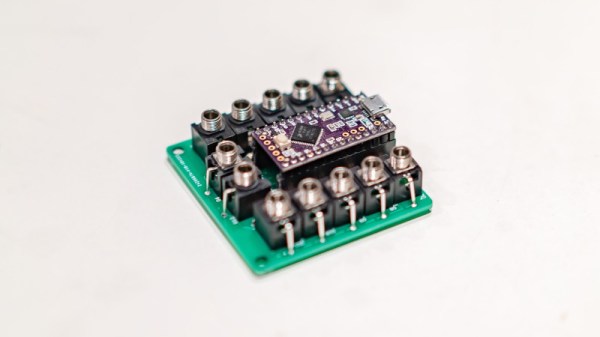
Eurorack synthesizer builds are known for a lot of things; simplicity isn’t necessarily one of them. However, not everything on a modular synthesizer build has to be inordinately complicated, a mess of wires, or difficult to understand. [little-scale] has built a neat and tidy module that might just find a place in your setup – the Chromatic Drum Gate Sync. The handy little device is based on a Teensy, and uses its USB MIDI libraries to make synchronizing hardware a snap.

The device has 12 channels, each responding to a single MIDI note. A note on message is used to set a gate high, and a note off message to set it low again. This allows very fine grained control of gates in a modular setup. The device can also output a variety of sync signals controlled by the USB MIDI clock – useful for keeping your modular rack in time with other digitally controlled synths.

It’s a build that espouses [little-scale]’s usual aesthetic – clean and tidy, with a focus on compactness. All the required details to build your own are available on Github.

We’ve seen the collision of [little-scale] and Teensy hardware before – with this rig playing 8 SEGA soundchips in unison.

Musical Mod Lets MRI Scanner Soothe The Frazzled Patient

Hackers love to make music with things that aren’t normally considered musical instruments. We’ve all seen floppy drive orchestras, and the musical abilities of a Tesla coil can be ear-shatteringly impressive. Those are all just for fun, though. It would be nice if there were practical applications for making music from normally non-musical devices.

Thanks to a group of engineers at Case Western Reserve University in Cleveland, there is now: a magnetic resonance imaging machine that plays soothing music. And we don’t mean music piped into the MRI suite to distract patients from the notoriously noisy exam. The music is actually being played through the gradient coils of the MRI scanner. We covered the inner working of MRI scanners before and discussed why they’re so darn noisy. The noise basically amounts to Lorenz forces mechanically vibrating the gradient coils in the audio frequency range as the machine shapes the powerful magnetic field around the patient’s body. To turn these ear-hammering noises into music, the researchers converted an MP3 of [Yo Yo Ma] playing [Bach]’s “Cello Suite No. 1” into encoding data for the gradient coils. A low-pass filter keeps anything past 4 kHz from getting to the gradient coils, but that works fine for the cello. The video below shows the remarkable fidelity that the coils are capable of reproducing, but the most amazing fact is that the musical modification actually produces diagnostically useful scans.

Our tastes don’t generally run to classical music, but having suffered through more than one head-banging scan, a half-hour of cello music would be a more than welcome change. Here’s hoping the technique gets further refined.

Continue reading “Musical Mod Lets MRI Scanner Soothe The Frazzled Patient”

A Fleet Of Pressure Washers Powers This Interactive Public Fountain

Public art installations can be cool. Adding in audience interactivity bumps up the coolness factor a bit. Throw civic pride, dancing jets of water, music, and lights into the project, and you get this very cool pressure washer powered musical fountain.

The exhibit that [Niklas Roy] came up with is called Wasserorgel, or “water organ”, an apt name for the creation. Built as part of a celebration of industry in Germany, the display was built in the small town of Winnenden, home to Kärcher, a cleaning equipment company best known for their line of pressure washers in the distinctive yellow cases. Eight of the company’s electric pressure washers were featured in the Wasserorgel, which shot streams of water and played notes in response to passersby tickling the sturdy and waterproof 3D-printed keyboard. The show was managed by an Arduino with a MIDI shield, which controlled the pressure washers via solid state relays and even accepted input from an anemometer to shut down the show if it got too windy, lest the nearby [Frau Dimitrakudi] be dampened.

The video below shows how engaging the Wasserorgel was during its weeks-long run in the town market square; there’s also one in German with build details. And while we can’t recall seeing pressure washers in public art before, we do remember one being used as the basis of a DIY water-jet cutter.

Continue reading “A Fleet Of Pressure Washers Powers This Interactive Public Fountain”

Quick And Dirty MIDI Interface With USBASP

[Robson Couto] recently found himself in need of MIDI interface for a project he was working on, but didn’t want to buy one just to use it once; we’ve all been there. Being the creative fellow that he is, he decided to come up with something that not only used the parts he had on-hand but could be completed in one afternoon. Truly a hacker after our own hearts.

Searching around online, he found documentation for using an ATtiny microcontroller as a MIDI interface using V-USB. He figured it shouldn’t be too difficult to adapt that project to run on one of the many USBASP programmers he had laying around, and got to work updating the code.

Originally written for the ATtiny2313, [Robson] first had to change around the pin configuration so it would work on the ATmega8 in the USBASP, and also updated the USB-V implementation to the latest version. With the code updated, he programmed one of the USBASP adapters with a second one by connecting them together and putting a jumper on the J2 header.

He had the software sorted, but there was still a bit of hardware work to do. To provide isolation for the MIDI device, he put together a small circuit utilizing a 6N137 optoisolator and a couple of passive components on a piece of perf board. It’s not pretty, but it does fit right into the programming connector on the USBASP. He could have fired up his PCB CNC but thought it was a bit overkill for such a simple board.

[Robson] notes that he hasn’t implemented MIDI output with his adapter, but that the code and the chip are perfectly capable of it if you need it for your project. Finding the schematic to hook up to the programmer’s TX pin is left as an exercise for the reader.

If you don’t have a USBASP in the parts bin, we’ve seen a very similar trick done with an Arduino clone in the past.

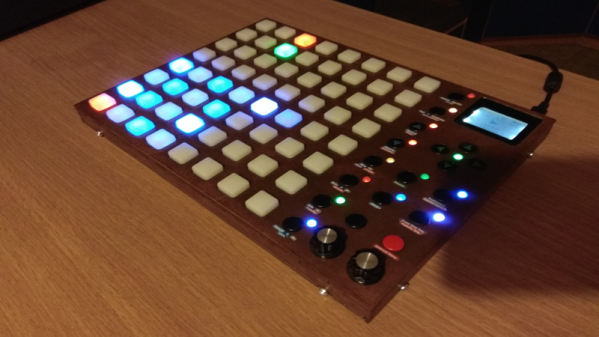
Redesigning The Musical Keyboard With Light-Up Buttons

A piano’s keyboard doesn’t make sense. If you want to want to play an F major chord, just hit an F, an A, and a C — all white keys, all in a row. If you want to play a B major chord, you hit B, a D#, and an F#. One white key, then two black ones. The piano keyboard is not isomorphic, meaning chords of the same quality have different shapes. For their entry into the Hackaday Prize, [CSCircuits] and their crew are working on a keyboard that makes chords intuitive. It’s called the Kord Kontroller, and it’s a device that would also look good hooked up to Ableton.

The layout of the Kord Kontroller puts all the scale degrees arranged in the circle of fifths in the top of the keyboard. To play 90% of western music, you’ll hit one button for a I chord, move one button to the left for a IV chord, and two buttons to the right for a V chord. Chord quality is determined by the bottom of the keyboard, with buttons for flat thirds, fourths, ninths, elevenths and fourteenths replacing or augmenting notes in the chords you want to play. Since this is effectively a MIDI controller, there are buttons to change octaves and modes.

As far as hardware goes, this keyboard is constructed out of Adafruit Trellis modules that are a 4×4 grid of silicone buttons and LEDs that can be connected together and put on a single I2C bus. The enclosure wraps these buttons up into a single 3D printed grid of button holes, and with a bit of work and hot glue, everything looks as it should.

It’s an interesting musical device, and was named as a finalist in the Musical Instrument Challenge. You can check out a demo video with a jam sesh below.

Continue reading “Redesigning The Musical Keyboard With Light-Up Buttons”

Wavetable General MIDI For Everyone

There are only so many ways to generate music with a computer, and by far the most popular method is MIDI. It’s been around for thirty-five years, and you don’t get to be a decades-old standard for no reason. That said, turning MIDI into audio is a pain, but this project in the Musical Instrument Challenge for the Hackaday Prize makes it easy. It’s a Fluxamasynth Module that turns MIDI into something you can hear.

The key to this build is a single chip that takes MIDI data in and spits out audio, according to the 128 general MIDI sounds. This might not sound like much, but if you’ve ever tried to turn MIDI into sound, you’ll find your options are limited. There is exactly one chip that can do this and is easily obtainable: the SAM2695 from Dream Sound Synthesis. This chip was originally designed for cheap toy keyboards, but if you have a chip, you can do anything with it.

The Fluxamasynth Modules are inspired by the original Fluxamasynth, an Arduino shield that is basically a breakout board for the SAM chip. There’s a MIDI in, and an 1/8″ jack for output, and not much else. The Fluxamasynth Modules extend the capability by adding more support, including stereo output, reverb, chorus, flange, and delay effects, and digs down deep into the configurable parameters for tuning.

The hardware is basically an audio appliance for the Arduino, Raspberry Pi, and the ESP32, and allows for generative music through code. You can see an example of this project in the video below.

Continue reading “Wavetable General MIDI For Everyone”

The Ultimate MIDI Wind Controller Is The Human Voice

When it comes to music, the human voice is the most incredible instrument. From Tuvan throat singing to sopranos belting out an aria, the human vocal tract has evolved over millions of years to be the greatest musical instrument. We haven’t quite gotten to the point where we can implant autotune in our vocal cords, but this project for the Hackaday Prize aims to be a bridge between singers and instrumentalists. It’s a hands-free instrument that relies on vocal gesture sensing to drive electronic musical instruments.

The act of speaking requires dozens of muscles, and of course no device that measures how the human vocal tract is shaped will be able to measure all of them, but the Multiwind does manage to measure breathing in, breathing out, the shape of the lower lip, the upper lip, and its own tilt, giving it far more feedback than any traditional wind instrument. It does this with IMUs and a mouthpiece mounted on a mount that is seemingly inspired by one of those hands-free harmonica neck mounts.

The output for this device is MIDI, although the team behind this build already has data streaming to an instance of Max, and once you have that, you have every musical instrument imaginable. It’s an innovative musical instrument, and something we’re really excited to see the results of.