Seaswarm: We Can Clean Up The Gulf In A Month

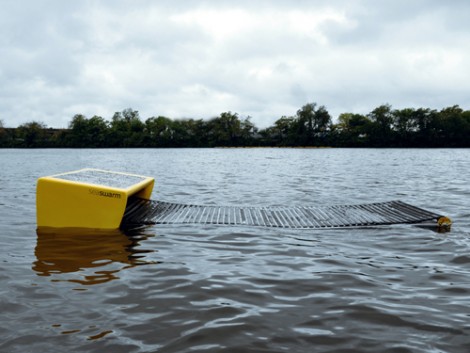
Want to clean up the Gulf of Mexico oil spill in one month? Seaswarm says it can be done with 5000 floating robots.

As the name implies, the project uses swarm robotics. Each unit draws power from the sun, and drags around a conveyor belt of oil absorbent nanofabric that doesn’t get wet in water. Once the fabric is saturated with crude it can be removed using heat; not a task the swarm can do by itself. But get this: after separating oil from nanofabric both can be used again. That means you get the environmental benefit of cleaning up the Gulf, not throwing away your collection medium, and the oil is once again a usable commodity. Sounds like a lot of high promises, but take a look at the video after the break and decide for yourself.

Continue reading “Seaswarm: We Can Clean Up The Gulf In A Month”

Programmable Origami

[youtube=http://www.youtube.com/watch?v=vZf3lo-16wQ]

Researchers at MIT have come up with this slick demo of, what they call,  programmable matter. This flat sheet covered in tiny foil actuators can be programmed to fold into specific shapes. Shown in the video above is a boat and an airplane.  Using the concepts set down by origami through the years, they can divide the sheet into triangles in specific arrangements to make certain shapes possible. This one is fairly simple, but judging by some of the insane origami we’ve seen around, this could get pretty cool.

[via slashdot]

Robots In Space

[youtube=http://www.youtube.com/watch?v=nl6lZbyLkzs]

SPHERES (Synchronized Position Hold, Engage, Reorient Experimental Satellites) are experimental robots made at MIT for the purpose of testing robot locomotion in space. As you can see in the video above, they are capable of maneuvering pretty well. They seem to hold formation fairly tightly. They are using compressed CO2, through 12 different thrusters for positioning. They should be capable of autonomously navigating around each other as well as docking to one another.

BiDi Screen, On (and Off) Screen Multitouch

[youtube http://www.youtube.com/watch?v=kXuxK6IeQfo&feature=player_embedded%5D

MIT is debuting their latest advancement in technology, a multitouch screen that also functions as a gestural interface. The multitouch aspect is nothing new, the team explains how traditional interfaces using LEDs or camera systems do work, but fail to recognize gestures off-screen.

Gestures are a relatively recent highlight with the introduction of projects like Natal or perspective tracking, but fail to work at closer distances to the screen. MIT has done what seems the impossible by combining and modifying the two to produce the first ever multitouch close proximity gestural display.

And to think, just a couple of months ago the same school was playing with pop-up books.

[via Engadget]

Arduino Powered Singing Table

[youtube=http://www.youtube.com/watch?v=vc4PSgXDp64]

This musical Lazy Susan, or “Crazy Adam” was brought to us by students from MIT.  It basically plays [Soul II Soul]’s “Back to Life”  as it turns.  In their words: “Through the interaction with the Singing Lazy Susan, we found the eating patterns and behaviors unique to each person, which reflect our personalities and interests. The dining experience expands to a new domain.”  Are we the only ones who think this is silly? Not only is an Arduino overkill for this, how does this help reflect our personalities and interests? We know, someone will say that art doesn’t need to make sense, but  this would just get annoying really fast. Good job coming up with an idea and making it happen. Please don’t bring that to our next office party. It is also worth noting that musical Lazy Susans aren’t exactly a new idea.

OmniDirectional Research Platform

[youtube=http://www.youtube.com/watch?v=-bcoAqKhdL4]

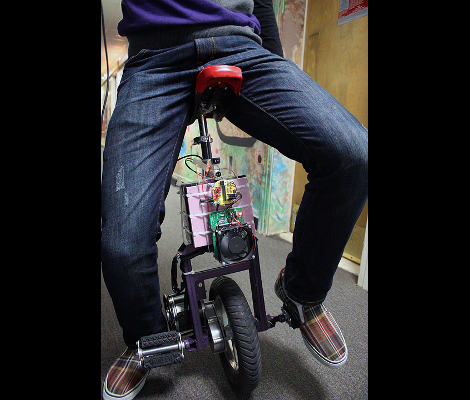
[Shachar Geiger] sent in an interesting project that he worked on with [Tal Avivi] at the Bezalel academy in Jerusalem. They were given the task of designing a 1-person electrical urban vehicle. They took some cues from MIT’s Transology and designed the OmniDirectional Research Platform (ODRi). There’s a video of it embedded above. It can be driven using three different input styles: an accelerometer joystick, a traditional gamepad, or body mass shift. They started with an Arduino, but needed more I/O and had to switch to a Wiring board (this was before the Mega). The platform is built mostly from scrap. The accelerometers were placed in an old Microsoft Sidwinder. The standard joystick is from a Sega Mega Drive. The weight sensors are out of cheap home scales.