Sugru – Moldable Silicone Adhesive

Reader [James] told us about a new product developed with hackers in mind. Sugru is a silicone-based adhesive that cures at room temperature. It is moldable and once hardened it remains slightly flexible. You can see in the picture above that it has been used to create a hook but the inventor shows off a slew of other uses such as replacing missing feet on a chair, molding hand grips, and waterproofing. One of the most enticing aspects is that Sugru will create a chemical bond with smooth metal.

The product reminds us of the two-part earplug material used to ruggedize electronics from a while back. The difference is that Sugru is one part and is an adhesive. It comes as a satchel full of individually-sized packets. To use it, choose how much you need, cut open the package to reveal the product, then knead and mold the chewing-gum-looking substance to fit your needs. Check out the demonstration video after the break.

Want to try some out? Yeah, so do we but it seems they’ve already sold out of their initial supply (good for them, bad for us) and we haven’t seen word on pricing. We’d love to use this to mold enclosures, and for about a billion other things.

Continue reading “Sugru – Moldable Silicone Adhesive”

Daft Punk Replica Helmet

daftpunkhelmet

For all their varied and entertaining uses, circuits and code comprise only part of the complete hacking experience. To really put your project over the top, sooner or later you’ll want to possess some physical fabrication skills. Consider the works of [Ben Heckendorn]: He’s always done a fantastic job with the electronics, but it’s the fit and finish of the enclosures that make him a legend.

“Fabrication” usually conjures images of shop tools — saws and sanders and drills — all tremendously useful skills worth learning, and easily within reach of most home shops or garages. Recently, the techniques of mold making and casting have seen something of a DIY renaissance. Mold making is nothing new, the basic concepts go back millennia, but in just the past few years the materials for extremely high-quality molds have become safer, simpler to use, and easier to acquire.

This being Halloween month, what better example of the medium than this impeccable replica helmet styled after half of the musical duo Daft Punk (a recurring theme among Hack a Day contributors), created by prop maker [Harrison Krix]. After sculpting an original master part (from common hardware store and art store materials, we might add), a one-piece flexible mold is built up from silicone, which captures every minute detail, and later the helmet form is cast from a thin layer of resin. The visor is vacuum formed. A follow-up with the internal electronics build is yet to be posted, but even at this stage the shell alone is so refined it looks straight off a showroom floor. If mold making can do this for someone’s noggin, imagine what it can do for your next creative hardware project. Smooth-On, a major supplier of these materials, has a free PDF introduction and a set of tutorials on their web site.

[thanks Wolf]

Home Injection Molding

injectionmold

[Kenneth Maxon] is a wizard who only does things one way, beautifully. While out of the average hacker’s production capabilities, his injection molding machine is amazing to behold. The machine has all features a commercial model would. It heats and cools the mold, produces over a ton of pressure to inject plastic with, and ejects parts automatically to name a few.

Defcon 16: Biometric Cloning


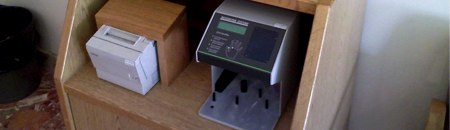
One of the more novel talks we saw at Defcon was [Zac Franken] presenting on access control systems. He covered several different types, but the real fun was his live demo of bypassing a hand geometry scanners like the one pictured above. With the help of two assistants, 4 pounds of chromatic dental alginate, and 5 liters of water, he made a mold of his hand. The box he placed his hand in had markings to show where the pegs on the scanner are located. After 2 minutes he could remove his hand from the cavity. They then filled the mold with vinylpolysiloxane, making sure to remove all bubbles. 20 minutes later the hand was solid and passed the scanner’s test. This may not be a completely practical attack, but it does defeat the overall idea of biometrics; biometrics are built on the assumption that every person is unique and can’t have their features reproduced.

[Zac] also showed an interesting magnetic card spoofer that emulated all three tracks using coils of magnet wire. We hope to see more about that in the future.

[photo: morgan.davis]