Taking A Moon Light From Grayscale To Full Color

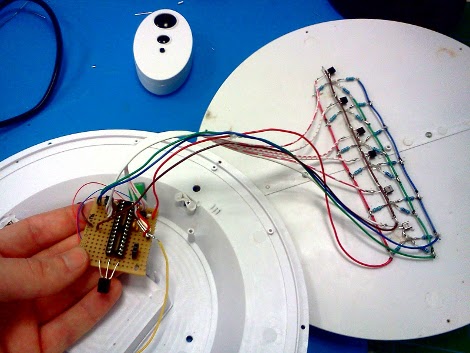
[Terry Miller] picked up a moon light on the cheap. All it does is light up some white LEDs to simulate moon phases after sensing nightfall via an LDR. He figured he could do better and set out to replace the electronics with a more colorful offering.

He chose to use an ATmega328 because he already had it on hand. The chip drives a series of RGB LEDs in a multiplex arrangement. To protect the I/O pins (and drive the LEDs at their target current) he is using a set of high and low side MOSFETs. Rather than rely on the light sensor to switch on the lamp he decided to add an IR receiver. In the video after the break you can see that this lets him cycle through colors and effects, in addition to switching the lamp on and off with a remote control.

With the enclosure put back together he is still able to reprogram the chip thanks to a serial header included in the design. The device is battery operated and the life estimates are included in his write-up.

Continue reading “Taking A Moon Light From Grayscale To Full Color”

The Interstellar Clock

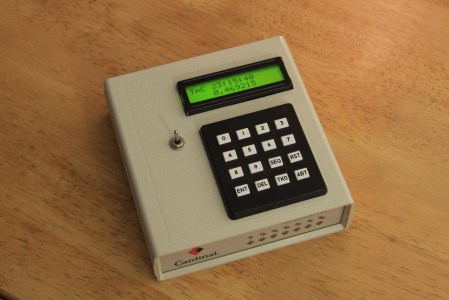
[Alexander Avtanski] has put together a nice clock to meet all your interstellar travel needs. Besides being another PIC based timer, this is a neat little project because it incorporates pretty much every feature you could think of when building a clock for our solar sytem.  For example, it has 16 independent timers and alarms, it can  simultaneously give the time for multiple planets, as well as keep track of other stellar events like the eye of Jupiter or the phases of the moon. To get this project off the ground [Alex] reverse engineered an old dial up modem to serve as an enclosure and power supply and then added in a rechargeable battery so that his  his interstellar clock wasn’t tied to a wall.

[via make]

Amazing Chassis Hacks

[Crabfu] pulled off some great chassis work on top of a remote control drivetrain. His most recent build turns the tiny traveler into a lunar rover complete with passenger and a communications array. For this he’s sourced the parts from a toy but boosted the realism with hand-painted details that leave us in awe. His previous project sourced the body from a model truck kit. Once again, it’s the paint work that makes us envious of his skills.

Both projects conceal a Losi 1/24 scale micro rock crawler that provides for some incredible locomotion. See video of both builds after the break.

Continue reading “Amazing Chassis Hacks”

Lunar Auto Repair Depends On The Sticky Stuff

lunar-rover-fender-uses-duct-tape

When you’ve got problems with your lunar rover you can’t just “trust the Midas touch”. Every unexpected repair that happens outside of the Earth’s atmosphere is a hack and it seems the common ingredient in each one is Duct tape. If you’ve seen the movie Apollo 13 you know it was used in making a square carbon dioxide filter fit into a round filter socket. [XD] let us know about another hack where NASA used Duct tape to replace a fender on the lunar rover during the Apollo 17 mission.

The rover kicks up a lot of moon dust as it cruises around on its wire tires. When a rear fender started to come loose it was secured with duct tape. We delighted in watching a moon-man tear off chunks of tape for the fix, shown in the video after the break. When the fender finally flew off of the vehicle, the engineers on the ground came up with a way to replace it using laminated maps and more duct tape.

We’ve been critical of the use of duct tape in the past. But when you’re in a bind, accept no substitutes.

Continue reading “Lunar Auto Repair Depends On The Sticky Stuff”