ChipKIT Sketch: Mini Polyphonic Sampling Synth

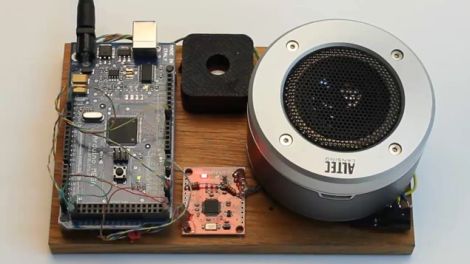
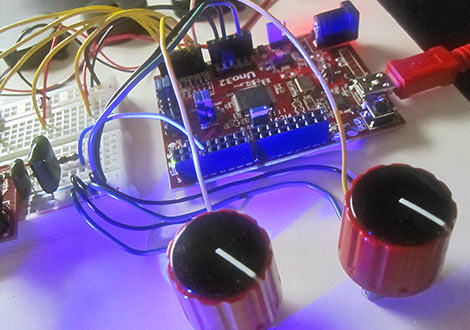
In our hands-on review of the Digilent chipKIT Uno32, we posed the question of what the lasting appeal might be for a 32-bit Arduino work-alike. We felt it needed some novel applications exploiting its special features…not just the same old Arduino sketches with MOAR BITS. After the fractal demo, we’ve hit upon something unique and fun…

Continue reading “ChipKIT Sketch: Mini Polyphonic Sampling Synth”

Music Tank Puts The Boom In Boombox

music_tank

When you think of Memorial Day weekend, what comes to mind? Well around here, all we can think about is this tank cum boombox that Instructable user [Elian_gonzalez] put together.

This build is actually the third version of his Music Tank, and it comes with all sorts of improvements over previous models. The tank is primarily constructed out of plywood, with cavernous compartments for holding all of its goodies. In its capacious body, the tank sports a 60 Watt stereo system that powers a pair of external speakers mounted on either side of the turret. The turret itself contains an air-powered cannon built from PVC tubing, which we imagine can be used to shoot a multitude of different projectiles.

While the concept itself is pretty cool, the tank happens to be nearly self-sustaining as well. The tank has a pretty deep battery well and uses a 50w home made solar panel to help keep things topped off while in use. [Elian] does not specify a total running time, but we imagine that it can go for hours on a nice, sunny day.

Keep reading to see a long video walkthrough of the Music Tank MK3 in action. Continue reading “Music Tank Puts The Boom In Boombox”

Resurrecting The Optigan Disc Format

optigan

The Optigan and Orchestron were a pair of electronic organs built by Mattel in the 1970s which used swappable optical discs to store instrument information. The discs can still be found today, but the organs are extremely scarce, much to [Gan’s] dismay. After researching the organs for a bit, he decided he could probably build his own MIDI-compatible interface for the audio discs.

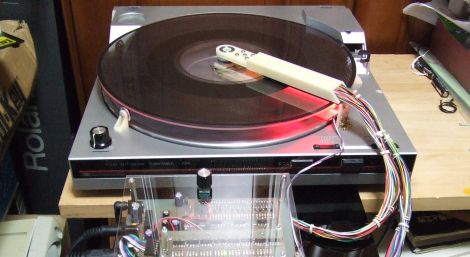
The discs have audio waveform data printed on them, which can be read using an LED on one side of the disc and an optical transistor on another. After successfully prototyping a reader that could interpret one of the disc’s audio tracks, he constructed a device to read all of the tracks simultaneously, just like the original organs.

His makeshift turntable was constructed on top of an old record player using acrylic discs and toy car wheels to keep things steady. Once the disc is placed on the turntable, he sets his reader in place, and via some custom circuitry, he is able to play the discs using his much more modern keyboard. It sounds pretty decent as you can see in the video below, though he does admit he would like to tweak a few things to make it sound even better.

[thanks Bryan]

Continue reading “Resurrecting The Optigan Disc Format”

Google ADK Project Shows Just How Easy It Is To Use

first_adk_project

[yergacheffe] was able to get his hands on a shiny new Google ADK board about a week before it was announced at I/O, and got busy putting together a neat project to show off some of the ADK’s features. His idea was to meld together the ADK and Google’s new music service, two items he says complement each other very well.

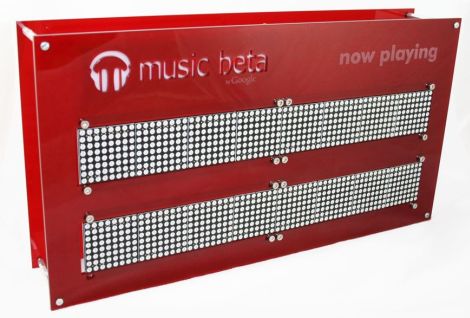
He had a handful of LED matrices left over from last year’s Maker Faire, which he decided to use as a Google music metadata display. The base of the display is made from laser-cut acrylic, with a few spare ShiftBrites lighting up the Google music beta logo.

He says it took literally just a couple lines of code to get his Android handset to talk with the display – a testament to just how easy it is to use the ADK.

Pretty much anyone can walk up, attach their phone, and see their current music track on the display with zero fuss, which you can see in the video demo below.

Continue reading “Google ADK Project Shows Just How Easy It Is To Use”

Generating Music With Credit Cards

mozarts_credit_card

[Steve] was browsing around at a local electronics surplus store when he spotted an old Tranz 330 point-of-sale terminal that seemed pretty interesting. He took it home and after disassembling it, found that it contained a Z-80 based computer. Because the 330 shares the same processor as other hobbyist-friendly devices such as the TRS-80, he figured it would be quite fun to hack.

While the Z-80 processor is pretty common, [Steve] still had to figure out how it was interfaced in this particular device. After spending some time reverse engineering the terminal, he had free reign to run any program he desired. After thinking for a bit, he decided it would be cool to use the terminal to generate music based on whatever card was swiped through the reader – he calls his creation “Mozart’s Credit Card”.

He found that just playing sounds based on the raw contents of the mag strips didn’t produce anything coherent, so he wrote a small application for the terminal based on the Melisma Stochastic Melody Generator. Music is generated somewhat randomly using various card characteristics, as you can see in the video below.

We think it’s pretty cool, but [Steve] says he’s always open to suggestions, so let us know what you think in the comments.

Continue reading “Generating Music With Credit Cards”

The Vibrotron

Behold the Vibrotron! Constructed by the Carnegie Melon University robotics club, the vibrotron is a piece of a larger project called the robOrchestra. The mechanics in action here are quite simple. You have two reservoirs of small steel balls. One at the bottom, one at the top. The bottom ones are fed to the top ones using an Archimedes’ screw. Once at the top, they are dispensed through some tubing down to plink off of a vibraphone key. All of the timing is done via solenoids mounted at the end of the tubes. The final product reminds us of the Animusic animations that were put out a few years ago.

For this system, since they wanted this to be an automated and reconfigurable bot, they are using an Arduino to control the solenoids. This way they can change songs as they please. We have to admit though, we’d love to see one where the timing for the song was all done through tube length or some other passive system allowing it to be hand cranked and purely mechanical.

Continue reading “The Vibrotron”

Easter Egg Hacking

ateam_easter_egg

Spring is upon us and Instructables user [Mischka] decided it was a good idea to combine two flavors we never considered putting together: The Easter Bunny and the A-Team.

He decided to build the egg as an Easter gift for his brother, who is a huge fan of the A-Team. He found a slightly larger than normal plastic egg, and proceeded to paint the shell white, adding a printed picture of Mr. T once the paint had dried.

The guts of the egg are made up of a Picaxe 08M micro controller mounted on a Picaxe protoboard. Rather fond of buzzing, beeping audio, he decided to forgo a normal speaker and opted to use a piezo instead. To activate the music when the egg is shaken, a tilt switch was added to the board as well. He uploaded his software to the Picaxe, sealed up the egg, and called it a day.

We can imagine his brother will be pretty pleased with the creation – who wouldn’t be? We only wish that there was video of the egg in action.