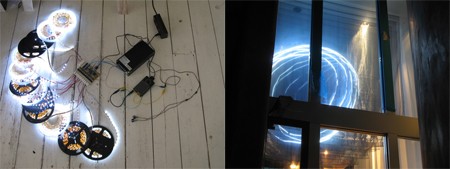
[Mortiz Waldermeyer], the man who brought us the interactive LED pong table, has recently completed a project commissioned by Microsoft: an interactive chandelier that can receive and react to music from a Zune mp3 player. The technology behind this project which [Waldemeyer] calls Twilight is not all that complex: at the core of the chandelier is a Zune, which acts as the receiver for other Zunes in the area. The central chandelier Zune then feeds graphic equalizer display data to another device, which in turn feeds a microcontroller running the LEDs embedded in the chandelier. The chandelier itself is constructed of 15 sheets of organza fabric. The result is a rich, dancing display of lights that people in the room with a Zune can take turns controlling. The installation has just opened in LA.
music457 Articles
AirPiano: Touch Free IR Piano
[youtube=http://www.youtube.com/watch?v=Gh4Ovsh2DZY&hl=en&rel=0&color1=0x3a3a3a&color2=0x999999]
We were excited to learn of [Omer Yosha]’s AirPiano, but being the persnickety nerds we are, we think its more like a theremin than a piano. The device lets users play 24 different notes with a wave of the hand over the AirPiano. The “keys” are arranged in a matrix of three tiers with eight notes per tier; if the user sustains his or her hand over the AirPiano, the corresponding note is sustained.
It’s construction is relatively simple: an Arduino, several infrared sensors, and LEDs corresponding to the notes make up the device. It doesn’t have any built-in audio hardware at all, so it’s most basic use is as a MIDI controller. Still, it is essentially an unspecified input device, so it could theoretically be used for other purposes. For us, it’s fun to just watch the AirPiano in action.
OiNK Uploaders’ Bail Extended

The six people arrested by British authorities for uploading files to the OiNK torrent network, all out on bail, have had the period of their bail extended. Charged with conspiracy to defraud the music industry, the woman and five men as well as OiNK operator [Alan Ellis] have been ordered to report to the police on July 1st, where their bail will be formally extended for another 27 days. According to TorrentFreak, sources close to the case believe that the police are still building their criminal case, which accounts for the bail extensions. They could have civil charges levied against them, but current British Law cannot prosecute individuals for illegal filesharing unless it is done for profit.
New Nintendo DS Homebrew Music Apps
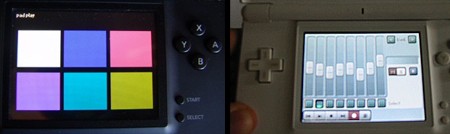
The Nintendo DS homebrew scene is heading into a heavily musical interlude with a few new apps. This is good news for anyone who liked Protein DScratch but wanted more options and functionality. More information after the break.
Dance Floor Power Generation
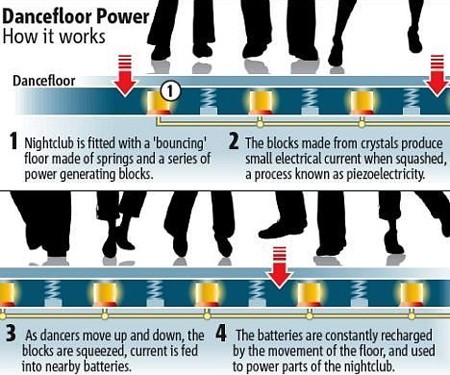
With concerns about the environment at an all-time high, do we roll up our sleeves and fix the situation or set our fears aside and dance the night away? [Andrew Charalambous], a nightclub owner in from Britain, doesn’t think we should have to choose, so he installed a dance floor that harnesses power from dancers into one of his clubs.
The dance floor uses piezoelectrics to collect the power: as clubgoers dance, electricity-producing crystals under the floor are compressed, producing a small current. The current is collect by embedded batteries, which in turn provide the power to lights, audio systems, and other parts of the club that consume electricity.
It’s certainly an interesting idea, but we’d like to know just how much power these floors are able to generate. Is this a gimmick or a genuinely practical solution? [Charalambous]’s club has adopted the somewhat hokey policy of forcing patrons to sign a pledge to be climate-conscious and do what they can to help the Earth, but that’s a small price to pay to earn green karma and have fun at the same time.
[via io9]
Robot Clarinet
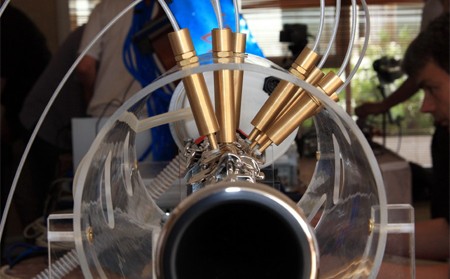
Australian research group NICTA in association with the University of New South Wales won the 2008 Artemis Orchestra Competition with their robot clarinet player. The competition challenges participants to design embedded systems that can play unmodified instruments. NICTA took first prize with their roboclarinet, due mainly to the complexity of the robot’s “mouth.” It uses two servo motors to act as a surrogate tongue and lips, vibrating the reed of the clarinet in a way consistent with human playing. The keys of the clarinet are pushed by a series of brass plungers. All of the robot’s functions are controlled by a computer running Linux. If great sound or novel technology are not enough for you, then the project is at least worth a look for the robot’s attractive, slightly steampunk-esque look. Watch it in action after the break.
World’s Oldest Computer Music Unveiled
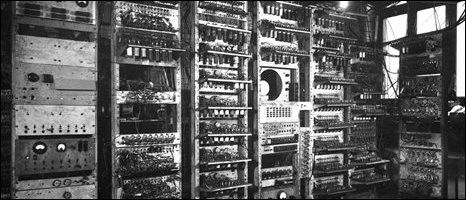
Fans of music made with obsolete technology are in for a treat: recordings of a Ferranti Mark 1 computer playing Baa Baa Black Sheep and In the Mood were recently released, and they are thought to be the oldest recordings of computer generated music in existence.
The Ferranti Mark 1 is a commercial version of Manchester University’s SSEM computer (aka Baby), which preceded several more well known computers like UNIVAC and EDVAC. It was one of the first computers that didn’t require a great deal of hardware rewiring to perform different tasks, making it ideal for this sort of purpose. It is not known whether the program was written to play these songs only or for more diverse composition and playback, but the author, [Chris Strachey] was known to be a friend of the legendary [Alan Turing]. The recording was released as part of the Manchester SSEM’s 60th anniversary celebration.