Making A Game Boy Color Louder

When [Anton] picked up an old translucent purple Game Boy Color, he noticed a nearly complete lack of sound coming from the speaker. This simply would not do, so [Anton] replaced the speaker and soldered in a 2 Watt amp, making his Game Boy very loud indeed.

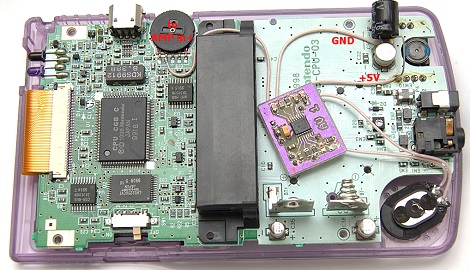
After cracking open his Game Boy, [Anton] noticed the speaker was rusted. He replaced it by soldering in a speaker from a Motorola cell phone, fixing the most immediate problem. After plugging in a few batteries, he still noticed a nearly complete lack of sound.

Turning to his electronics junk drawer, [Anton] pulled out a TI TPA2000D1 Class D amplifier. This tiny amplifier is able to provide 2 Watts to a speaker and is very power efficient given it’s Class D pedigree.

After making a PCB and wiring up his amp to the Game Boy’s circuit board, [Anton] spent a little time tracking down the source of some high-frequency hissing. As it turns out, the power regulators and converters on a 15-year old Game Boy aren’t of the highest quality, but after adding a few capacitors [Anton] got everything under control.

Now [Anton]’s Game Boy has very loud, crystal-clear sound. Considering the lengths chiptune artists take modifying old ‘brick’ style game boys for use with Little Sound DJ or nanoloop, [Anton]’s build could become a worthwhile modification for musicians looking for a little more oomph to their performance.
Adding Famicom Audio Channles To An NES Without Messing Up The Console

[Callan Brown] wrote in to show us a really interesting NES audio hack. [Callen] decided that he wanted the full Castlevania III audio experience, which (without modifications) can only be had through the original Japanese Famicom console. [Callen] weighed a few adapter options, and instead decided to come up with his own.

The issue is that the Japanese Famicom and the American NES actually have a different cartridge connector. The change in hardware from a 60 pin to a 72 pin connector added “features” like the 10 pins connected directly to the expansion port (used for stuff like the teleplay modem, who knew). The other two additional pins are used by the annoying 10NES lockout chip. While they were at it, Nintendo decided to route the audio path through the expansion connector instead of the cartridge.

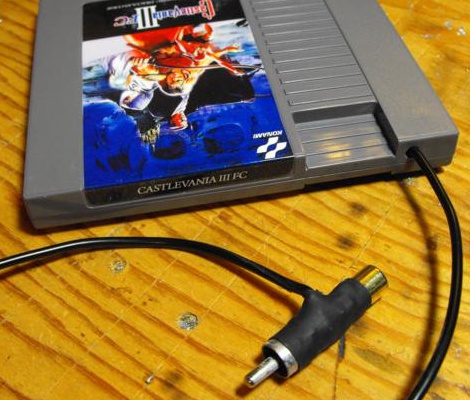
This means that the Japanese cartridges can’t pipe sound to the NES audio channel with just a pin adapter. Good news though, after sourcing a pin adapter hidden inside certain NES games (Stack Up, Gyromite), audio can easily just be pulled from the adapter PCB. This requires the more expensive Famicom Castlevania III cartridge (Akumajou Densetsu). To cleanly route the new audio cable out of his front loading NES [Callan] reuses the sacrificial adapter game’s cart to make some kind of unholy hybrid. To round it off [Callan] also goes over steps to flash a translated ROM to the Japanese game.

What difference could an extra two squares and a sawtooth make? Check out the sound comparison video after the jump! Thanks [Callan].

Continue reading “Adding Famicom Audio Channles To An NES Without Messing Up The Console”

NES Light Gun Gets A Burning Laser Upgrade

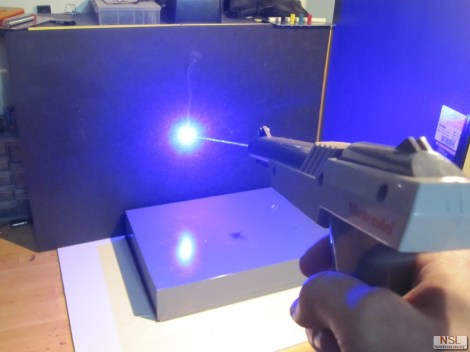
The Nintendo Light Gun makes a perfect burning laser. Of course it’s been gutted to make this happen. Nonetheless, the retro look can’t be beat, and the gun form factor is just what you need in a laser weapon.

This will literally burn your eye out of your head, so [Justin] and his buddies over a North Street Labs are all wearing protective goggles designed for this laser’s wavelength. But they also built a safety into the zapper itself. At the beginning of the video clip (embedded after the break) you will see there’s a key lock mounted in the butt. This lock completes the circuit between the battery and driver board. The 2W output is achieved by a 445nm M140 diode. A lot went into the heat sink and mounting cylinder to make sure the diode doesn’t just burn up after a few seconds of use.

Continue reading “NES Light Gun Gets A Burning Laser Upgrade”

Turning A DS Into A Game Boy Advance

The venerable Game Boy is dead – and has been for a long time – after being replaced by the DS, DSi, DSi XL, and the 3DS. That doesn’t mean there’s nothing of value to the old Game Boy catalog; Pokemon Red/Blue is still as much fun as it was 15 years ago, and the game play of Advance Wars is still superb.

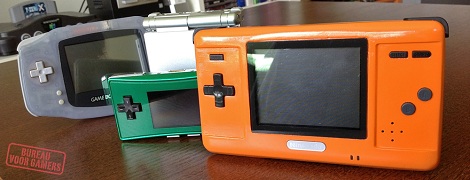
[Maarten] over at Bureau voor Gamers decided to put a modern twist on our old friend by taking a first-gen DS and converting it to a proper single screen Game Boy (Dutch, Google translation).

The donor machine was a broken first gen DS with a broken top screen. [Maarten] removed the top screen, did a tiny bit of Bondoing, moved the speaker, and gave his new toy a bright orange paint job.

Now [Maarten] has a modern version of the best portable system ever created, packed full of more powerful hardware and a much more capacious battery. Sure, it’s not a build that requires rewiring everything, but it’s still an awesome build for GBA aficionados.

N64 In An N64 Controller

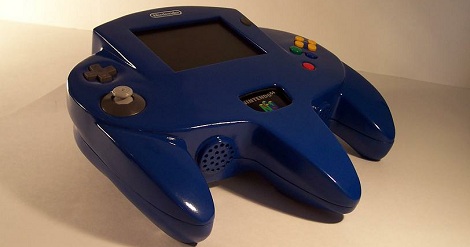
We’ve seen portable N64s before, but none were at the level of [Bungle]’s oversized N64 controller casemod.

Instead of the usual ‘sanding Bondo and gluing styrene’ method we’ve seen in other casemods, [Bungle] decided to make a silicone mold with a positive master. Not only did [Bungle] end up with a case indistinguishable from something produced in a factory, but the molding process left him with more internal room and the ability to make identical duplicates of his over sized controller.

The electronics are the standard fare – a slightly modified N64 with a PSone LCD screen. Because the rumble and memory packs are built in to the body of the gigantic controller, [Bungle] added a multifunction pak to provide ports for power, brightness controls, a/v, and a second controller.

This is an amazing build that really steps up the game for console modders. You can check out [Bungle]’s demo video after the break.

Continue reading “N64 In An N64 Controller”

SNES-001 Advance Puts Displays In The Controllers

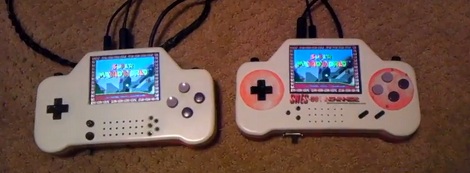
Twenty years ago, [Downing] would fight with his siblings over who got to watch TV. Obviously, this gave him the idea of putting a television inside his Super Nintendo controller, but at he tender age of 12, [Downing] had neither the experience nor skills to make that happen. Now that he’s older, and much less impressed by the Sega Nomad, [Downing] made his dream a reality.

Reading over [Downing]’s madebybacteria forum thread, he began the build by adding two controller ports and painting the system a classic Famicom red and white. The prominent feature of [Downing]’s design – a display in each controller – are connected to the console through a second pair of SNES controller ports. Internally, the video signal generated by the SNES is broken out to each controller; the controller displays are just a small mirrored version of whats sent to the TV.

Like [Downing]’s previous Genesis portable, the SNES-001 is a master work of Bondo and vacuum forming. After the break you can see a few demos of what this console mod can do.

Continue reading “SNES-001 Advance Puts Displays In The Controllers”

The WiiKart, A Wireless Go Kart

Whoops… Looks like we covered this already. My mistake.

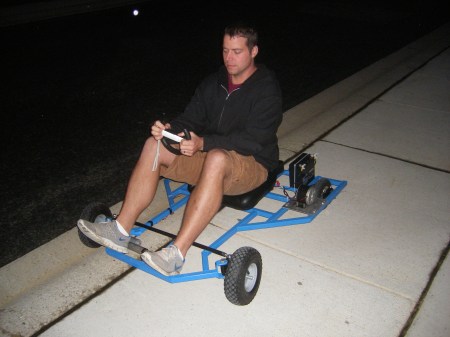
In case the name didn’t tip you off, this fun little kart was inspired by MarioKart. The goal was to build a functional go kart that could be controlled via the Nintendo Wiimote. They did a pretty good job and kept it fairly simple too. They designed a frame that vaguely mimics the shape of the carts in the game. The steering is handled by a 4″ stroke linear actuator. This was initially hooked directly to the tie-rod, but they found it to be too slow. Their solution was to put a lever in between the two with a 1to 3 ratio. This made everything much snappier.

Though they were capable of implementing PWM on the motors in their hardware, they opted to stick with full on, full off because of the push-button nature of the controller. The connection and communication are handled with an Arduino and they don’t mention what bluetooth module they use.

You can see in the video below it is fairly responsive and has more than enough power to lug a passenger over some varied terrain.

Continue reading “The WiiKart, A Wireless Go Kart”