A Light-Following Pong Game

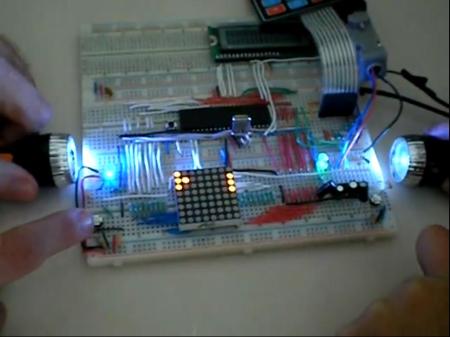
Although not everyone has the ability to make a hacked Pong game Like [Marcelo], even fewer have the ability or the creativity to come up with the elaborate hack that he did. The basic premise of his game is a version of pong played on a breadboard with a 8×8 matrix of LEDs. The controls are really what sets this hack apart. Instead of using a paddle controller or normal switches, small flashlights are used to control the on-screen (on-LED matrix) paddle. This is accomplished using a series of photoresistors and a PIC processor.

Innovative as this would be by itself, [Marcelo] decided to make a program in Flash to display the action on a computer.  Communication is done serially, and C# is used to translate everything as Flash doesn’t natively work with a serial connection.

Another innovation is that there are two LEDs connected on either side powered via pulse width modulation. The lights get dimmer as one player is about to lose. Check out [Marcelo’s] pong game after the break!

Continue reading “A Light-Following Pong Game”

Super Pixel Bros Now With Manufactured PCB And Rewritten Software

[Retro Brad] has come a long way with his 8×8 gaming device which he calls Super Pixel Bros. The newest rendition has a fab house PCB and freshly rewritten code. The game is still played on an 8×8 LED matrix, but it looks like he’s sourced a version with square pixels, which is a nice touch since he was inspired by the block-based Super Mario games. Also new in this version is the character LCD screen which displays score, level, and life information. But it’s not just the shiny new hardware that’s different, he’s rewritten the software in Swordfish Basic to run on the PIC 18F4550. The new code allowed him to tweak how levels are loaded and stored. He’s even written a level editor and has finished 20 levels thus far.

The demo after the break does a great job of showing off the hardware and the game play. He’s added a lot, including enemies, the ability to shoot fire, and of course the common moves of jumping and breaking blocks is all there. He mentioned that the fab house he used is selling boards for around $5 and he’s looking into the possibility of getting a kit service up and running.

His progress since we last checked in on the project is quite impressive.

Continue reading “Super Pixel Bros Now With Manufactured PCB And Rewritten Software”

Laser Trip Wire In An Easy-to-use Form Factor

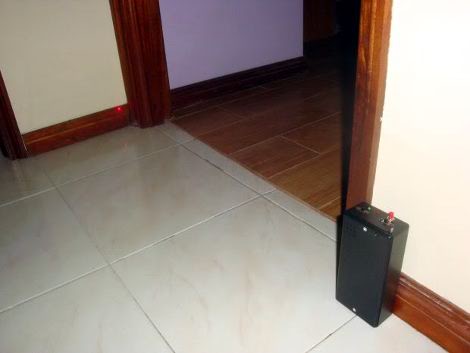
[Rul] built a nice laser trip wire alarm for use in Airsoft matches. Just place the enclosure so that the beam crosses a doorway and it will sound an alarm when the beam is broken. The only problem with this setup is that you need a reflective surface on the opposite side that can be positioned to direct the beam of light back to a photoresistor. But wait, there’s a second option. [Rul] also added a leaf switch that can be connected to an actual trip wire instead of using the laser.

A PIC 16F688 controls the laser module and monitors the photoresistor and leaf switch. When power is first switched on the box goes into a setup mode where it waits until the laser is detected by the photoresistor, switching on an LED to signal that you’ve got the beam aimed correctly. One press of the push-button puts it in activate mode which will sound the hacked window-alarm inside when the beam is broken. A toggle switch lets the operator chose between laser or wire operation.

You certainly won’t miss the alarm when it’s set off. Watch it scare the life out of a poor house cat in the clip after the break.

Continue reading “Laser Trip Wire In An Easy-to-use Form Factor”

Spinning UV Light Writer

uv_light_writer_ring

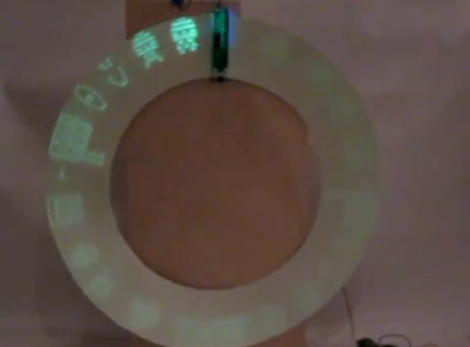
[David] has always wanted use UV LEDs to write on a phosphorescent surface ever since saw an article about it on Make. He accidentally purchased UV LEDs when he meant to buy purple ones, so he figured that his mistake was all the reason he needed to give UV light writing a try.

He built a PIC16F628 UV POV board using the LEDs, and while manually swiping the writer across various glow in the dark surfaces was cool, he wanted to keep the POV board stationary, moving the writing medium instead. He bought some phosphorescent vinyl, but found that it wasn’t too flexible, meaning he could not use a conveyor belt approach for his display. One day it dawned on him that a vinyl ring might work pretty well, and using a motor from an old cassette player, he constructed the UV writer you see above.

It seems to work pretty well despite a small flaw in the UV ring, and while [David] is happy with the results, he already has plenty of ideas in mind for the second revision.

Check out the video of his UV light ring in action after the jump.

[Thanks, Riley]

Continue reading “Spinning UV Light Writer”

PIC-based Voice Recorder

[Vinod] just finished building a voice recorder and it turned out even better than he thought it would. The video after the break shows him recording what is surely one of your favorite songs from his cellphone and then playing it back. The audio quality does sound quite good for a project with very few components.

A PIC 16F877A makes up the majority of the build. Its ADC is used to capture the incoming line from an amplified microphone input (you’ll find that amp schematic half way through his post). He’s storing the data on an MMC card, which was a bit of a hack since the PIC has limited RAM to manage that overhead. The stored data is in a raw format, as the card is not accessed using a file system. This makes it easy to record at a high bit rate, leading to better audio quality. Playback consists of connecting a speaker via a low-pass filter and amplifier circuit to the hardware PWM output on the PIC.

Continue reading “PIC-based Voice Recorder”

Addressing Microchip’s Open Source Problem

microchip_call_for_open_source

Hackaday alum and owner of Dangerous Prototypes [Ian Lesnet] recently wrote an editorial piece calling out Microchip on some of their less than friendly attitudes towards open source.

[Ian] and his company use PIC microcontrollers extensively in their projects, and they have quite a high opinion of their products overall. The gripe that he has (and thinks you should have too) is regarding Microchip’s approach to open source.

You see, Microchip invested in the Arduino IDE and released the chipKIT, a 32-bit Arduino compatible development board, along with big promises of “playing nice” with the open source community. The problem, according to [Ian], is that while Microchip’s compilers are based on GCC, they “keep some special sauce locked up”, which means that certain parts of the chipKIT toolchain are not open. Many in the community, including [Ian] had high hopes for the chipKIT based on the successes seen by Atmel’s open source initiatives, but many things are still locked up behind closed licenses.

An example of this unfriendly attitude towards open source can be seen in Digilent’s recently released network shield. It supports Ethernet and USB features of the chipKIT MEGA, but the TCP/IP and USB stacks are completely closed source. Digilent pushed hard to get the ability to release open drivers for the board, but it was a battle they ultimately lost. This behavior creates roadblocks for seasoned developers of open source products such as Dangerous Prototypes, as well as the curious beginner, which is why [Ian] is making a point in bringing these issues to light.

[Ian] urges Microchip to give something significant back to the community they are tapping, a result which can only be achieved by speaking up. Be sure to check out his editorial, and if after reading it you have any interest in letting your voice be heard, drop Microchip a line and let them know that their one-way relationship with the open source community is something you would like see change.

Adding Wireless Controls To Vintage Stereo Equipment

marantz_wifi_remote_control

[Jean] was shopping around for a vintage stereo receiver, and happened upon a broken, but repairable Marantz 4240. After getting things back to working order, he thought it would be great if he could use his iPhone to remotely control the unit (PDF Writeup, Schematics and Code).

He scrounged around for parts, and after locating a PIC and a handful of parts from old copiers and printers, he got down to business. He etched some custom boards to house electronic bits, then strapped motors to the volume and source selection knobs. He also rigged up the push button power switch on the receiver, using a small servo and a bit of string.

Now, he can control everything using his iPhone, which communicates with the stereo over WiFi. While the power, volume knob, and input selector can be triggered remotely, he still has the ability to tweak any of these items manually if desired.

We think that this is a great way to add modern amenities to vintage electronics, without ruining the aesthetics of the components. Don’t take our word for it though, check out the video demonstrations [Jean] but together after the jump.

Continue reading “Adding Wireless Controls To Vintage Stereo Equipment”