Location Recorder And Mapper

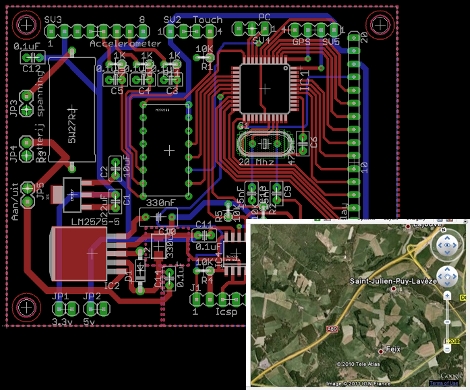
[Jeroen’s] student project is a module that uses GPS tracking to create travel data on Google maps. It’s not really a spy device as the data isn’t transmitted, but would be a lot of fun to use on cycling and hiking adventures. A PIC 18F2550 reads location and altitude data from a GPS receiver as well as data from an accelerometer. This information can be displayed on an attached touchscreen display and it is also saved to a pair of EEPROMs. When you get back from your trip, the data pulled from the device via a serial connection is processed by [Jeroen’s] C# application and used to overlay the route on a google map. He’s got a source code package available for download but we’ve saved you the trouble if the schematic is all you’re after. It’s attached after the break.
Continue reading “Location Recorder And Mapper”

Digital Measuring Tape

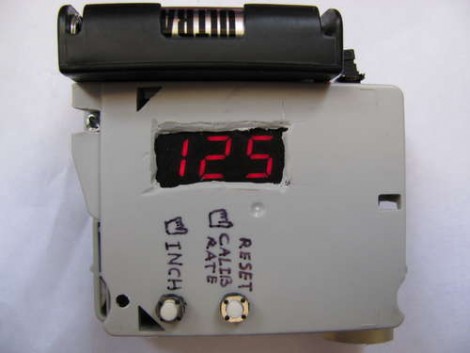
You’ll never come up short with this measuring tape. That’s because there isn’t actually any tape in the device; it measures distance based on the rotation of a wheel. Roll it across the room and you’ll get an accurate measurement of the distance the little bugger traveled. Like the Etch-a-Sketch from Monday this uses the encoder wheel from a mouse as the input. The IR emitter and sensor from the ubiquitous peripheral find a new home on the PCB that hosts the PIC 16F819. It monitors the rotation, turns it into inches, then spits that number out on a 7 segment display. Handy, and cheap!

Water-dosing Coffee Maker Augmentation

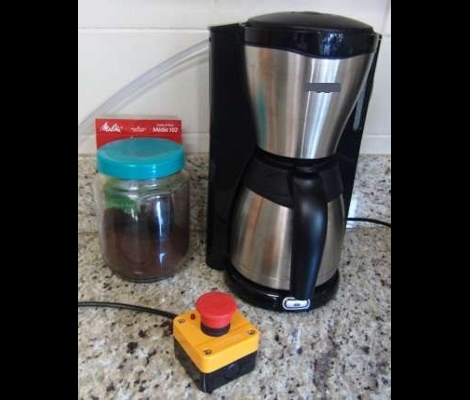
[Arthur Benemann] has the worst part of making coffee licked. His add-on for a drip coffee maker fills the water to the proper levels for you, saving the drudgery of rinsing out the carafe, carefully filling it to the appropriate level, then pouring it into the machine without getting everything wet. This isn’t limited to a full pot, but is user selectable by the cup based on how many times in a row you hit that red button. One LED gives feedback on the selected mode, then the device uses a washing machine water valve to turn on the tap for the appropriate amount of time. We’re a little bit leery of connecting homebrew hardware to the water pipes in our house. Make sure you’ve done a good job of debugging so that an infinite loop doesn’t flood you out.

Out Engineering A Sneaky Cat

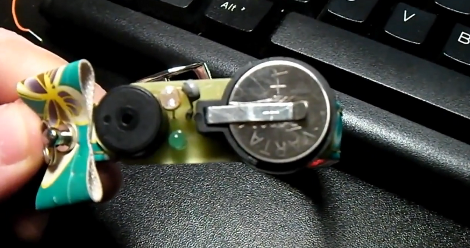
Cats do what they want, which rarely coincides with what their owner wants them to do. In [Dumitru]’s case, his girlfriend’s cat [Pufu] tended to make it outside into the cold more often than desired. Rather than settle with the normal bell which gets obnoxious even when the cat isn’t misbehaving, he decided to put together a custom Cat Finding collar. He used a PIC microcontroller as the brains, and temperature and light sensors to decide whether the cat had snuck into the cold, dark night. Once the cat has been marked as being outside, a buzzer and LED are set to go off at regular intervals until returned into the safety of the indoors.

[Dumitru]’s website along with his YouTube videos are in Romanian, though the schematics and source code provided speak for themselves. He does a wonderful job walking through the entire design process, including time spend in the IDE as well as EAGLE designing the board. YouTube has managed to subtitle the majority of the details, but we imagine this post will be a real treat to any Romanian speaking hobbyists out there. Be sure to catch both videos after the break.

Continue reading “Out Engineering A Sneaky Cat”

Simple Sensors To Calculate RPM

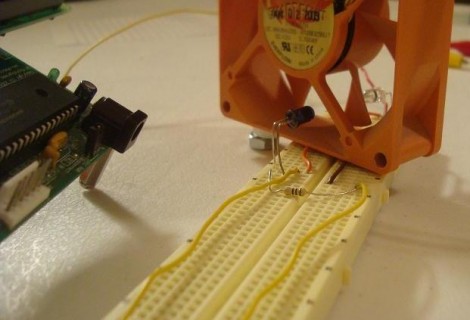
Ever wonder how to calculate revolutions per minute using a microcontroller? This project shows you how by purposing an IR emitter and detector and a computer fan. As the fan blades spin they disrupt the beam of infrared light between the emitter and the receiver. This results in a waveform on the receiver’s circuit which can be easily used to trigger interrupts in any microcontroller. In this case a PIC 18F452 monitors the detector’s signals for a rising edge. By measuring time data between interrupts the period can be established and RPM calculated. You can see a video of the test rig after the break.

So what can you use this for? It’s the method that most spinning POV displays use to stabilize the display. You won’t be limited to an IR sensor, but can use a hall effect sensor in the same basic fashion.

Continue reading “Simple Sensors To Calculate RPM”

Patching Into An Optical Mouse With A PIC

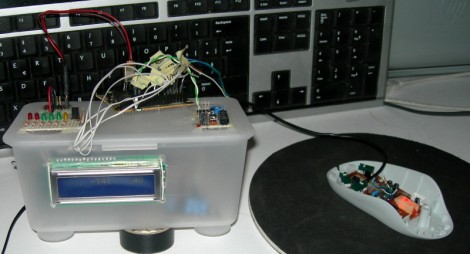
[MikyMouse] cracked open a couple different optical mice (or is it mouses?) in order to play with the data communications coming off of the chips inside. Once he figured out the protocol, it wasn’t too hard to grab the data for use in his own projects. The chip that controls the mouse is one of two he looked at, either an ADNS2051 or an ADNS2610. They run at 5V and use serial communications via SDIO and SCK pins. The clip after the break shows the test apparatus displaying coordinates of the mouse on an LCD screen. This seems like an easy and inexpensive way to get position data from your project. The only tricky part is going to be deciding when and how to to zero out the location.

Not interested in this type of mouse hack? Can we spark your curiosity with this mouse auto-fire project?

Continue reading “Patching Into An Optical Mouse With A PIC”

MCP2200 USB To Serial Chip Hacked To Do Your Bidding

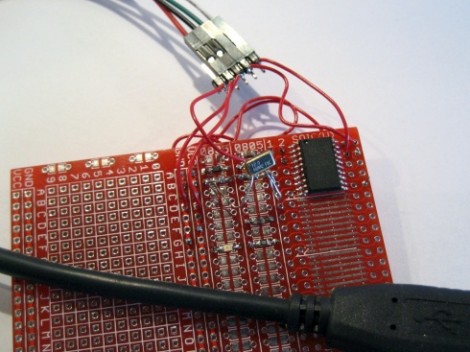
Mircrochip has a new USB to Serial converter available called the MCP2200. [Sjaak] suspected that it may have been made from an existing 20-pin PIC and found that reading the device signature with the PICKIT3 shows that the chip is an 18F14K50. Most likely this is running Microchip’s USB stack but it’s hard to tell because chip is code-protected, reading back all zeros. So he set out to write some replacement firmware which would provide the same functionality and give you access to the rest of the chip’s features.

There were some speed bumps along the way. The first one is that Microchip’s licensing for their USB stack won’t allow you to open source your firmware. That’s okay, it seems there is already a USB stack that can be ported which doesn’t have this restriction. The second wrinkle in the plan is that [Sjaak’s] code doesn’t come with a VID/PID pair that you can use like V-USB does for AVR chips. But that doesn’t diminish the accomplishment of getting the device to work by echoing back characters it receives. Full USB to serial support with the replacement firmware is on the way.

[Thanks Chris]