RGV Laser

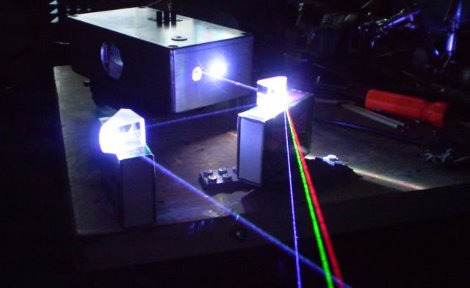
[Carl] sure has come a long way with laser modifications, now introducing his portable RGV Full Colour Laser. Although it feels just like yesterday when he showed us his green spiro and his Lego diffraction grating projector.

But enough of the past, the RGV laser is built using a White Fusion Mixing Kit and his own Full Colour Driver Extension. We couldn’t find any circuit diagrams or code to build your own at the moment, but it appears fairly straight forward and you can always take a look at [c4r0’s] Colour Laser.

Palm-sized Atari 2600

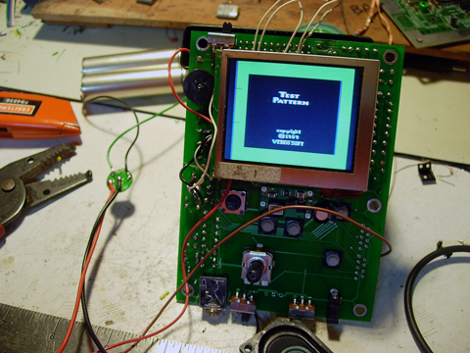
[The Longhorn Engineer] is working on a portable Atari 2600. Instead of taking the old gaming system and cramming it into a portable form factor he’s designed his own circuit board in a new-hardware initiative he calls Project Unity. The handheld will include everything you need to play, including video, audio, controller buttons, paddle control, and a cartridge connector. For the demonstration, embedded after the break, he’s using the Harmony Cartridge to store his Atari ROMs but do note that the system is designed to use cartridges rather than work solely as a game jukebox.

Continue reading “Palm-sized Atari 2600”

Gorgeous Portable N64 Built To Order

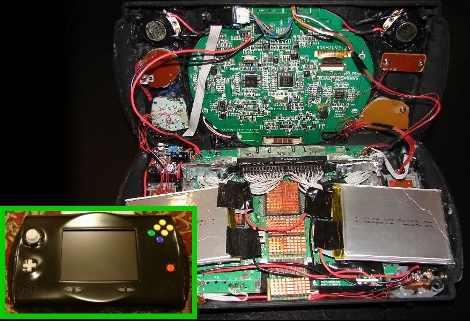
[Hailrazer] is at it again with a new portable N64 build. He’s done the impossible by improving upon his last design. The LCD screen is now mounted flush for a cleaner and smaller case. The controls draw from a lot of different sources; a gamecube stick for durability, a 3rd party N64 controller for buttons, and a PlayStation controller for the shoulder buttons that serve as L, R, and Z (either hand). There is a breakout box that allows two controllers to be plugged in. Combine this with the TV out feature and it acts as a console or a handheld. His in depth demonstration is embedded after the break.

The build log (linked above) details every part of the hack so that you can try to do this yourself. The relocation of the expansion slot requires patience and solid soldering skills. The case work is an art in itself. We speculate that this commission comes somewhere close to $1000 but it’s hard to put a price on quality craftsmanship. We’ve seen smaller, but these features and finished look can’t be beat.

Continue reading “Gorgeous Portable N64 Built To Order”

[techknott]’s Portable Dreamcast

[youtube=http://www.youtube.com/watch?v=FOZvlEOZaCg]

[Sydney] sent in this fantastic portable Dreamcast, built by [techknott], in response to the one we posted yesterday. While we agree, this one is much more polished, we want to point out why the post yesterday is more Hack A Day material. Sure, it looks more “hackish”, but that’s not what we are referring to. What we want to draw your attention to, is the lack of information. Yesterday, there was a build log. Today, there is not. Sure the other one could have had much much more information and we’re not commenting on which one is “better”. We’re just reminding you to please please please document your projects. Oh, and also, this thing is awesome.

DSO Nano Oscilloscope Reviewed

dsonano

We’ve been eyeing Seeed Studio’s DSO nano digital storage oscilloscope with a mix of intrigue and skepticism. A pocket-sized $89 storage ’scope? This is a joke, right? Hack a Day reader [Blair Thomson] has written a thorough review based on his experience with one of the beta test units, and it might be a winner after all.

[Blair] feels the unit compares favorably to buying a similarly-priced secondhand analog oscilloscope. The DSO nano wins major points for ease of use, a good range of functionality, and of course the whole portability thing (the enclosure is a repurposed portable media player). Can’t say we’re entirely convinced though. As a single-trace ’scope with 1 MHz bandwidth, the DSO nano may be extremely limiting for anything but basic hobbyist use…which, to be fair, is exactly how they’re marketing it. We can see a place for this the same way there’s a place for $10 multimeters — an inexpensive, toss-in-the-toolbag second ’scope to quickly test for vital signs, something that might complement but not replace a good bench unit.

$100 Portable Wikipedia

wr_hand1_small

OpenMoko, the company behind the FreeRunner open-source phone, released their latest product today: WikiReader. It’s a small mobile device for browsing Wikipedia. Rather than use a wireless network to pull data off of the web, it has local copy of the database on a 8GB microSD card. This approach has been used before, and it lets the WikiReader be compact and really cheap. It uses a Kindle-esque touch-screen display that allows it to run on 3 AAA’s for about a year. The device itself costs just $99, but you can choose to receive updates by snail mail for just $29/year. Alternatively, you can just download the +4GB file and dump it on the card.

Like the FreeRunner, this project is also open-source. The code isn’t available yet, but they say it will be released soon. With luck, the device will be really easy to hack.

Repurpose An Unused Portable CD Player

diy_wall_mounted_cd_player

[Ariel] liked the look of the Muji wall mounted CD player. He set out to build his own, posting a how-to that documents his project. The custom paperboard case contains a portable CD player, two portable speakers with amplifier, and a pull-string switch to turn it on and off. With mp3 players sending portable CD players the way of the dodo, and with the proliferation of powered mini-speakers this is a thrift-store build waiting to happen.

[via Boing Boing Gadgets]