
Making Mobile Audio Work At Home

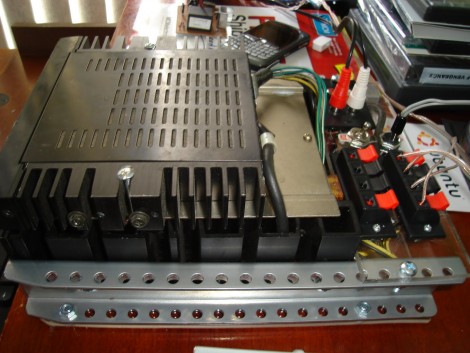
[Nikita] made a great find while cleaning out his garage: a set of audio amplifiers from a 1986 Volvo. After a bit of testing, he dislodged a stuck relay and set out to use these amps for a home audio system. He grabbed some left over brackets from his TV mount and used them as rail mounts. On the back he wired standard speaker connectors and RCA connectors to the wiring harness for the amplifiers. The final aspect is powering up the device, for which he used his ATX psu previously modified as a bench supply. 130-Watts of power for the cost of a few connectors.

We surprise to find we haven’t covered this common ATX bench-supply conversion before. What we have seen is an adapter to use one as a bench supply.
‘tiny’ Power Supply Monitor

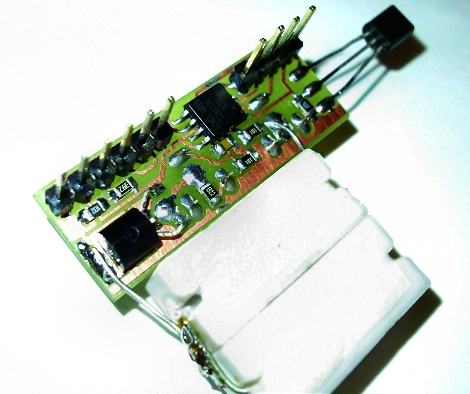
[Manekinen] built a power supply monitor based around an AVR ATtiny13. Voltage and amperage are displayed on a 16×2 LCD character display (we’re not sure what the third number is… samples per second?). This is no small feat considering that the tiny13 is an 8-pin chip. He makes it happen by using the pins for both LCD control and ADC input. To make this happen the HD44780 compliant display is used in 4-bit mode. Check out the video after the break and hit up the non-translated page if you want to download the source code and PCB artwork. A note of warning, he’s using the RESET pin for I/O which means once you burn the fuses you’ll need a programmer that has High Voltage Serial Programming capabilities if you want to reprogram the chip. Continue reading “‘tiny’ Power Supply Monitor”

Pre-spun Hard Drives

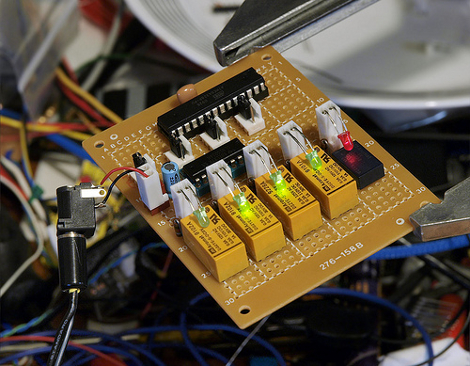
This device is lovingly called the SPINmaster. [Linux-works] built it to spin up multiple hard drives before the motherboard starts up. It detects the power-up from the PSU and uses a relay to hold the motherboard in reset, indicated by the red LED. Each of four relays then spins up a hard drive and illuminates the green LED when ready. Once all green lights come on the reset relay shuts off and the bios starts up. This type of staggered startup takes a lot of the load off of an under-powered PSU. He’s posted firmware and there’s a schematic available too. We took a look at his video but there’s not much to see as it’s just the inside of the machine while it boots up.

Dual Voltage Power Supply

dual_regualted_power

[Melanie] had some time this weekend so she whipped up a dual voltage power supply from parts on hand. This design plugs right into a breadboard and, unlike the last breadboard power supply we saw, provides two voltages at one time. 5v is delivered to one power bus while 3.3v goes to the other. Her design uses two linear low voltage drop regulators from the LF00 family (PDF datasheet) to accomplish this. Nice work!

Tube Amplifier In A PSU

tube_amp_in_psu

[Niclas] sent us his home made tube amplifier. For the case he used a computer power supply unit, took out the guts and replaced them with the amplifier board. He based this build off of an existing design but took a more minimalist approach. The wooden face plate has an on/off switch, an audio jack, and volume control. Apparently, the tubes are floating loose inside of the case. We’d recommend a more secure mounting method for these delicate parts.

Regulated Breadboard PSU

sparkfun_bbpsu

SparkFun has released a breadboard power suppy that can provide regulated 3.3v or 5v. Unlike the supply we saw from adafruit industries earlier this summer, this one is based on an lm317. This small device features on/off switch, voltage selection swith, and appropriately spaced pin headers to plug into both the top and bottom rails of a standard breadboard.  Rather build it yourself? Take a look at the schematic provided (PDF).

Bench Power Supply Adapter

psu_adapter

Every electronics workbench could benefit from having a bench power supply. Converting a PC power supply works, but often, it involves splicing wires and limits the supply to only bench use, and building one from scratch is definitely an undertaking. To counter this, [silic0re] and his father came up with a detachable adapter that simply plugs into the existing connectors. The adapter provides posts for four different voltages and can be built in no time. It’s nice to see a solution that will let you use any power supply laying around without having to worry about the dangers of opening it or cutting it up.

[Thanks silic0re]









