Hackday Links: March 16, 2012

Shamrock hat

[Josh] whipped up a shamrock themed hat by adding an outline of green LEDs to this bowler. Just remember, don’t drink and solder. Happy St. Patrick’s Day everyone!

Battery-powered Xmas lights can be more useful

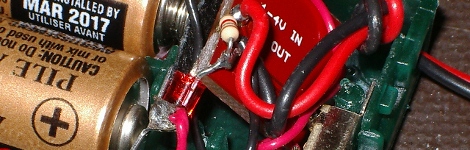
[Karl] took a string of mostly useless battery-powered Christmas lights and found a good use for them. He replaced the stock board with a boost convert and uses the two AA batteries as a 5V power supply when mains power isn’t handy.

3D printed appliance repair

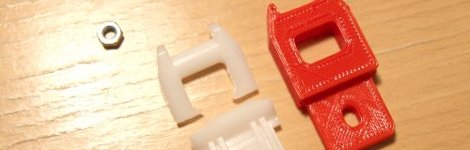
The broken plastic piece seen here keeps a dishwasher closed while running. The part couldn’t be sourced by a repairman but the best solution turned out to be printing a perfect replacement part.

Generating labels for resistor storage

[Darrell] picked up a surplus test-tube rack to use as resistor storage. It’s a great system, but his Ruby script that uses LaTeX to generate color-coded labels is a really nice touch as well.

DeLorean quadcopter build log

No, it’s not a dupe. [Alp_X] found the link to a build log for the DeLorean quadcopter that headlined our last Links post. It’s in Russian but the machine translation should help a bit.

[Vijay Kumar’s] TED Talk On The State Of Quadcopter Research

[Vijay Kumar] is a professor at the University of Pennsylvania and the director of the GRASP lab where research centering around autonomous quadcopters is being met with great success. If you were intrigued by the video demonstrations seen over the last few years, you won’t want to miss the TED talk [Dr. Kumar] recently gave on the program’s research. We touched on this the other week when we featured a swarm of the robots in a music video, but there’s a lot more to be learned about what this type of swarm coordination means moving forward.

We’re always wondering where this technology will go since all of the experiments we’ve seen depend on an array of high-speed cameras to give positional feedback to each bot in the swarm. The image above is a screenshot taken about twelve minutes into the TED talk video (embedded after the break). Here [Dr. Kumar] addresses the issue of moving beyond those cameras. The quadcopter shown on the projection screen is one possible solution. It carries a Kinect depth camera and laser rangefinder. This is a mapping robot that is designed to enter an unknown structure and create a 3D model of the environment.

The benefits of this information are obvious, but this raises one other possibility in our minds. Since the robots are designed to function as an autonomous swarm, could they all be outfitted with cameras, and make up the positional-feedback grid for one another? Let us know what you think about it in the comments section.

Continue reading “[Vijay Kumar’s] TED Talk On The State Of Quadcopter Research”

Human-shaped Planes Troll NYC


It looks like a genetic leap has unleashed the age of mutants, but this is really just a few guys trolling New York City with some custom RC aircrafts. The video after the break shows the fliers up close. They’re pretty much full size, we’d guess 5’10” from head to heel. The outstretched arms and body act as wings, while the legs act as ailerons and rudders. But from afar (or even a medium distance) it’s quite difficult to make out the flat surfaces… they look like office workers loosed from their cubicles. Unfortunately we don’t have more than a flight demo to share with you. If you know where to find build info (or any extra details at all actually) don’t forget to send in a tip We wonder if these are the same guy who made the flying hero we posted back in July?

There’s another nugget of delight right at the beginning of the video. A sweet octocopter which looks much like this one was used to capture the aerial footage.

Continue reading “Human-shaped Planes Troll NYC”

DIY Quadcopter For Around $200

We think [FlorianH] did a bang-up job of prototyping his Minima Quadcopter on the cheap. The total bill comes in right around $200 and we’re very happy with the quality of parts as well as the results.

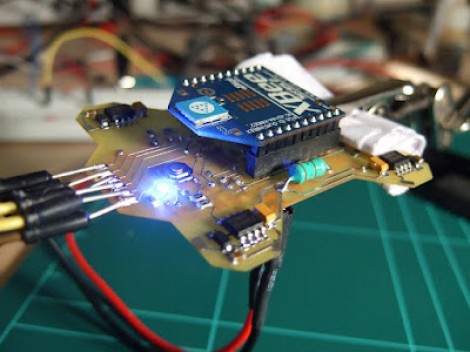
Here you can see the top of the double-sided board which he etched to host all of the components. At each corner there is a power MOSFET which drives the motor. At first glance we thought that the Xbee module was acting as the radio control and processer as well. But on the underside you’ll find an ATmega32 which is responsible for reading the Gyroscope sensor and Accelerometer, processing these signals and driving each MOSFET via PWM lines to provide stability.

You can see some flight tests after the break. [FlorianH] mentions that there is some oscillation in the feedback loop when both the gyro and accelerometer are used. But cut the accelerometer out of the equation and the platform is rock-solid.

This build uses carbon tubes to mount the motors, which we think will be a little more robust than the all-PCB designs are.

Continue reading “DIY Quadcopter For Around $200”

All PCB Quadcopter Makes The Most Of Each Component

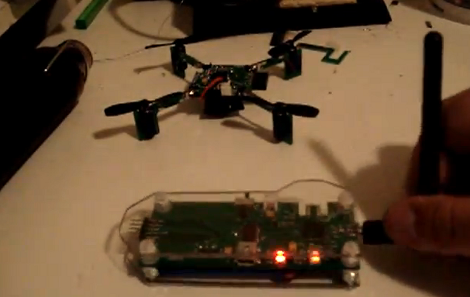
It’s difficult to contain our excitement for this tiny quadcopter project called the Picopter. [Frank] managed to pull together an impressive collection of features when developing the project. First off, the quadcopter itself uses all-PCB construction. Even the supports for the motors are PCBs with keyed slots to mate perpendicular to the main control board, then held firm with solder joints. We think this will be a more resilient option than this other all-PCB build.

The control board seen in the foreground has an edge connector which mates with a Wii classic controller connector. This is what you use for flight control. But there’s even more. The pinheader just visible on the left side of the controller mates with a socket on the ‘copter board. This allows you to sync the two so that there’s no radio frequency interference, and recharge the batteries from a USB connection. Speaking of those wireless communications, [Frank] chose to use an ATmega128RFA1. This is a newer microcontroller from Atmel that has a radio built into it. Add a gyroscope sensor and some motor control and you’re in business.

Don’t miss [Frank’s] video after the break when he explains all of the goodies found in his build. Continue reading “All PCB Quadcopter Makes The Most Of Each Component”

Quadcopter Build Ready For First Flight

[Abhimanyu Kumar] has been hard at work building and posting about his quadcopter. So far he’s published ten installments for this build, letting us relive the adventure vicariously. But it’s number 11 that we’re really excited about as he plans to share the first free-flight footage in that one.

The bug was planted in his brain after hearing that a quadcopter was used to shoot some of the footage in Spiderman 2. He wanted one to call his very own but the cost of a ready-made unit was out of his league. So he decided to build one instead. The first version uses aluminum bracket for the cross making up the motor mounts. He added LEDs to liven things up and even made a demo video of the thing tied to a table (no IMU yet so free flight would be fatal). After this stepping stone he decided to go with a Wii Motion Plus and Wii Nunchuck as the positioning feedback sensors. There is also a body redesign with helps lighten the load.

It’s a fun project, and we can’t wait to see where he goes from here!

Dog Pod Grid One Step Closer To Reality

What’s better than one amazingly acrobatic quadcopter? How about a swarm of acrobatic micro-quadcopters? It’s not a rhetorical question, but an experimental reality. A team at the University of Pennsylvania are showing off their latest round of hovering robots which can move in formation and alter their orientation as a swarm.

You may remember us salivating over the unbelievable stunts the team pulled off with a single ‘copter back in 2010. That device needed a sophisticated camera installation to give provide feedback, and this uses the same framework. But we don’t that detracts from the achievement; it’s simply a future hurdle for the project.

The video after the break shows some of the stunts the slew of whirring devices are capable of. Watching them move as a grid, and even landing simultaneously, we can’t help but think of the Dog Pod Grid from Neal Stephenson’s book The Diamond Age. It was used as a protection system, keeping unwanted flying intruders out. Doesn’t sound so far-fetched any more, does it?

Continue reading “Dog Pod Grid One Step Closer To Reality”