Ground Effect Aerodynamics On An RC Car

Ground effect aerodynamics will return to Formula 1 in a big way in the 2022 season, hopefully washing away the bad taste left in fan’s mouths after the recent controversial season decider. [Engineering After Hours] has experimented with F1 aerodynamics on RC cars before, and decided that it was time to try and implement a proper ground-effect design himself.

The aim of ground effect aerodynamics is to create a constriction for airflow between the bottom of the car and the ground underneath. This constriction accelerates the flow beneath the car, and as per Bernoulli’s principle, causes a corresponding pressure drop, sucking the car down onto the track. Viscosity also plays a role; from the car’s perspective, the road beneath the vehicle is moving backwards at some speed, pulling on the fluid thanks to the boundary layer on the ground itself. This further helps increase the strength of the effect.

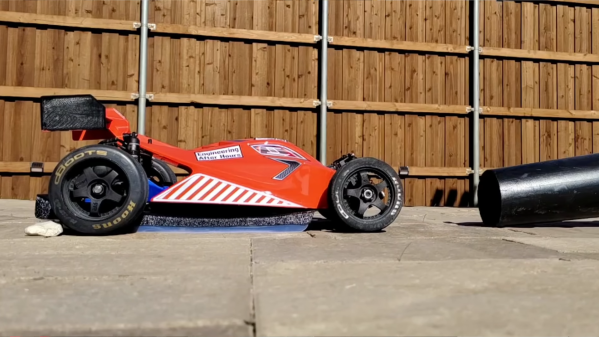
A vacuum-formed undertray complete with side skirts was installed on the RC car in order to generate ground effect downforce. A quick test with a leaf blower indicates the system works, and that the side skirts are a key component.

Lateral acceleration was significantly improved by around 20% in testing with the ground effects installed, though [Engineering After Hours] admits that without a wind tunnel, the results aren’t the most scientific. However, with the undertray being relatively lightweight, we suspect the aero elements are likely providing plenty of benefit without too much of a negative effect on acceleration or handling.

Check out some of the other aero experiments [Engineering After Hours] has undertaken, too. Video after the break. Continue reading “Ground Effect Aerodynamics On An RC Car”
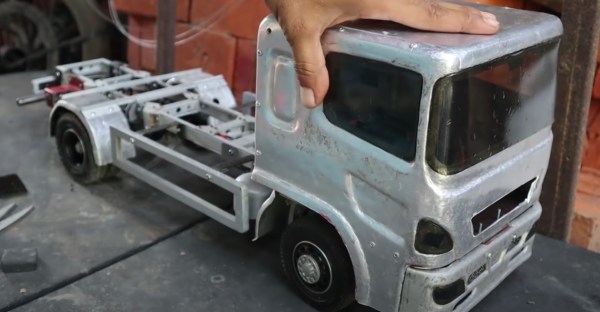

Building An Aluminum RC Truck From Scratch

These days you can get just about any kind of radio controlled vehicle as a ready-to-run model. Cars, trucks, excavators, you name it. Open the box, charge the batteries, and you’re ready to roll. Even with all these modern conveniences, there is still a special breed of modelers who create their own models using only a few off-the-shelf parts.

[Rini Anita] is exactly that rare breed, creating this aluminum RC truck from scratch. The truck itself is a cab-over — short for Cab Over Engine (COE), a style seen making local deliveries worldwide. He starts with the ladder frame chassis, which is constructed using an extruded aluminum channel. This is the same material you’d normally use for the door tracks in retail store display cases. The electronics and standard RC fare: a receiver, electronic speed control, and a servo for steering. Batteries are recycled lithium cells. The main gearbox and drive axle look to be sourced from another RC vehicle, while leaf springs and suspension components are all custom built.

The truck’s body is a great example hand forming metal. First, a wooden form was created. Sections for the windows and door panels were carved out. Sheet aluminum was then bent over the wood form. Carefully placed hammer blows bend the metal into the carved sections – leaving the imprints of doors, windows, and other panel lines.

Throughout this build, we’re amazed by [Rini]’s skills, and the fact that the entire job was done with basic tools. A grinder, an old drill press, and a rivet gun are the go-to tools; no welder or 3D printer to be found. This puts a project like this well within the means of just about any hacker — though it may take some time to hone your skills! For his next truck, maybe [Rini] can add a self driving option!

Continue reading “Building An Aluminum RC Truck From Scratch”

Fan Lets RC Car Drive On The Ceiling

Downforce is a major part of modern motorsport, keeping cars glued to the track at high speeds. However, for small radio control cars, adding a fan for a little suction can achieve even greater feats, as demonstrated by this build by [DD ElectroTech].

The build began as a simple two-motor, skid-steer RC car build with a fan for suction. Controlled by a smartphone app, a cheap Arduino board with an HC-05 Bluetooth module ran the show. However, when this was all assembled, the car was too heavy to climb walls or stick to the ceiling.

Thus, a weight-saving plan was in order. Wheels were swapped out for lighter 3D printed parts. The electronics saw significant re-engineering, too, with the multiple separate modules all condensed down into one single custom PCB. After a few other tweaks, the new lighter car was able to easily drive on the ceiling and even climb walls, albeit with some difficulty.

It’s a fun little build and a good demonstration of how easy it is to whip up cool projects with modern electronics and 3D printed parts. We’ve seen other printed fan car builds before, too, but did you know the concept was first trialed in real-world motorsport competition? Video after the break.

Continue reading “Fan Lets RC Car Drive On The Ceiling”

A Cold Gas Thruster On An RC Car

Tesla have boldly claimed that one day they’ll ship a Roadster complete with a cold-gas thruster for truly ridiculous acceleration. Whether or not that ever comes to pass remains to be seen, but [Engineering After Hours] decided to try out the technology on an RC car instead.

The thruster uses a pair of disposable CO2 canisters to deliver 1770 g of thrust via a converging-diverging nozzle. Actuated by servos and a simple valve, the system dumps the high-pressure CO2 to help accelerate the car up to speed. Paired with sticky tires and a powerful brushless motor, the plan was to try and beat Tesla’s claimed 1.1 second 0-60mph acceleration figure for the thruster-boosted roadster.

Unfortunately, the high center of gravity of the RC car led to stability issues, largely due to the mounting of the thruster itself. Additionally, the high weight of the car – around 4.3kg – meant that at best, the thruster would only add 0.5g to the vehicle’s acceleration.

While the car didn’t net a quick 0-60 time, it’s still neat to see a cold gas thruster on an RC car. It may not have been a Tesla-beater like some earlier projects, but it was cool all the same. Video after the break.

Continue reading “A Cold Gas Thruster On An RC Car”

RC Car Gets Fan-Assisted Downforce To Slay Tesla’s 0-60 Times

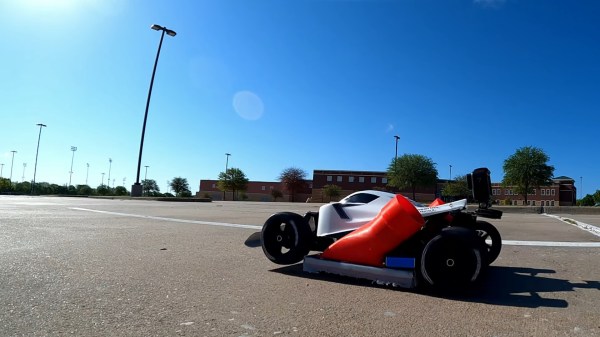
Tesla have claimed that their upcoming new Roadster will post a sub-2 second 0-60mph time. While it’s backed up by little more than a shiny website at this stage, [Engineering After Hours] took the number as a target to beat with his RC fan car build. (Video, embedded below.)

We’ve seen an earlier prototype of this build before, with the first version generating enough downforce to successfully drive upside down. The new build has several modifications to maximise its lateral acceleration capabilities. The new build drives all four wheels, which are fitted with sticky tyres coated in traction compound for maximum grip. The main drive motor, along with the fan and skirt assemblies, are all mounted in the center of the car now to properly balance the aero loads across the axles and provide a stable weight distribution for fast launches.

The results are impressive, with the car posting a 0-60mph time of just 1.825 seconds. There’s likely still time left on the table, too, once the car can be tuned to launch harder off the line. We’d love to see a racing series of fan-equipped RC cars hit the track, too, given the amount of grip available with such hardware.

Continue reading “RC Car Gets Fan-Assisted Downforce To Slay Tesla’s 0-60 Times”

Modding A Hot Wheels Car Into A Radio Controlled Drift Weapon

Hot Wheels are some of the most popular diecast toy cars worldwide. The car bodies are faithful recreations of the real thing, though the models are mere stationary playthings. That wasn’t good enough for [Jakarta Diecast Project], who set about modifying a little BMW E30 M3 into an awesome radio-controlled drift car.

The build starts by disassembling the original car, and pulling out the original wheels. The baseplate is then modified to accept a new rear suspension and axle assembly. A small DC motor is mounted to the assembly to drive the rear wheels. A set of front steering knuckles are then installed up front, with their own suspension and hooked up to a tiny servo for steering. Everything’s controlled by a compact off-the-shelf RC receiver, which even features a gyro to help keep the tiny car straight under acceleration. The bodyshell is then stripped of paint, and given a sweet bodykit, before receiving a lurid orange paint job and decals. It’s reattached to the car’s baseplate via magnets, which make taking the car apart easy when service or modifications are required.

While the build doesn’t go into the nitty gritty on some of the harder parts, like the construction of the incredibly complex front knuckles, it’s nonetheless a great guide to building such a tiny and well-presented RC car. In looks and performance, the result trounces typical commercial offerings in the same scale, as you’d expect from such a hand-crafted masterpiece. It may not be the smallest RC car we’ve featured, but it is one of the coolest. Video after the break.

Continue reading “Modding A Hot Wheels Car Into A Radio Controlled Drift Weapon”

You’re Going To Flip Out Over This Rocket League RC Car

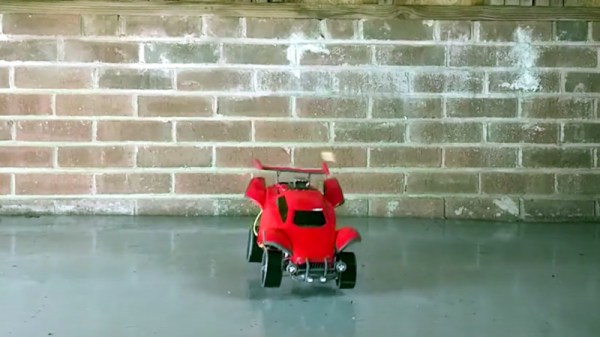
Rocket League is a video game famous for being wildly popular despite being virtually unplayable without several hours practice. It involves hyper fast cars playing soccer, complete with the ability to flip, jump, and rocket boost into the ball. [mrak_ripple] decided he wanted some of that action in a real RC car, and set to work.

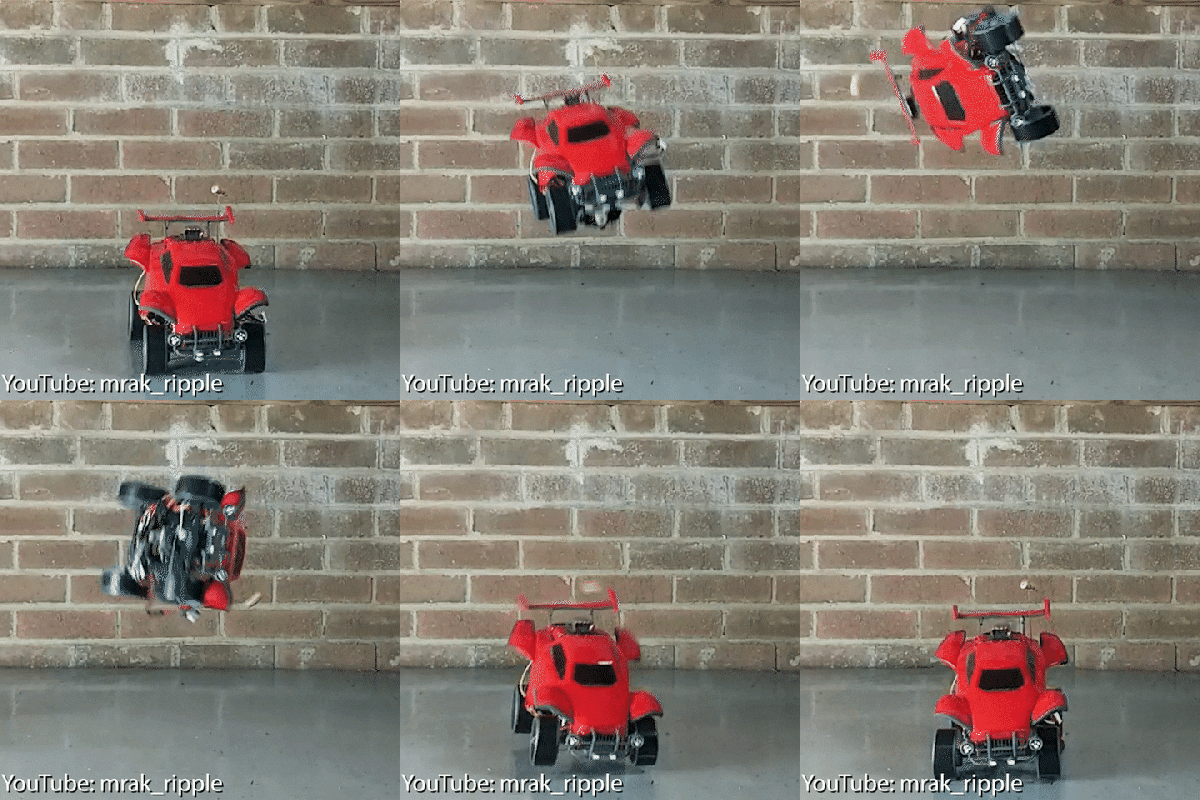
While rocket boosts were out of scope for this build, [mrak_ripple] was pretty confident he could build a jumping, flipping RC car modelled after the Rocket League Octane vehicle. Initial experiments involved a custom 3D printed spring mechanism, but the results were underwhelming. Instead, in the true hacker spirit, a jumping mechanism was taken from an existing toy, and installed in the car instead. This was combined with a mechanism built out of a brushless motor with a flywheel added to generate a flipping moment in mid-air.



The final result is impressive, with the car flipping relatively cleanly once refined and lightened from its original design. We’d love to see a two-axis build that can front- and back-flip as well. It’s a step up in complexity from the last build we saw from [mrak_ripple], the amusing mashed potato trebuchet. Video after the break.

Continue reading “You’re Going To Flip Out Over This Rocket League RC Car”