Hackaday Links: August 30, 2014

hackaday-links-chain

Adafruit did another Circuit Playground, this time concerning frequency. If you’re reading this, no, it’s probably not for you, which is great because it’s not meant to be. If you have some kids, though, it’s great. Not-muppet robots and oscilloscopes. Just great.

The Hack42 space in Arnhem, Neterhlands recently got an offer: clean out a basement filled with old computer equipment, and it’s yours. Everything in the haul had to fit through an 80cm square door, and there are some very heavy, very rare pieces of equipment here. It’ll be a great (and massive) addition to their museum. There’s a few pics from the cleanout here and here.

[Mike] has been working on a project to convert gerber files into SVGs and it’s great.

[Carl] did a roundup of all the currently available software defined radios available. It’s more than just the RTL-SDR, HackRF, and BladeRF, and there’s also a list of modifications and ones targeted explicitly to the ham crowd.

This is a Facebook video, but it is pretty cool. It’s a DIY well pump made in Mexico. A few rubber disks made out of an old inner tube, a bit of PVC pipe, and a string is all you need to bring water to ground level.

What can you do with a cellphone equipped with a thermal imaging camera? Steal PIN codes, of course. Cue the rest of the blogosphere sensationalizing this to kingdom come. Oh, what’s that? Only Gizmodo took the bait?

About a year ago, we saw a pretty cool board made by [Derek] to listen in on the CAN bus in his Mazda 3. Now it’s a Kickstarter, and a pretty good one at that.

Your connectors will never be this cool. This is a teardown of a mind bogglingly expensive cable assembly, and this thing is amazing. Modular connectors, machined copper shields, machined plastic stress relief, and entire PCBs dedicated to two caps. Does anyone know what this mated to and what the list price was?
 

IPad Finds New Home In Mac Classic

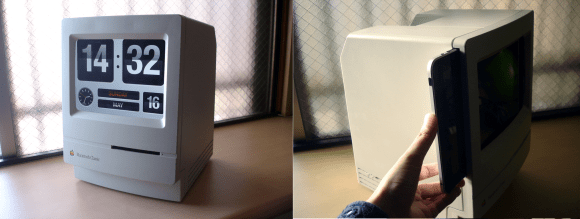
Who of us out there don’t have a spare iPad and Mac Classic kicking around? If you are one of those lucky folks then this project is for you. [site hirac] has made a pretty neat stand for an iPad made out of a Mac Classic case (translated). It just happens that the screens of the Mac Classic and iPad are pretty darn close in size. Although the screen size is similar, the resolution is not. The original Macintosh Classic had a black and white screen with a resolution of 512 × 342 pixels. The iPad’s resolution of 1024 x 768 pixels has 450% more pixels than the original Mac.

To get the iPad to fit correctly, the case had to be significantly modified. First, all of the internals of the Mac were removed, leaving just an empty case. The front panel of the case was removed and a slot on the left side is made. This slot helps to allow the iPad to slide into the Mac. On the inside of the front panel quite a few of injection molded supports were trimmed away for clearance. A slot was also cut in the left side of the rear case half. When the case is re-assembled, the slots in the front and rear halves provide a large enough hole for the iPad to fit through. Oddly, there are some plastic features on the front panel that are at just the right height to hold the iPad in the ideal location to line up with the screen cutout in the case.

Continue reading “IPad Finds New Home In Mac Classic”

The Entire Commodore 64 Library In Your Pocket

[sweetlilmre] is just beginning his adventures in retrocomputing, and after realizing there were places besides eBay to buy old computers, quickly snagged a few of the Amigas he lusted after in his youth. One of the machines that didn’t make it into his collection until recently was a Commodore 64 with Datasette and 1541 drive. With no tapes and a 1541 disk drive that required significant restoration, he looked at other devices to load programs onto his C64.

These devices, clever cartridge implementations of SD cards and Flash memory, cost more than anyone should spend on a C64. Realizing there’s still a cassette port on the C64, [sweetlilmre] created Tapuino, the $20 Commodore tape emulator

The hardware used to load games through the Datasette connector included an Arduino Nano, a microSD breakout board, a 16×2 LCD, some resistors, buttons, and a little bit of wire. The firmware part of the build – available here on the Git – reads the .TAP files off the SD card and loads them into the C64.

[sweetlilmre] posted a very complete build post of the entire device constructed on a piece of protoboard, Pop that thing in a 3D printed case, and he can have the entire C64 library in his pocket.

MARCH Attends HOPE X In July

hopex_web_topbar_b

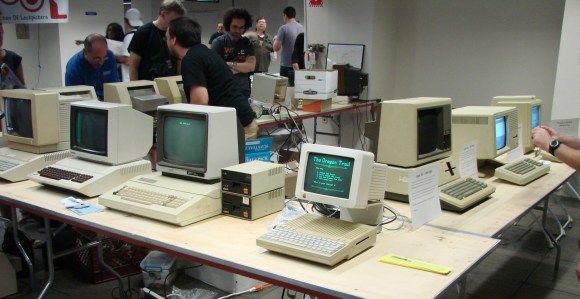
The Mid-Atlantic Retro Computing Hobbyist (MARCH) group is at HOPE X displaying a chronology of Apple computers, everything from an accurate Apple 1 reproduction all the way way up to an Apple Macintosh, and of course including all the II’s in between. Although they are only displaying Apples at this event, don’t confuse them for an Apple group. They love all types of vintage computers from the 1940’s to the 80’s.

[Evan], president of the group, elegantly explained why they are here; “to let people know that vintage computing is a thing and there are people in the area that do that thing”. He would like to encourage everyone who is mildly interested in retro computing to contact their local retro computer group and get involved in the community.

The group also puts on a yearly Vintage Computer Festival in New Jersey. This year’s event has already passed but you can still see what happened as Hackaday was there documenting all the cool stuff.

Mid Atlantic Retro Computing Group

VCF East Wrapup MegaPost

VCF East, the fabulous retrocomputing festival held in Wall, NJ this last weekend was a blast. We had a great time, dropped t-shirts and stickers to just about anyone who wanted one, took a lot of pictures, and shot a lot of video. Now that it’s over it’s time for the post-mortem, with one insanely long post.

We saw some very cool stuff that merited its own post, and much more that we simply didn’t have time to video. The previous posts from VCF East:

There’s still tons more, including a tour of the retrocomputer museum that hosted VCF East. The biggest talk was from [Dave Haynie], lord of the Amiga giving part three of a multi-year talk on the soap opera that was Commodore International.

Click that ‘Read more…’ to see all this.

Continue reading “VCF East Wrapup MegaPost”

Putting A Mac Plus On The Internet

plus

[Jeff] has a Mac Plus, an 8 MHz computer with 4 MB of RAM and a 512×342 1-bit screen. It was his first ‘real’ computer, and like those guys that take Model A Fords out for a Sunday drive, [Jeff] decided to put this old box on the Internet.

A Plus has a few options to get on the Internet. The best, but most expensive, is a SCSI to Ethernet computer. For a somewhat slower connections, a PowerPC mac can be used as an Ethernet to Localtalk (the Macintosh serial port networking protocol) bridge. Lacking either of those pieces of hardware, [Jeff] decided to use a Raspberry Pi. The Pi does the heavy lifting, and a handful of serial adapters and voltage converters turns the Pi into something that can talk to the Plus’ serial port.

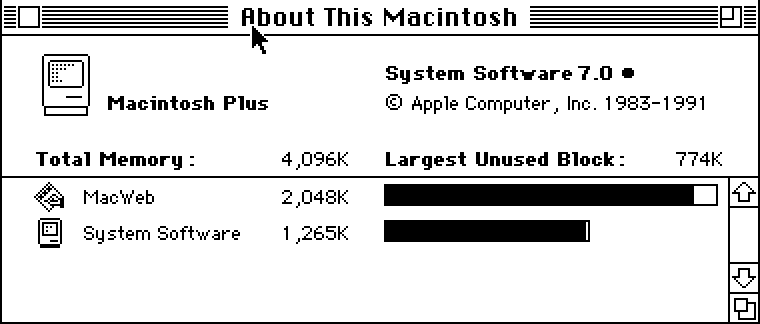
Even with the MacTCP stack and the MacWeb browser, there are still some things this ancient computer couldn’t do. HTTPS hadn’t been invented until 1994, cookies are just a pain, and CSS is right out. This means modern websites (except, of course, the Hackaday retro edition) simply won’t render properly. To fix this issue, [Jeff]’s friend [Tyler] came up with a Python script using Requests, Beautiful Soup, and Flask to strip out all the Web 2.0 cruft, handle the cookies, and to get rid of SSL.

The end result is a Mac Plus with 4 Megabytes of RAM on the Internet, able to pull up Wikipedia and Hacker News. It isn’t fast by any means – in the video below, it takes about five minutes to pull up the front page of Hacker News – but it is a 27-year-old computer on the Internet.

Continue reading “Putting A Mac Plus On The Internet”

An Overkill Network Adapter For Retrocomputers

amiga

If you want to get an old Apple, Commodore 64, Amiga, or any other retrocomputer up on the Internet, this is for you. [Stian] had an Amiga 500 lying around and wanted to put it on a network. The A500 isn’t expandable, so he needed to look at some sort of adapter to put it on a network. The solution came to him in the form of a Raspberry Pi, a null modem cable, and a few bits of software.

To connect his Amiga to his network, [Stian] made a small serial converter board for his Raspi that breaks out the Tx and Rx pins on the Pi to a 9-pin serial port. With the physical connection to the Pi made, the only thing left to do was to get some software for the Amiga, namely AmiTCP and PPP. It’s not exactly a fast network connection, but this build allows [Stian] to connect to WiFi networks with ancient hardware.

One interesting aspect of [Stian]’s build is the fact it’s completely transferable to other retrocomputers – everything from old S-100 bus computers to classic macs, apples, and pretty much anything else with a serial port that supports PPP. Even with the expense of a Raspberry Pi, it’s much cheaper than absurdly expensive second-hand SCSI to Ethernet controllers and other tomfoolery.