Reverse Engineering Radio Controlled Outlets

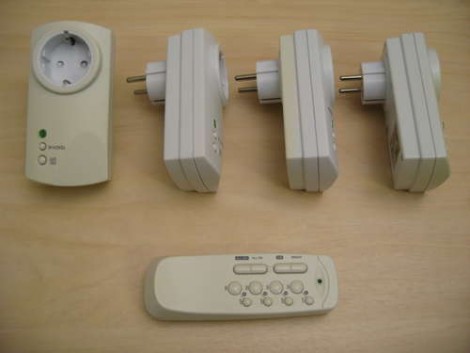
[Chr] picked up a pack of remote control outlets in order to reverse engineer them and build control into his own projects. These can be plugged into outlets around your house and a relay inside each module will switch whatever device is plugged into it after receiving a command from the remote. Once he cracked open the control housing it was easy to find the data line for the RF module which was on its own board. He used a logic analyzer to capture data from various button presses and then spent some time deciphering the communication protocol. He used what he learned to roll the module and code into an interface box where an ATmega8 connects via USB and passes commands from a computer to the RF board. Now he’s added home automation via a computer quite inexpensively. After the break you can watch a clip of the outlets switched using a smartphone.

So why not just patch into the buttons on the remote? Well, this same project was attempted at our local hackerspace earlier this month and the buttons don’t just pull a pin to ground. They use tri-state logic and are arranged into a matrix that is a lot harder to mimic (if not impossible) with a microcontroller. Analyzing the communications going into the RF module is definitely the less labor-intensive of the two approaches.

Continue reading “Reverse Engineering Radio Controlled Outlets”

Creating Art From An Old Christmas Tree

So you manged to get a great deal on a fake tree during the after Christmas sales, but what should you do with your old one? If it was lighted with fiber optics you can reuse the strands to create your own star map. [Mr Trick] shows how to disassemble one of these trees, grouping the fibers by length. He built a wood frame, then covered it with a layer of cardboard and another of black fabric. From there the painstaking process of routing the fibers in a way to looks convincing starts.[Mr Trick’s] final product uses multiple LED light sources and even includes RF control.

Think this project is large and time-consuming? Check out the same idea built into a bedroom ceiling.

Designing An RF Transceiver

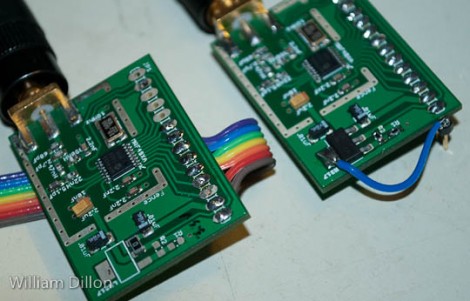
[William Dillon] is finishing up his degree. His final project as a student was to design an RF transceiver. He decided to work with the Microchip MRF49XA, which runs around $3 but will cost you $20 if you want it in a ready-to-use module. He didn’t find a lot of info on the Internet about communicating with these chips so he’s shared his design, code, and board files. If you’re ever wanted to delve into RF design this is a good primer. [William] talks about building around the example circuit from the datasheet but also includes a discussion of the calculations he made in working with the 434 MHz band, and an AVR-based library for using his module.

Home Automation Without Pulling Wires

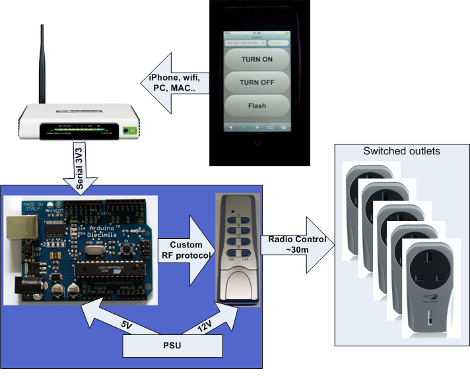
Here’s a bit of simple home automation using hacks with which we’re become pretty familiar. [Mrx23] combined OpenWRT, a microcontroller, and a set of RF controlled outlet switches to add automation to his plug-in devices. An RF remote that controls the switched outlets has been connected to an Arduino. The router communicates with the Arduino via a serial connection. And the router is controlled by a web interface which means you can use a smartphone or other web device to control the outlets.

The best thing about this system is the power that the router wields. Since it has an underlying Linux kernel you have the option of setting CRON jobs to turn lighting on and off, and group settings can be established to set up a room’s lighting level for watching movies, hosting guests, etc. Combine this with the fact that OpenWRT can use port forwarding for Internet control and the possibilities really start to open up.

[Thanks Arpad]

FM Bug Using Salvaged SMD Parts

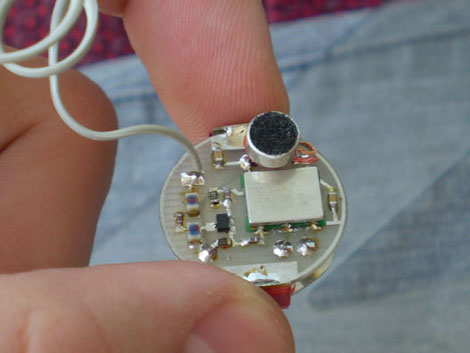
If you’re a soldering ninja this FM transmitter bug is for you. It’s quite similar to the one we looked at yesterday, but this uses 100% salvaged parts. Two phones donated components; a Nokia 3210 for its voltage-controlled oscillator and a Nokia 1611 for the rest of the parts. The bad news is that mobile technology like cellphones use some of the smallest surface mount packages known to man. That’s where the soldering skill come into play. The good news is that if you’ve been scavenging for discarded phones in order to reuse their LCD screens you already have these parts on hand.

[Thanks George]

Data Confirmation With RF Communications

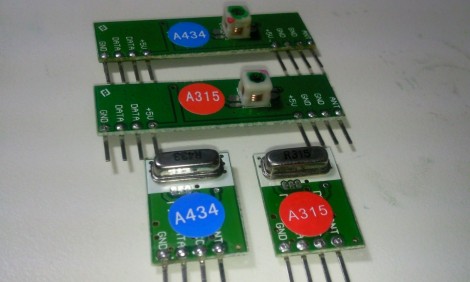
[Rafael] built a system that uses radio frequency for communications. The code he was using with the inexpensive receiver/transmitter pairs already had some error correction but from time to time an entire message would be missed by the receiver. He set out to make these RF communications more robust.

A little more than a year ago we looked at using these same transmitters with an Arduino. [Rafael] has a similar setup but since they are unidirectional he chose to use two pairs for bidirectional communication (each operating at a different frequency to avoid interference). On one end, a computer transmits data to the Arduino which is in a remote location. His confirmation protocol relies on a randomly generated message identifier. The computer will continually transmit the same message. The Arduino continually receives these messages, comparing them with the last successfully received message. If they match, it is considered a successful data transfer and the Arduino transmits a confirmation back to the computer which then starts transmitting the next message.

This isn’t an application-specific protocol. For demonstration purposes [Rafael] built a quick home automation setup that uses it to operate a house lamp.

Giving An IR Transmitter Some Strength

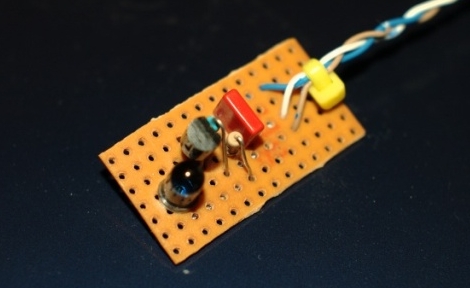
[Jkx] was using a Thomson VS360U video transmitter to make a wireless connection between a cable box and his television. The system using an RF remote, but relies on an IR transmitter to communicate between the base station and the cable box. He found the IR module that comes with the device is under-powered and set out to fix the situation. Using a scope he found the pin that drives the IR LED. The board above contains a boost circuit that patches into voltage and ground, using the pin he sniffed out to control the base of a transistor. Now the device has enough power to reliably control the cable box.