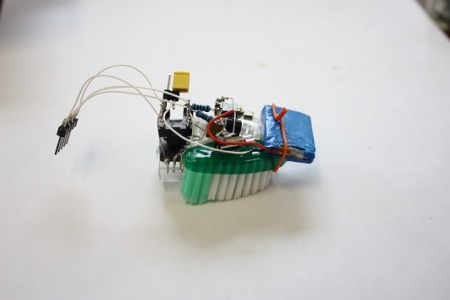
[sprite_tm], whose projects we have covered in the past, took the popular bristlebot to an extreme and created a controllable version. A bristlebot consists of a small vibrating motor mounted with a battery on the head of a toothbrush. These micro-robots buzz around randomly, and he attempted to tame them. He used a platform of twin bristlebots and added an optical sensor from a laser mouse and an ATtiny13. The optical sensor is used to determine the relative motion of the robot, so that the motors can be adjusted accordingly. He also has a video of the bot using the sensor to find a mark on the floor and stay within bounds. Although it isn’t as accurate, it acts like a traditional line-following robot.
robot1018 Articles
Folding Hexapod Bodies

At Berkeley, they’re coming up with new ways to make their itty bitty hexapods. These are basically tiny flatpacked bodies cut from cardboard. The end goal is to not only make them smaller and faster to build, but to reduce the friction in the joints. You can download the files on their site as well as download movies of them in action. For a larger and somewhat less complicated flatpacked robot, check out the flatpacked 2 motor walker.
[thanks Thuli]
Robotic Guitar Like Instrument
[youtube=http://www.youtube.com/watch?v=HxLTJmmyqn4]
This guitar bot is part of the Legue of Electronic Musical Urban Robots, or LEMUR. As you can see in the video, it has 4 strings, each mounted on it’s own unit. The pitch is controlled by a sliding bridge, while the strings are plucked by a series of picks mounted to motor. The sliding bridge is quite fast, being able to shift 2 whole octaves in a quarter of a second. The final effect is quite nice, we would listen even if we weren’t watching a robot work. This is the kind of thing we should expect to see at the Guthman Musical Instrument Competition.
[via Hacked Gadgets]
Plant Fasting: Robotic Gardening
[flickr video=3479713449]
This art display system was created by [Peter Sand]. It is called Plant Fasting and is comprised of a giant robot with interchangeable tools for various gardening tasks. Though the system is mostly automated, it can be controlled via a game pad. It has an Arduino as its brain and it looks like he’s done a completely custom setup for powering the interchangeable pieces.
Autonomous Tank Terrorizing Campus

As a senior design project for ECE4007, [Nate], [An], [Chris], and [Wink] built an autonomous toy tank. It is using a Panasonic IR motion sensor to find targets, then once it’s facing the target it switches to visual motion tracking through it’s web cam. If it can get close enough, it will stop and begin rotating the turret for more accuracy. Finally it fires a pellet. It’s brains are an ICOP technology eBox-2300 running windows CE. All of the programming is available on the site, as well as a breakdown of the various sensors and hardware. As you can see in the video after the break, it does a decent job. Given some more time, we’re sure they could speed up the target acquisition process. Maybe we should add a category for Georgia Tech final projects.
Fast Little Hexapods
[youtube=http://www.youtube.com/watch?v=GC4vWKenA7Y]
We’ve posted many many times about hexapods. One of the most common comments, aside from how creepy they are, is about their speed. Hexapods are generally pretty slow. These little bots are quite a bit different though. The Sprawl and iSprawl, are anything but slow. Using a hybrid leg mechanism that aims its piston like “toes”, they mimic the motion of cockroaches. The video shows the speed can be pretty quick, especially the iSprawl in the second half. The leg mechanism the Sprawl is air powered, while the iSprawl uses a push/pull cable transmission system. As pointed out at BotJunkie, it’s nice for the “i” in iSprawl to actually mean something. It stands for “independent”.
[via BotJunkie]
Microbot For The Robocup 2008
[youtube=http://www.youtube.com/watch?v=dMJJ2FJqsdI]
[tioguerra] helped make these tiny bots for the World Robocup 2008 in china. There’s tons of information on the Mixed Reality forum, but you might be specifically interested in the bot section. There are breakdowns of different aspects, such as charging and IR communication, as well as some great photographs of the unit along with a smaller one. The construction of the robot seems so nicely fit together, someone spent a lot of time getting the design just right. Since we don’t see a new section for 2009 bots, we are guessing that they’ll use this design again.