THP Semifinalist: Stubby, The Adorable Hexapod

After talking with a few of the judges for The Hackaday Prize, documentation will be a large factor in determining who wins and takes a trip to space, and who is left with their feet safely planted on the ground. Stubby the Hexapod is one of the most well documented projects in the running. There are already two hardware revisions for the walking mechanism, several board layouts for the controller, and more project log entries than you can shake a stick at.

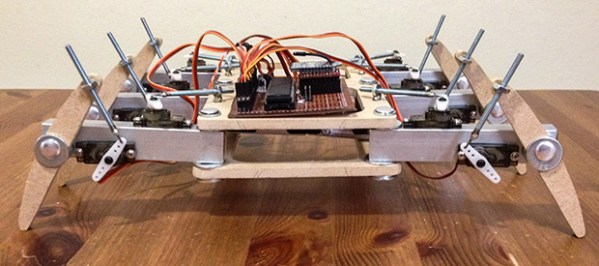
Stubby is the brainchild of [The Big One] (a.k.a. [Wyatt] with [Warren], [Princess Sparkle], and [exot] filling out the rest of the team). The project originally began as an educational robotics project meant for teaching [Wyatt]’s kids the ins and outs of robotics and electronics. He’s doing this by developing an open source hexapod robot platform, complete with a frame, electronics board, and a lot of interesting code driving 18 hobby servos.

The frame for Stubby’s first hardware revision is rather interesting; it’s able to be reproduced with nothing more than a scroll saw. The latest revision is a complete rethinking of hexapod locomotion using 2DOF legs and a more mechanical gait.

Being completely open source and very well documented, you can already make your own Stubby hexapod with a scroll saw and the files on [Wyatt]’s site. If 3D printing is more your thing, there’s also a few files to help you with that.

You can check out a few videos of the different Stubby revisions below:


SpaceWrencherThe project featured in this post is a semifinalist in The Hackaday Prize.

Continue reading “THP Semifinalist: Stubby, The Adorable Hexapod”
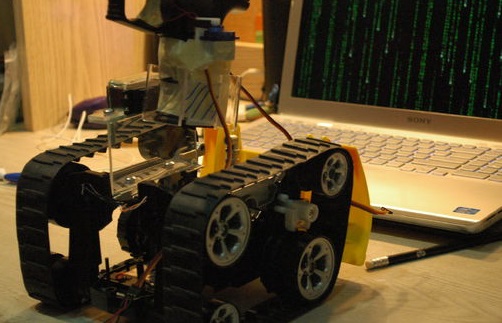
The Counter-Strike Airsoft Robot

F6R9THZHR4SR0HV.MEDIUM

[Jon] and his brother converted an RC car into a robot that can fire airsoft pellets into the air. The little motorized vehicle was disassembled and a handheld was attached to the top. A pulling mechanism was put in place and a safety procedure was added to make sure no accidents occurred.

The chassis stand was created to hold the handle. The setup was then tested at this point, and a Raspberry Pi server was configured to have a camera that would act as the eyes for the robot. Once everything was in place, the wheels hit the ground and the vehicle was able to move around, positioning itself to aim the servos at a designated target. Footage was transmitted via the web showing what the robot was looking at.

A video of the remote-controlled counter-strike robot can be seen after the break. You could consider this your toy army. That makes this one your toy air force.

Continue reading “The Counter-Strike Airsoft Robot”

Defcon Side Trip: Pololu And Robots

PololuDuring our trip out to Vegas for Defcon, we were lucky enough to catch up with a few of the companies that should be of interest to Hackaday readers. One of the companies based out of the area is Pololu, makers and purveyors of fine electronics and robots. In an incredible bit of lucky scheduling, LV Bots, the Las Vegas area robot builders club, was having an event the same weekend we were there. A maze challenge, no less, where builders would compete to build the best robot and write the best code to get a pile of motors and electronics through a line-following maze in the fastest amount of time.
The Bots

The LV Bots events are held in the same building as Pololu, and unsurprisingly there were quite a few Pololu employees making a go at taking the stuff they developed and getting it to run through a maze. At least one bot was based on the Zumo kit, and a few based on the 3pi platform. Interestingly, the Raspberry Pi Model B+ was the brains of quite a few robots; not extremely surprising, but evidence that the LV Bots people take their line-following mazes seriously and are constantly improving their builds.

Each robot and builder ‘team’ was given three runs. For each team, the first run is basically dedicated to mapping the entire maze. A carefully programmed algorithm tries to send the robot around the entire maze, storing all the intersections in memory. For the second and third runs, the bot should – ideally – make it to the end in a very short amount of time. This is the ideal situation and was only representative of one team for that weekend’s event.

Continue reading “Defcon Side Trip: Pololu And Robots”

THP Entry: A 6502 SBC Robot (On Multiple Boards)

SBC

Robots have always been a wonderful tool for learning electronics, but if you compare the robot kits from today against the robot kits from the 80s and early 90s, there’s a marked difference. There are fairly powerful microcontrollers in the new ones, and you program them in languages, and not straight machine code. Given this community’s propensity to say, ‘you could have just used a 555,’ this is obviously a problem.

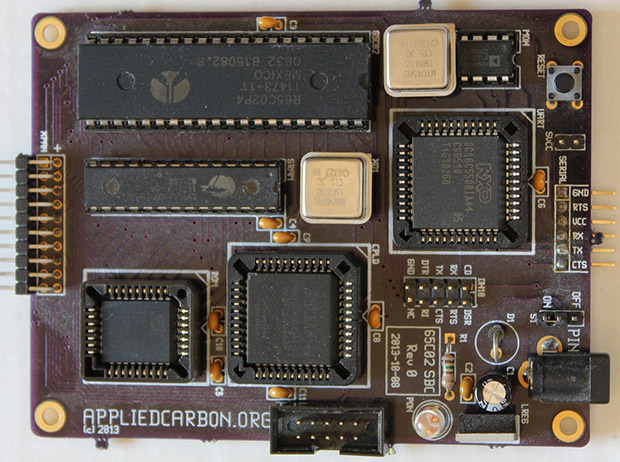
[Carbon]’s entry for The Hackaday Prize is a great retro callback to the Heathkit HERO and robotic arms you can now find tucked away on a shelf in the electronics lab of every major educational institution. It’s a 65C02 single board computer, designed with robotics in mind.

The 6502 board is just what you would expect; a CPU, RAM, ROM, CPLD glue, and a serial port. The second board down on the stack is rather interesting – it’s a dual channel servo board made entirely out of discrete logic. The final board in the stack is an 8-channel ADC meant for a Pololu reflective sensor, making this 6502 in a Boe-bot chassis a proper line-following robot, coded in 6502 assembly.

[Carbon]’s video of his bot below.


SpaceWrencherThe project featured in this post is an entry in The Hackaday Prize. Build something awesome and win a trip to space or hundreds of other prizes.

Continue reading “THP Entry: A 6502 SBC Robot (On Multiple Boards)”

Self-Assembling Origami Robots

orgami-robots-harvard

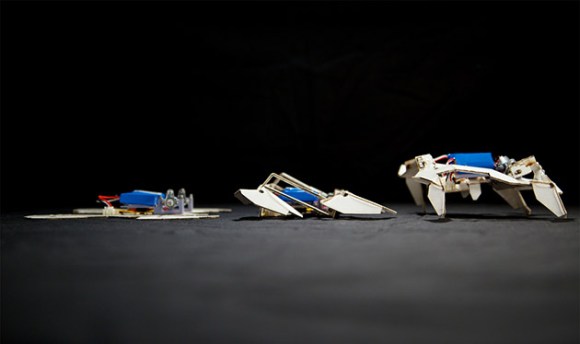
MIT engineers have developed a technique to address the challenges involved in manufacturing robots at a cheap and accessible level. Like a plant folding out its petals, a protein folding into shape, or an insect unveiling its wings, this autonomous origami design demonstrated the ability for a mechanical creature to assemble itself and walk away. The technique opens up the possibility of unleashing swarms of flat robots into hard to reach places. Once on site, the robots mobilize from the ground up.

The team behind the project used flexible print circuit boards made out of paper and polystyrene, which is a synthetic aromatic polymer typically found in the commercially sold children’s toy Shrinky Dinks™. Each hinge had embedded circuits that were mechanically programmed to fold at certain angles. Heat was applied to the composite structure triggering the folding process. After about four minutes, the hinges would cool allowing the polystyrene to harden. Some issues did arise though during the initial design phase due to the amount of electrical current running the robots, which was ten times that of a regular light bulb. This caused the original prototypes to burn up before the construction operation was completed.

In the long-term, Core Faculty Member [Robert] would like to have a facility that would provide everyday robotic assistance to anyone in the surrounding community. This place would be accessible to everyone in the neighborhood helping to solve whatever problems might arise, which sounds awfully like a hackerspace to us. Whether the person required a device to detect gas leaks or a porch sweeping robot, the facility would be there to aid the members living nearby.

A video of [Robert] and [Sam] describing the project comes up after the break:

Continue reading “Self-Assembling Origami Robots”

More Pole Climbing Bots, Haul Antennas And Bikes

Pole Climbing Robot

A few days ago we posted about a Pole Climbing Device. Since then we’ve gotten a few emails with tips about other pole climbers. We are going to talk about two of those here, they are completely different from each other and have completely different uses. Who knew there was such a variety of pole climber bots out there?

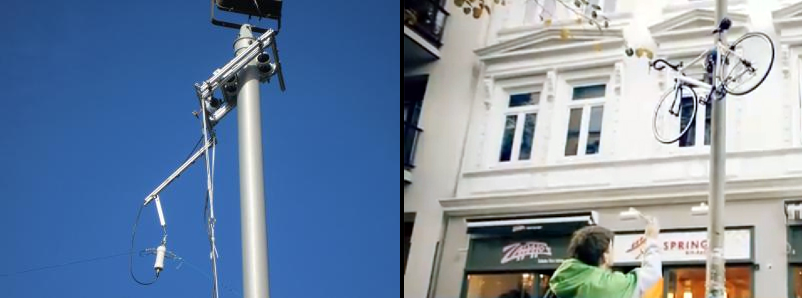
First up is this an antenna-wielding bot that climbs up poles in order to promote over the air communications. The system is called E-APS (Emergency Antenna Platform System) and is used by enthusiasts to turn any ol’ parking lot lamp post into an antenna tower. This particular machine has a large rectangular frame made from extruded aluminum. There are four wheels, two of which are driven by what appears to be a car power window motor. The weight of the antenna forces each set of two wheels to be pressed up against opposite sides of the pole, creating enough friction to not only support the unit but allow it to travel up and down the pole. There is not a lot of explanation about the build but there are a lot of detailed photos of the final product. We saw E-APS in action at MakerFaire New York 2013, and it was very impressive.

We’ve covered this next device before but it’s worth mentioning again. The project assumes that no bike lock is strong enough to deter the most persistent thief. Instead of locking your bike up and hoping for the best, this ‘theft preventer’ hikes your bike up out of the reach of would-be bike nabbers. So how do you get your bike down once it is up the pole? A remote control fob, of course.

There are 2 cool videos of these inventions after the break…..

Continue reading “More Pole Climbing Bots, Haul Antennas And Bikes”

Rolly Bot Puts A New Spin On Independent Wheel Control

rolly bot

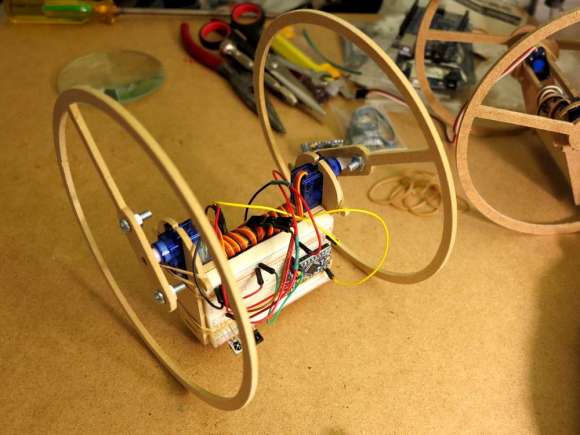
All of [Darcy]’s friends were making wheeled robots, so naturally, he had to make one too. His friends complicated theirs with h-bridges and casters for independent wheel maneuvering, but [Darcy] wanted something simpler. A couple of 9g servos later, the Rolly Bot was born.

Rolly Bot is self-balancing because of its low center of gravity. Should it hit a wall, the body will flip over, driving it back in the other direction. The BOM comes to a whopping $10, and that includes continuous rotation servos. It does not include the remote control capability he added later, or the cost of the CNC you would need to completely replicate this build. He even made a stand so he could test the wheels during programming.

[Darcy]’s code is on his site along with some pictures of another version someone else built. Watch Rolly Bot roll around after the jump.

How would you make this build even simpler? Tell us in the comments.

Continue reading “Rolly Bot Puts A New Spin On Independent Wheel Control”