The Internet Of Interactive Cats

[Tuco] is a cat who shares the space of [Micah Elizabeth Scott]. He is a large tabby tomcat, and he is polydactyl, which is to say he has a congenital excess of toes. He is an extremely active and engaging creature and enjoys playing and interacting with her. We covet [Tuco].

Sadly for the rest of us who love cats, of course, unless we know [Micah] personally we’ll never have the opportunity to play with [Tuco]. She appreciates the cat-shaped void that will leave in our lives, and to help us she’s building a telepresence robot to allow the rest of us to interact with him in real time.

Her idea is to make a flying robot equipped with a camera on a gimbal, and because to mounting it on a multirotor platform would be a hazard, instead she’s making something closer to the aerial cameras you might be familiar with from sporting fixtures, a motorised platform suspended from the corners of her roof space on a set of nylon ropes, that can move at will by adjusting the length of each tether. It is suggested that one day the device will be able to launch plastic bolts for [Tuco] to chase and to incorporate other interactive features to allow online users to engage with him.

We are shown progress so far in the video introducing the project that we’ve placed below the break, she has completed a prototype windlass mechanism and worked on reverse engineering the gimbal mechanism for serial control. We’ll probably never meet [Tuco] in person, but we can’t wait to interact with him online.


Continue reading “The Internet Of Interactive Cats”

Make Munich Was Awesome

It was a good weekend to be geeky in Bavaria. In addition to our own Hackaday Prize Bring-a-Hack party, there was the reason that we scheduled it in the first place, Munich’s independent DIY expo, Make Munich.

If you’re a loyal Hackaday reader, many of the projects would seem uncannily familiar. I walked in and was greeted by some beautiful word clocks in both German and English, for instance. Still, seeing the Open Theremin being sold with an “as seen on Hackaday” sticker made us smile. And then we had a great conversation about [Urs Gaudenz]’s other project: DIY biological apparatus, also seen on Hackaday.

There were robots galore. Someone (from Gmünd?) was driving around a graffiti-bot and spraying the floor with water instead of paint or chalk to very nice effect. The full evolution of the Zoobotics robot family was on display. Even the Calliope (a German version of the micro:bit) booth had this cute Bluetooth vibrobot. Join me after the break as I dive into all of the great stuff on display over the weekend.

Continue reading “Make Munich Was Awesome”

Automate The Freight: Drones Across The Sea

When you think about which of the many technological advances of the 20th century had the most impact on the global economy, which one would you rank as the most important? Would it be the space program, which gave rise to advances in everything from communications satellites to advanced composite materials? Or would it be the related aerospace industry, which stitched the world together so tightly that you can be almost anywhere on the planet within 24 hours? Or perhaps it’s the Internet, the global platform for buying almost anything from almost anyone.

Those are all important, but for the most economically impactful technology of the 20th century, I’d posit that the lowly shipping container and the containerized cargo industry that grew around it win, hands down.

Continue reading “Automate The Freight: Drones Across The Sea”

[Homo Faciens] Builds A Winchbot

The trademark hacker style of Hessian YouTuber [Homo Faciens] is doing a lot with a little. Given a package of parts from a sponsor, he could have made something “normal” like a fancy robot arm. Instead, he decided to make a winchbot. (Video embedded below.)

What’s a winchbot? It’s a big frame that supports three relatively heavy motors that pull steerable gripping arms around. It’s a little bit like the hanging Hektor / wallbot / plotterbot and a little bit like a delta-style 3D printer. Although [Homo Faciens]’s build doesn’t showcase it, a winchbot is also a great way to lift heavy things because the parts that need to be beefy — the frame and the lifting motors — don’t have to move. We love the gimballed square rod that works in concert with the winches!

With five extra servos on hand, and the computing power of a Raspberry Pi, [Homo Faciens] couldn’t just stop with lifting a claw. Instead, the gripping-arms part of the bot is mounted with four degrees of freedom and is powered with software that makes it stay parallel with the table and rotate around the gripper to make programming easier. Watch it in action in the video to see what we mean.

The biggest unsolved problem that we can see is the jerkiness that it displays in moving things around. That doesn’t stop it from building up a tower and a domino knock-down. We suspect that there’s some combination of firmware and hardware tweaking that can solve this problem, or it could just be run slowly so that the wobbles damp themselves out. We’re also quite confident that [Homo Faciens] will come up with an elegant and cheap solution. Have you seen his CNC machine?

Continue reading “[Homo Faciens] Builds A Winchbot”

Mintomat: An Overcomplicated Gumball Machine

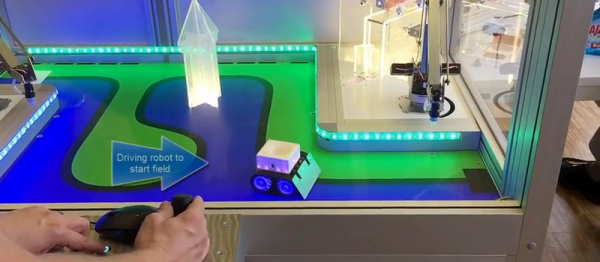
How do you get teenagers interested in science, technology, and engineering? [Erich]’s team at the Lucerne University of Applied Sciences makes them operate three robots to get a gumball. The entire demonstration was whipped together in a few days, and has been field-repaired at least once; a green-wire fix was a little heavy on the solder and would short out to a neighboring trace when mechanical force was applied.

Continue reading “Mintomat: An Overcomplicated Gumball Machine”

Technically A Hack. Still Questionable. Remote Control Food.

We thought we were going to read an article about, perhaps, a quadcopter that could fetch beer, or donuts. What we got was more along the lines of a donut dragging itself across the floor, rendering it pitiful and advisibly indigestible.

Sometimes people joke about not wanting to get in mind of a crazy person. We understand. While we could certainly follow [Michael Kohn]’s logic, the motivation was alien. Either way, in a rare turn of events there was not a single Arduino to be seen; just reverse engineering, unique solutions, and even a custom board. This is what some of you have been asking for… we think.

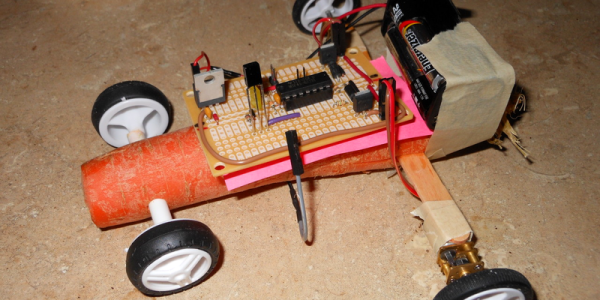
The brain of the questionable contraption is a TI MSP430G2231 and a tiny forward only motor driver circuit. The MSP waits for a signal from a hacked IR remote control from a cheap RC car. It then turns those into the appropriate motor control signals which go to some of those nice tiny metal gearboxes.

There were, naturally, a lot of technical issues in mounting the electronics to the food that, well… they didn’t need to be solved, but they were solved. For example, masking tape apparently does not stick well to green peppers, so toothpicks must be employed to pin the tape in place. Hopefully knowledge like this is scheduled for the nightly wipe while we sleep, but we’ll probably hold onto  it till we die, unlike expensive piano lessons.

In the end we had a good laugh, and the idea is so dumb it will probably be an educational Kickstarter next week. Video after the break.

Continue reading “Technically A Hack. Still Questionable. Remote Control Food.”