A Perpetually Powered Wireless Outpost

For [Justin], the topic of remotely powering electronics in the field comes up often. So often in fact he decided to put up a tutorial for powering electronics from solar power and batteries, as well as sending and retrieving data with the help of a cellular connection.

The electronics [Justin] chose for his remote wireless project include an AT&T 3G connection to the Internet provided by a Beaglebone, BeagleTouch display, and BeagleJuice battery pack. Of course an Arduino had to make it into this project, so a few light sensors were wired into a few Arduino Unos and connected to the Beaglebone.

After finding a few deep cycle boat batteries, [Justin] wired up a pair of solar panels that put out about 200 mA in full sun. This equates to about 2700 mAh a day, about 300 mAh more than his Beaglebone/Arduino/3G connection/WiFi setup needs per day.

As for what [Justin] can do with his wireless outpost, it makes setting up remote sensors for agriculture a breeze, and could easily be used to automagically send pictures from a game camera straight to a web page. Pretty neat, and very useful if you need to wire up sensors in the field to the Internet.

Continue reading “A Perpetually Powered Wireless Outpost”

Raspberry Pi Keeps Tabs On Your Solar Power Setup

raspberrypi-solarlogger

[Brian Dorey] has been adding green power solutions to his home for some time now, and as things have progressed, he has experimented with several different iterations of data loggers. The latest system watching over his solar power setup is a Raspberry Pi armed with a custom-built I2C analog/digital converter.

The Rasp Pi is responsible for monitoring several different temperature sensors related to his solar water heating and storage system, but that’s just the beginning. It also keeps watch over his roof-mounted solar electric panels, his battery bank, and its charge controller. For good measure, he also monitors his home’s temperature and his water tank’s recirculation pump because, why the heck not?

All of the collected data is relayed to his web server where it is handsomely displayed for his perusal and analysis. [Brian] has made his code available here, so you can monitor your home in the same fashion with little fuss.

Driving Your Home Appliances With Hybrid Power

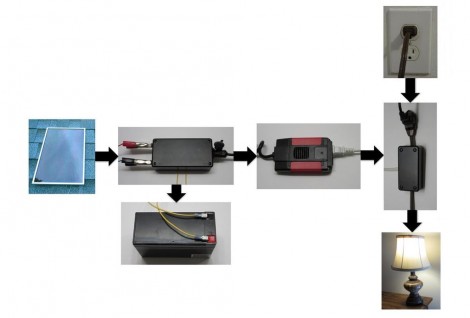
This system of hybridizing your home’s electric appliances is an interesting take on solar energy. It focuses on seamlessly switching appliances from the grid to stored solar energy as frequently as possible. There’s a promo video after the break that explains the setup, but here’s the gist of it.

Follow along on the pictograph above. We start on the left with solar panel. This feeds to a charger that tops off a 12V battery. When that battery is full, the charger feeds to the inverter which converts the 12V DC to 110V AC power. This is fed to a pass-through which is in between the appliance (in this a case a lamp) and the wall outlet. The pass-through will switch between mains power coming from the outlet, and the 110 coming from the inverter. The homeowner won’t know, or care, which power source is being used. But sunny months should result in lower energy bills. The real question is how long it takes to cover the cost of the system in saved electricity.

Continue reading “Driving Your Home Appliances With Hybrid Power”

LiPo Battery Tester For Solar Vehicle Battery Array

If you’re building solar vehicles at a competitive level you’ve got to know exactly how the storage batteries will perform. To that end [Matthew] built a Lithium Polymer battery tester for use by the McMaster University Solar Car Project. It worked well, but could only test one battery at a time. He just finished up a second version, which can test battery specifications on up to eight units at once. It saves a lot of time, but still takes fifteen hours to test just one set of the units used by the vehicle.

The most important aspect being measured is the discharge curve. Sure, there’s a datasheet that includes this information, but how can be sure that what you received will perform at spec? Each of the eight channels can be disconnected from the system using a relay. This is just one of the safety features which watch for things like over-voltage and over-current conditions. Remember, Lithium batteries can heat up fast if there’s a problem. Data is sampled on a 12-bit ADC and can be pushed to a computer via USB for graphing.

Keep An Eye On Your Palatial Estate With This Solar Powered WiFi Cam

If you’re expecting the serfs to hop the fence with pitch forks and torches you may want to employ a surveillance system. WiFi cameras are a cheap way of doing this, but you’ll need power. [CheapGuitar] decided not to run extension cords, and instead added solar power to his wireless camera. The solar panels are easy to spot in this image, but you’ll have to look close to see the camera.

He already had everything on hand, and this included a cheap WiFi camera which runs on 5V. To weatherproof it he used a plastic sandwich meat container. This is actually one of our favorite project enclosures, we used it for our door-bell button garage door lock. [CheapGuitar] painted it black to help keep it hidden after cutting a hole in the lid for the camera lens. Under the solar panels you’ll find a 12V car battery which uses a USB car charger to regulate voltage for the camera. Each of the panels is a 5W trickle charger and they’re designed to top off deep cycle batteries. The entire thing is cleverly hidden behind his existing landscaping.

[via Reddit]

Hacking Color And Battery Life On A Solar Powered Garden Light

Give your garden lights a little bit more life by changing out the LEDs. In the process, you can also choose a different color if you like. It really is as simple as cracking it open and replacing the stock LED, but a bit of a change may also prolong the stored charge.

These garden lights consist of a small solar cell and an LED, both controlled by a small PCB powered from a NiMH rechargeable battery. Sure, you could try to put in a battery that has more potential, but if you replace the single LED with two of them in series, it drops the current consumption and increase the battery life. Just make sure to use super bright LEDs and the intensity change will not be all that noticeable. That comes partly from the fact that our eyes don’t detect intensity changes as well when a light is already very bright. And since it’s two LEDs, mixing colors is an option as we see above.

[Thanks Ken]

Prototyping A Solar Charger For Your Truck

[Bryan] got his hands on a solar panel and decided to take it on the road rather than throwing it on the roof of the house. On sunny days it will top off the car battery, letting him use his stereo in the middle of nowhere without needing to keep the engine running. Instead of buying a ready-made solution he chose to design and build his own charging circuitry.

The charger uses an Arduino, which draws its own power from the panel via a regulator. It senses the voltage level of the battery and the available juice from the panel, connecting or disconnecting it from the electrical system as necessary. The system includes a set of LED indicators, which he installed in the dashboard near the cigarette lighter. This also gave him an excuse to install a voltmeter which uses a 2.5 digit seven segment display to read out the battery voltage. You can see a brief overview after the break.

Continue reading “Prototyping A Solar Charger For Your Truck”