Deploying An Open Source Pollution Monitoring Network

pollution-monitoring-network

[Kasey] and [Guyzmo] have been working for the past couple of years on a side project that lets them monitor pollution using a network of sensors. They’ve just decided to make the project open source, both hardware and software. The details of the system are available at their GitHub repository.

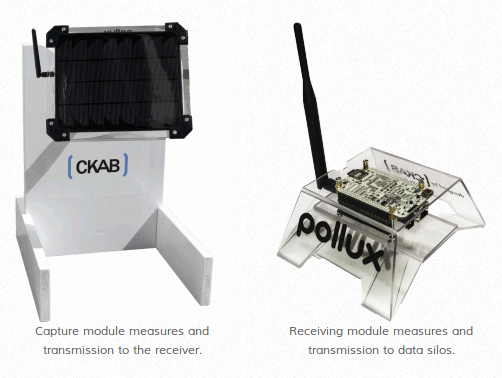
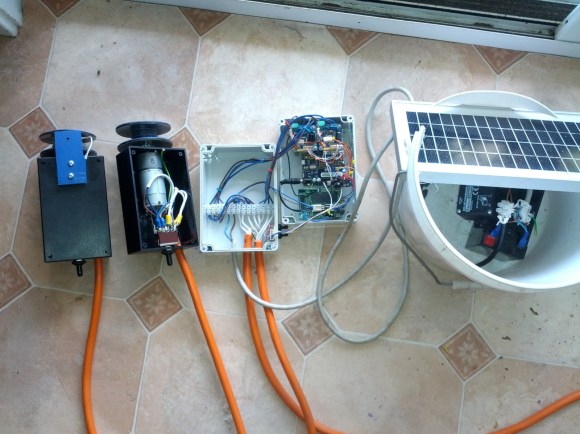
There are two main components to the system. On the right is a base station which collects the data from the array of sensor, one of which is shown on the left. Each sensor runs off of a battery, but features a PV solar panel which keeps the power source topped off. It uses an Arduino to drive the system, and an XBee radio for communications. Some info about the sensors can be found on this summary page. There’s a PM10 particle pollution sensor, temperature, sound, nitrogen, and oxygen sensors. We also wonder if any data can be gleaned from how much electricity the solar panel is able to harvest?

The base station also uses an XBee radio to poll the network, but it’s not driven by an Arduino. They’ve gone with the ARM-based BeagleBone to manage the data.

A Solar Powered Cattle Crossing Gate

solar-powered-cattle-crossing-gate

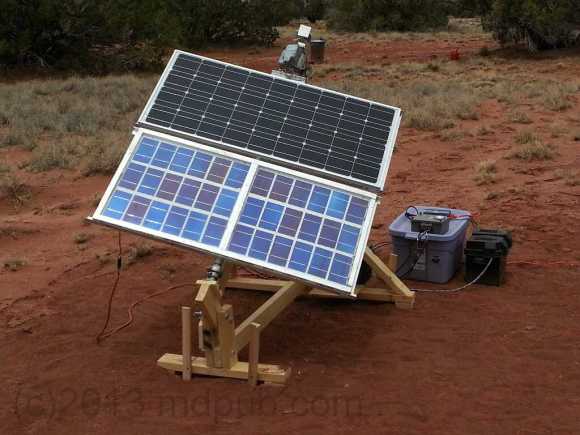
Anyone who’s traveled the grounds of a cattle ranch will tell you there’s a lot of stopping to open and close gates. But this project is aimed at letting you operate the gate from the comfort of your vehicle. It uses a spool of wire as the gate, lowering it for vehicle access with the use of a remote control.

The base station uses a solar panel to keep the battery topped off. But if you’re not frequently using the system it shouldn’t take much electricity at all. An Arduino board listens for the signal from the remote control. It then unspools the wire until it lays flat across the ground and can be driven over. Once the car has passed another click of the remote raises the gate back into position. There’s even a version that uses two gates which make up a cattle corridor.

We were thinking that it would be easy enough for the cows to push right through this. But after seeing the clip after the break it’s obvious they like to follow the rules.

Continue reading “A Solar Powered Cattle Crossing Gate”

Hacking The International Space Station With A Toothbrush

nasa-iss-toothbrush-hack

[Douglas Adams] will tell you not to forget your towel when it comes to space travel. But NASA may start mandating that astronauts always carry a toothbrush. That’s because when a recent repair on a critical International Space Station component went wrong it was a toothbrush hack that saved the day.

The culprit here is a bolt that wouldn’t re-seat after replacing a power transfer module that routes electricity from solar cells to the station’s electrical systems. About how many times have you had trouble with bolt threads? Now put yourself in a space suit in orbit for eight hours trying to get the thing to work. Yikes!

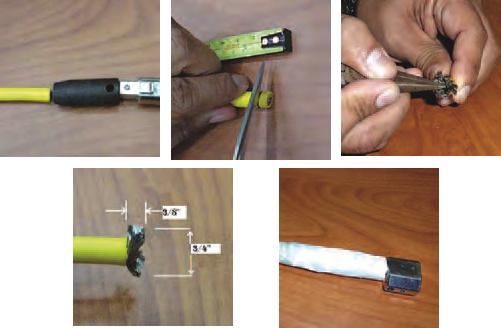
Just like in the movies there was a team of engineers at the ground center which gathered all the supplies available in the ISS. They figured out that metal shavings in the threaded hole needed to be cleaned out and the area lubed for the bolt. One of the two types of tooth brushes on hand would work for the lube, but needed to be stiffened. There was also a brush for cleaning the threads which was made out of a jumper cable. The images seen above are the step-by-step instructions the team uploaded to the astronauts who reproduced their hacked hardware to complete the repairs.

[Thanks G Mob]

Solar Clock Uses Capacitors For Style And Function

solar-clock-uses-storage-capacitors-and-batteries

This solar clock was built using a lot of salvaged parts. We find it interesting that [Nereus] combined a ring of storage capacitors with a power cell (translated) to create a hybrid energy storage setup.

The machine translation makes it a bit rough to understand how this works, but the schematic helps quite a bit. The pair of solar cells, which were pulled from some cheap solar cellphone chargers, feed the bank of capacitors encircling the clock face. If placed in a room that gets plenty of sunlight the cells will top off the capacitors which then feed an ICL7663 regulator. We’d love to hear comments on this part choice, as it’s our experience that linear regulators are rather inefficient. But anyway, the regulated power feeds both the energy cell as well as the clock motor. When output from the regulator dips the battery picks up the slack. The project also includes a voltometer and thermometer which can be displayed on the tiny LCD screen just about the six o’clock tick mark.

Now if you want something completely battery-free you’ll have to check out [Jack Buffington’s] take on solar clock.

[Thanks Manekinen]

LTC3105 And LTC3109 Energy Harvesting Chips

a-look-at-energy-harvester-chips

[Shahriar] devoted the lastest episode of The Signal Path to looking at energy harvesting chips. These parts are designed to gather energy from non-traditional sources as efficiently as possible. The full episode, which is embedded after the break, is about one hour long. It starts with a bit of background about the nature of these parts, and a brief overview of the wide-range of chips available. Each is suited for a different type of energy source.

He moves on to test and explain the LTC3105 and the LTC3109. The former is shown above on a development board. [Shahriar] hooks it up to his bench equipment to compare its performance to the published specs. This culminates in a circuit that uses a solar cell as the source with a super capacitor used as storage. The latter is connected to a Peltier cooler and used to convert the potential energy of ice cubes to electrical energy which charges his iPhone for about thirty seconds. This might be useful in that Peltier generator we saw last week.

Continue reading “LTC3105 And LTC3109 Energy Harvesting Chips”

Flashing LEDs Protect Livestock From Lion Attacks

When we think of defense against lion attacks, the first thought is usually guns. Lots and lots of guns.  [Richard Turere], a 13 year old Kenyan tinkerer with neither books nor any technical education, has come up with something entirely different – He’s keeping the lions at bay with a solar powered system of flashing LEDs. Yup. Flashing LEDs.

Since he and his family live next to Nairobi National Park, lion attacks are an ever present danger. The only defense systems available were far too expensive for his family to afford, so he decided to build his own. He utilized the basic resources he had readily available: LED bulbs removed from broken flashlights, some switches, an old car battery, wire, and a solar panel that also operates his family’s TV.

The results speak for themselves. His family has had no lion attacks in over two years, and at least five of his neighbors believe in the system enough to have had him install it on their fences too. With the cost for this set up at less than ten dollars, and all the parts being readily available, this rather basic electrical system is an amazing breakthrough for the Kenyan pastoralists.

We look forward to seeing more of [Richard’s] inventions. Way to go!

More LED Madness!

So last week [Caleb] posted an article about hacking a floating LED ball.  In response, here’s a couple simple LED hacks or repurposings that I’ve come up with recently.

glow-cube-LED

LED Solar Glow Cube: If you’ve ever seen path lights lighting up people’s gardens or walkways you may have wondered what components they had in them and how they could be repurposed.  As shown in this article, there’s not much too them other than a circuit board, rechargeable battery, and, of course, a solar panel. Combine this with some leftover foam with a hole in it, and you have the device pictured above.  Really simple, but the results are pretty cool as seen in the video after the break.

LED light-nunchucks

LED Nunchucks: If you thought that wheel lights were only for actual wheels, than you haven’t seen these nunchucks built with some PVC pipe and acceleration-sensitive wheel lights. This may not be much of a “hack” in that they are quite easy to build, but the results are pretty neat, being fun to sling around or even for use in long-exposure photography.  Check out the videos after the break of these nunchucks in action and of some LED light paintings that can be made with them. Continue reading “More LED Madness!”