Simple Touch Sensors With The Arduino CapSense Library

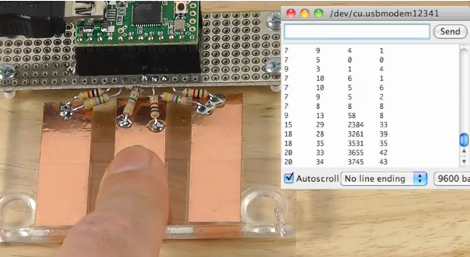
Ever thought of using touch sensors on your projects but didn’t because it would be too much work? [Paul Stoffregen] proves that it can be pretty easy if you use the CapSense library for Arduino. Here he’s created three touch sensors, connecting them to the Teensy microcontroller with two resistors each. The larger resistor (looks like 4.7 megaohms here) sends a signal through the copper pad which is read by the secondary pin. Here that pin is protected from electrostatic discharge with the 1k resistors. The microcontroller takes a reading by measuring how long it takes the voltage to change on the input pin.

Since the CapSense library takes care of the timing involved in these readings, all you have to do is decide how your program will react to the numbers that are coming in. In the video after the break [Paul] is echoing the timing figures back through the serial monitor to get an idea of what the data looks like. He experiments with touching the copper directly, and touching it through a piece of clear tape.

We’ve seen the CapSense library at work before in this interactive exhibit piece.

Continue reading “Simple Touch Sensors With The Arduino CapSense Library”

You’ll Shoot Your Eye Out With This Laser-filled Tennis Ball

laser-ball

We love lasers, you love lasers…who doesn’t love them?

[Matt Leone] recently took his passion for lasers over the top and built a little something called the Laser Ball. Fed up with the deluge of of LED cubes floating around online, he says that the Laser Ball is the new sheriff in town – and we’re inclined to agree.

He bored a bunch of holes in a standard tennis ball, and fitted it with 14 red laser diodes. Before he installed the lasers into the ball he modified each with a small bit of diffraction grating to liven up the display. The lasers were connected to a Teensy micro controller, which was stuffed inside the ball along with a small rechargeable LiPo battery.

While the laser ball was pretty awesome already, [Matt] decided that it wasn’t finished just yet. Using an IR remote package from Adafruit, he added the ability to trigger the Laser Ball’s light patterns from afar. You know, just for kicks.

Be sure to check out the video below to see the Laser Ball in action!

via BuildLounge

Continue reading “You’ll Shoot Your Eye Out With This Laser-filled Tennis Ball”

USB And PS/2 Key Loggers And Mess With Your Grammar

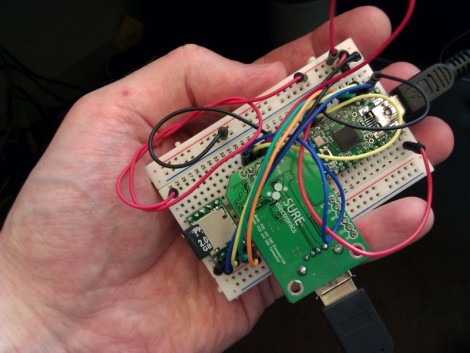
[Irongeek] is up to his old tricks once again with this new key logger prototype. It’s in the early stages, as attested by the breadboard built circuit, but [Adrian] still gives us a demo video after the break showing where he’s at right now. It comes in two flavors, the USB pass through seen above, or another that still connects to the computer via USB but functions with a PS/2 keyboard.

Aside from the obvious issue of a key logger stealing everything you type, there’s some prank value in this device too. The Teensy has more than enough processing power to watch what you typing and make changes as it goes. He shows off blatant rewrites, like changing “has” to “haz” or “you” to “U”. We think it would be better to change things like “they’re” to “their” or “it’s” to “its”. These would be very difficult to see happening and if you added randomness to how often the replacements occur, your victim would sooner come to the conclusion that they’re going crazy than that they’re the target of a little hazing. In fact, that’s probably the reason for our own grammar errors though the years; blast!

Continue reading “USB And PS/2 Key Loggers And Mess With Your Grammar”

Add Some LED Enhancement To Your Netbook Lid

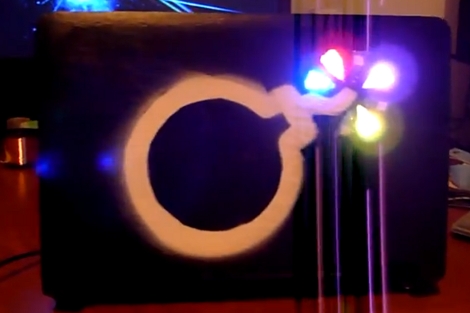
[Mathieu] needed to open up his Acer Aspire One to do a hard drive replacement and decided to add a bit of pizzazz while he was in there. The image above is the lid of the netbook adorned with RGB LEDs and a spray painted stencil.

He previously purchased a set of surface mount RGB packages on eBay and thought that they were perfect for this hack. after removing the case he found that by using a flex PCB he would be able to fit the LEDs inside, and pass the connections through to the main computer housing. The leads connect to a Teensy board, which is held in place with a liberal application of hot glue. [Mathieu] removed the USB connector and soldered jumper wires to one of the computers ports. In the video after the break you can see that he uses the programming software to write some code to the Teensy, driving the LEDs. We’d like to see it set to listen for serial communications and react accordingly. That way you could use it for notifications, as an audio VU meter, to track torrent progress, etc.

Continue reading “Add Some LED Enhancement To Your Netbook Lid”

MindFlex Watches As You Judge Others By Sight Alone

mindflex_headset

[Paul] really wanted to know what his brain was thinking.

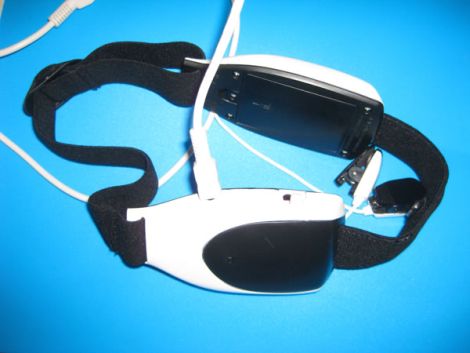
No, really. He is aware of all the thoughts that come and go, but he wanted to know what was going on in his brain below his conscious thought stream. Armed with a MindFlex headset and a Teensy, he set out to decode what really was going on inside his head.

He spent a month crawling 35 million Google profiles, downloading each user’s pictures into a MySQL database. The Teensy was attached to the MindFlex sensor board, and collects all of the headset’s output over a serial connection.

His experiment consisted of flashing each of the profile pictures on his monitor for one second, recording 2 of the 11 available brainwave channels from the MindFlex. These values were then plotted out so that he could visualize the “Attention” and “Meditation” values captured by the headset. At the end of the day he discovered, interestingly enough, that looking at dogs relaxed him the most!

We would love to see what correlations could be drawn from his collected data, and what sorts of “hidden” thoughts are coursing through others’ brains. It could certainly end up being a double-edged sword, uncovering subconscious biases and other such things, but it’s an incredibly intriguing experiment to say the least.

Be sure to check out the video below of the experiment in progress.

Continue reading “MindFlex Watches As You Judge Others By Sight Alone”

Burning Man: Pirate Ship Sports Arduino Powered Flame Sails

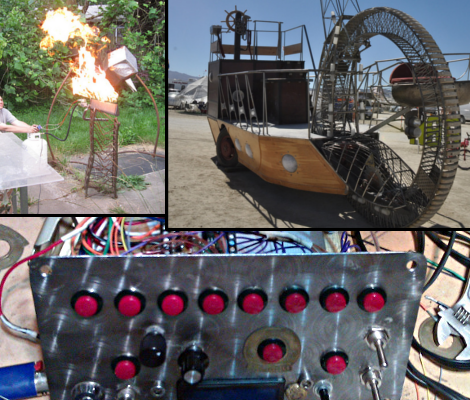
The 2011 Burning Man festival starts in just a few short days, and with that we have an excellent mutant vehicle accessory that no insane desert dweller should be without. An Arduino powered fire cannon sequencer! [Paul] was asked by Lostmachine’s [Andy] to spice up the flame effects on their Priate Ship mutant vehicle and provide a cool looking fire show that represented the ship’s sails.

[Paul] tossed together a hand full of arcade buttons, switches, and an LCD display to control eight 12V Solenoid valves tasked with switching on various regulated propane sources that throw some brutal looking flame effects. The controller combines a Teensy 2.0 with a custom board that contains eight P-channel MOSFET circuits. Flyback from the coils is handled through zener diodes, and the IRFR5305s are sized quite above and beyond what is needed for the 12v solenoids. With the heat, dust, and chaos of the desert one can’t be too careful. [Paul] even tosses in RC snubber circuits just to prevent things from getting too out of hand. Of the twelve arcade buttons eight are used for manual over rides, and the remaining four arcade buttons, knobs, switches, and the LCD display are all connected to the Teensy to handle the sequencing. [Paul], sadly, will not be able to make it out to Burning Man to troubleshoot the sequencer, which is a cause for some concern throughout the build.

It just so happens that I leave for Burning Man this Friday, and have an 18″ by 18″ Hackaday QR Code that will mark my area, see if you can find me out there! Also check out a video of the sequencer controlling what is easily a 6 foot flame bar after the jump!

Continue reading “Burning Man: Pirate Ship Sports Arduino Powered Flame Sails”

More FrankenKindle Progress

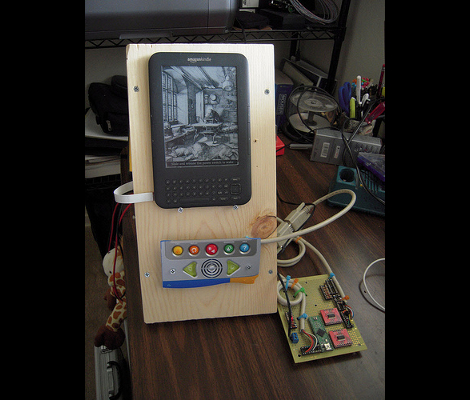
[Glenn] sent us an update on his FrankenKindle project. You might remember this hack from back in July. [Glenn] is modding the device to make it easier for his sister, who has Cerebral Palsy, to use.

The latest revision adds a case for the hardware. The silver button pad is what remains of the V.Reader (a children’s toy), having had the screen portion hacked off. The case provides a stable base for the reader and buttons, holding them at a nice angle for easy use. There’s just a bit of cable routing that needs to be finished to protect some fragile connections. The picture above does show the circuit board to the side, but there is a place for it around back.

In the video after the break [Glenn] mentions that the response to keypresses is a little sluggish. Sure, some of this is Kindle’s own delay when refreshing the ePaper display. But we can’t help but think the code running on the Teensy could also be optimized. We’ve asked him to post his code if he wants some tips, so check back and help out if you can.

We do have one feature suggestion for him. The Kindle keyboard no longer functions because that flat cable coming out the side is what connects to it. It’s quite easy to add a PS/2 keyboard port to a microcontroller. That would be a nice addition to the FrankenKindle as it would make things like shopping for books a bit easier.

Continue reading “More FrankenKindle Progress”