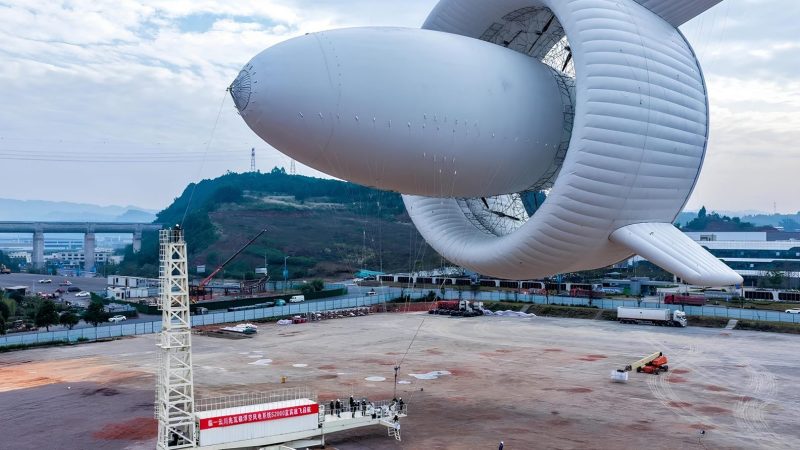
The S2000 at a much lower altitude than 2000 m.

Wind Power Is Taking Off In China– All The Way To 2000 M AGL

2000 m above ground level (AGL), winds are stronger and much, much more consistent than they are at surface. Even if the Earth were a perfect sphere, there’d be a sluggish boundry layer at the surface, but since it’s got all these interesting bumps and bits and bobs, it’s not just sluggish but horribly turbulent, too. Getting above that, as much as possible, is why wind turbines are on big towers. Rather than build really big tower, Beijing Lanyi Yunchuan Energy Technology Co. has gone for a more ambitious approach: an aerostat to take power from the steady winds found at high altitude. Ambitiously called the Stratosphere Airborne Wind Energy System (SAWES), the megawatt-scale prototype has recently begun feeding into the grid in Yibin, Sichuan Province.

The name might be a bit ambitious, since its 2000 m test flight is only one tenth of the way to the stratosphere, but Yibin isn’t a bad choice for testing: as it is well inland, the S2000 prototype won’t have to contend with typhoons or other ocean storms. The prototype is arguably as ambitious as the name: its 12 flying turbines have a peak capacity of three megawatts. True, there are larger turbines in wind farms right now, but at 60 m in length and 40 m in diameter, the S2000 has a lot of room to grow before hitting any kind of limit or even record for aerostats. We’re particularly interested in the double-hull construction– it would seem the ring of the outer gas bag would do a good job funneling and accelerating air into those turbines, but we’d love to see some wind tunnel testing or even CFD renderings of what’s going on in there.
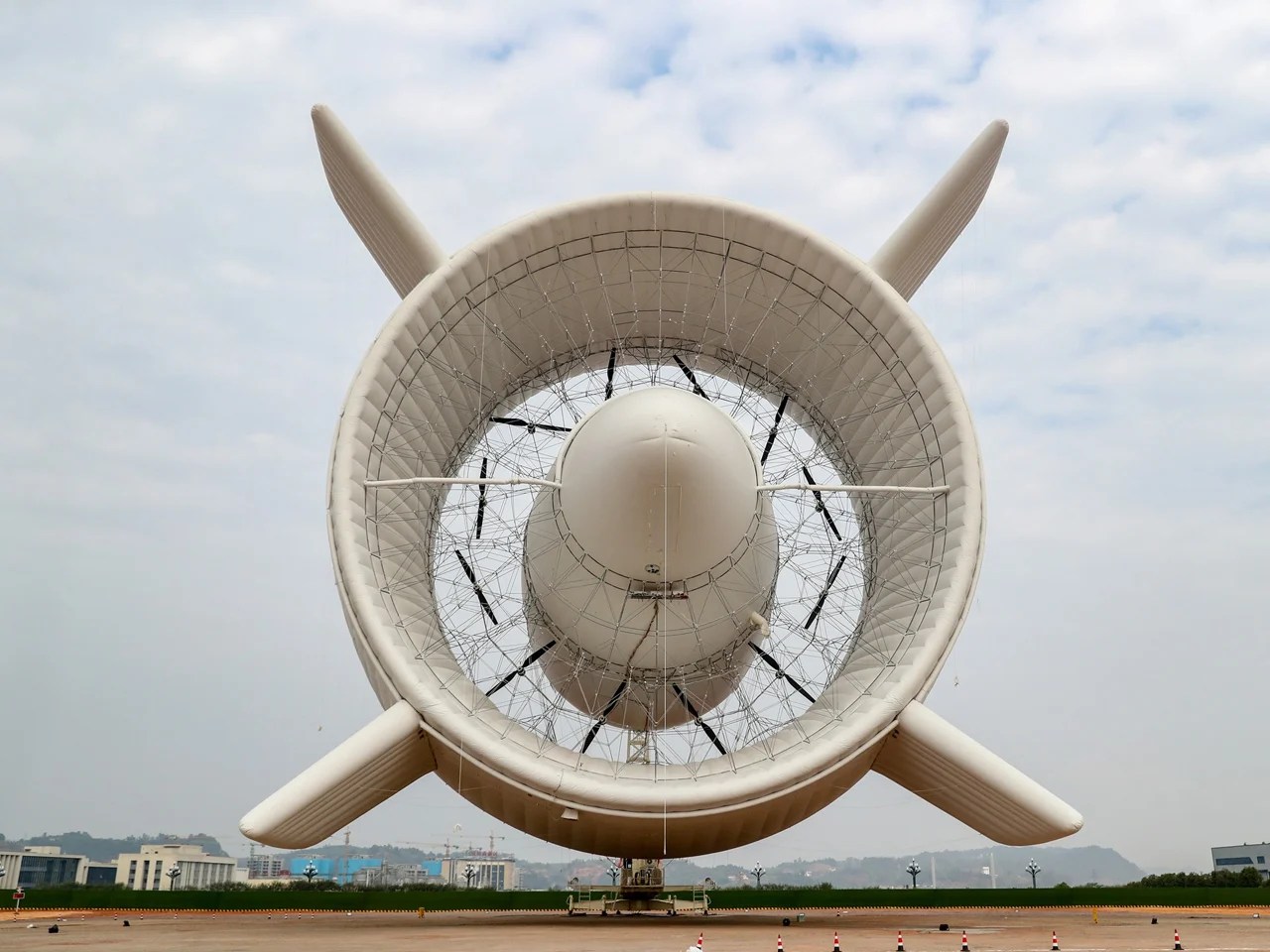
A rear view shows the 12 turbines inside the double hull. It should guide air into the gap, but we wonder how much turbulence the trusses in there are making.

During its first test flight in January 2026, the system generated generated 385 kilowatt-hours of electricity over the course of 30 minutes. That means it averaged about 25% capacity for the test, which is a good safe start. Doubtless the engineers have a full suite of test flights planned to demonstrate the endurance and power production capabilities of this prototype. Longer flights at higher capacity may have already happened by the time you read this.

Flying wind turbines isn’t a new idea by any means; a few years ago we featured this homemade kite generator, and the pros have been in on it too. Using helium instead represents an interesting design choice–on the plus side, its probably easier to control, and obviously allowing large structures, but the downside is the added cost of the gas. It will be interesting to see how it develops.

We’re willing to bet it catches on faster than harvesting wind energy from trees.

All images from Beijing Lanyi Yunchuan Energy Technology Co., Ltd.
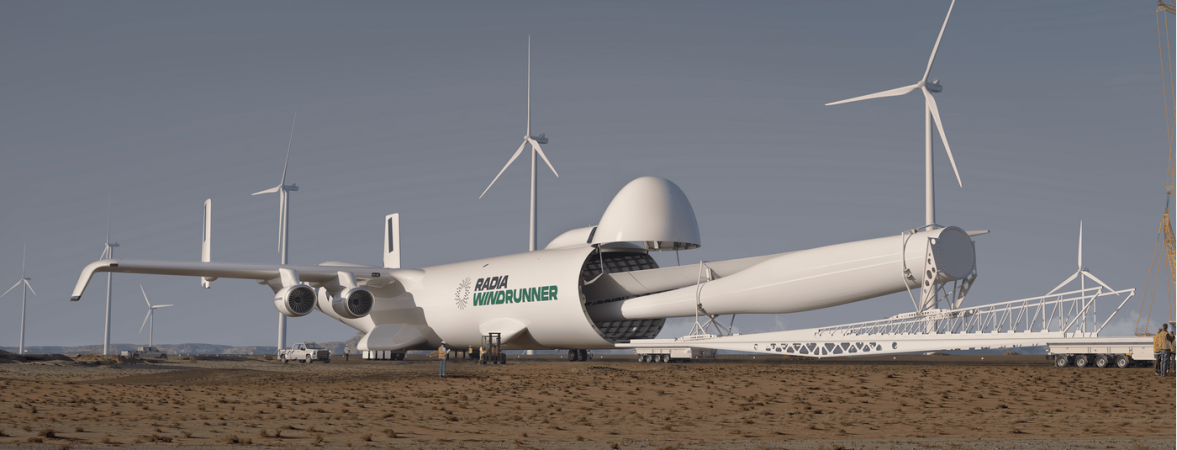
 

The WindRunner unloading a blade, image Radia.

Giant Airplane Goes Long On Specialization

While not everyone agrees on the installation of wind turbines in their proverbial back yards, one thing not up for debate is that there is a drive to build them bigger, and bigger. Big turbines means big blades, and big blades need to be transported… somehow. If air freight is going to stay relevant to the industry, we’re gonna need a bigger airplane.

A startup called Radia has a plan for that plane, and it is a doosie. The “WindRunner” would clock in at a massive 108 meters (354 feet) long, but with a wingspan of just 80 m (262 ft). That’s very, very long, but it might not be the largest airplane, depending how you measure it. Comparing to the 88 m wingspan for the late, lamented An-225 Mriya, you can expect a lower payload capacity, but heavy payloads aren’t the point here. Wind turbine blades really aren’t that heavy. They’re big, or they can be — the WindRunner is designed to fit a single 105 m blade within its long fuselage, or a pair of 90 m blades.

Continue reading “Giant Airplane Goes Long On Specialization”

An image of a desert with dramatically cloudy skies. In the middle of the image is a series of clay doorways with vertically-oriented wooden slats surrounding a central pole. These form the basis of a panemone windmill.

Help Wanted: Keep The World’s Oldest Windmills Turning

While the Netherlands is the country most known for its windmills, they were originally invented by the Persians. More surprisingly, some of them are still turning after 1,000 years.

The ancient world holds many wonders of technology, and some are only now coming back to the surface like the Antikythera Mechanism. Milling grain with wind power probably started around the 8th Century in Persia, but in Nashtifan, Iran they’ve been keeping the mills running generation-to-generation for over 1000 years. [Mohammed Etebari], the last windmill keeper is in need of an apprentice to keep them running though.

In a world where vertical axis wind turbines seem like a new-fangled fad, it’s interesting to see these panemone windmills are actually the original recipe. The high winds of the region mean that the timber and clay structure of the asbad structure housing the turbine is sufficient for their task without all the fabric or man-made composites of more modern designs. While drag-type turbines aren’t particularly efficient, we do wonder how some of the lessons of repairability might be used to enhance the longevity of modern wind turbines. Getting even 100 years out of a turbine would be some wicked ROI.

Wooden towers aren’t just a thing of the past either, with new wooden wind turbines soaring 100 m into the sky. Since you’ll probably be wanting to generate electricity and not mill grain if you made your own, how does that work anyway?

Continue reading “Help Wanted: Keep The World’s Oldest Windmills Turning”

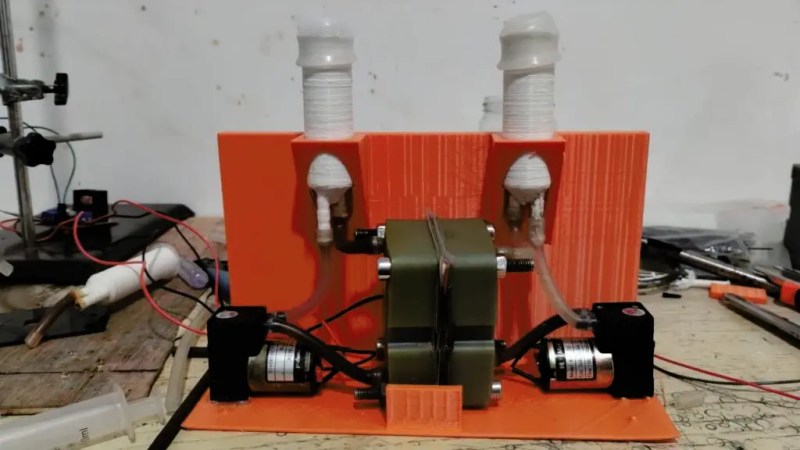
An L-shaped orange mounting structure with two white reservoirs on top, a set of pumps on the outer bottom edges, and a membrane cell bolted together in the center. The parts are connected by a series of transparent tubes.

Open Source Residential Energy Storage

Battery news typically covers the latest, greatest laboratory or industry breakthroughs to push modern devices further and faster. Could you build your own flow battery stationary storage for home-built solar and wind rigs though?

Based on the concept of appropriate technology, the system from the Flow Battery Research Collective will be easy to construct, easy to maintain, and safe to operate in a residential environment. Current experiments are focusing on Zn/I chemistry, but other aqueous chemistries could be used in the future. Instead of an ion exchange membrane, the battery uses readily attainable photo paper and is already showing similar order of magnitude performance to lab-developed cells.

Any components that aren’t off-the-shelf have been designed in FreeCAD. While they can be 3D printed, the researchers have found traditional milling yields better results which isn’t too surprising when you need something water-tight. More work is needed, but it is promising work toward a practical, DIY-able energy storage solution.

If you’re looking to build your own open source wind turbine or solar cells to charge up a home battery system, then we’ve got you covered. You can also break the chains of the power grid with off-the-shelf parts.

Renewable Energy: Beyond Electricity

Perhaps the most-cited downside of renewable energy is that wind or sunlight might not always be available when the electrical grid demands it. As they say in the industry, it’s not “dispatchable”. A large enough grid can mitigate this somewhat by moving energy long distances or by using various existing storage methods like pumped storage, but for the time being some amount of dispatchable power generation like nuclear, fossil, or hydro power is often needed to backstop the fundamental nature of nature. As prices for wind and solar drop precipitously, though, the economics of finding other grid storage solutions get better. While the current focus is almost exclusively dedicated to batteries, another way of solving these problems may be using renewables to generate hydrogen both as a fuel and as a means of grid storage. Continue reading “Renewable Energy: Beyond Electricity”

Virginia To Get Large-Scale Wind Farm

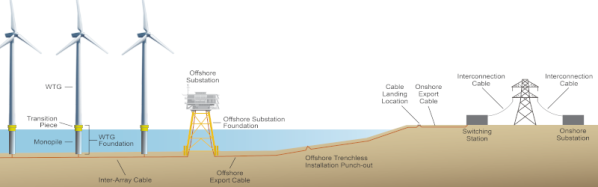
If you go about 27 miles off the coast of Virginia, you’ll find two windmills jutting up out of the sea. Two windmills aren’t particularly interesting until you realize that these two are on the edge of a 2,100-acre lease that Dominion Energy is placing in Federal water. According to the company, those two will be joined by 176 more windmills on a nearly 113,000-acre adjacent lease. The project has been in the planning and pilot phase for a while, but it was recently given the green light by the US government. You can see a promotional video about the project below. There’s also a video of the first monopiles — the mounts for the windmills — arriving in the area.

The project will eventually have three offshore substations that feed the power to the state military reservation and, from there, to Naval Air Station Oceania, where it feeds the commercial power grid. The final project will power 660,000 homes.

Continue reading “Virginia To Get Large-Scale Wind Farm”

Hackaday Prize 2023: A 3D Printed Vertical Wind Turbine

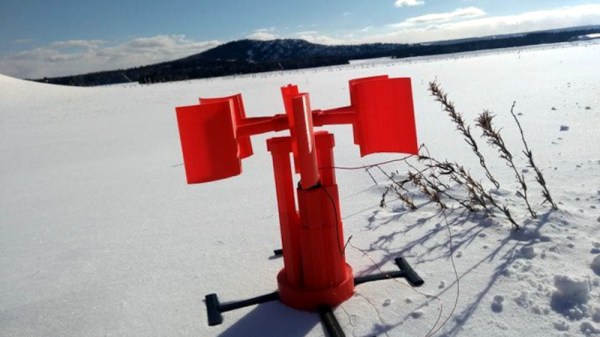
We feature a lot of off-grid power projects here at Hackaday, whether they’re a micropower harvester or something to power a whole house. Somewhere in the middle lies [esposcar90]’s 3D-printed vertical wind turbine, which it is claimed can deliver 100 watts from its diminutive tabletop package.

It’s designed to be part of a package with another turbine but makes a very acceptable stand-alone generator. The arms have large scoop-like 3D-printed vanes and drive a vertical shaft up the centre of the machine. This drives a set of satellite gears connected to a pair of DC permanent magnet motors, which do the work of generating. For different wind situations, there are even some differing STL gear choices to speed up the motors. The motors are 12V devices, so we’re guessing the output voltage will be in that ballpark. However, it’s not made entirely clear in the write-up.

Continue reading “Hackaday Prize 2023: A 3D Printed Vertical Wind Turbine”