Zigbee-powered Wireless Scale

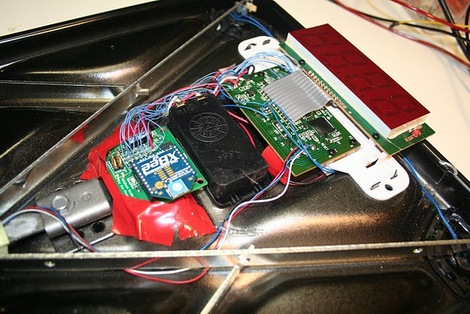
[joe] wanted to make it easy to record his weight every day, and added a few bits to decode the weight and send it to his computer. The end result is a ZigBee-powered wireless scale. Additionally, his scale can track more than one person’s data simply by knowing whose previous weight the new measurement is closest to. Now [joe] and his family can spend more time working out, and less time messing with spreadsheets and data entry.

[joe]’s build is not only elegant, but well-documented, too. He walks through the reasons he chose this specific floor scale, reverse engineering it to decode the weight, then provides links to his schematics, source code, and pretty much everything else you would need to play along at home.

DIY Wireless Keylogger Makes You Feel Like James Bond (In Your Own Little World)

wireless_keylogger

Do you need to keep tabs on the kids while they browse the Internet? How about your husband/wife – do you suspect they are dabbling in extra-curriculars on the side? Hey, you’ve got your insecurities reasons, we won’t judge. We will however, show you what [Jerry] over at Keelog has been working on lately.

While the company sells hardware keylogger kits online, [Jerry] has relied on, and understands the importance of open source. Since we all benefit from things being open, he is giving away all of the details for one of his most recent projects, a wireless keylogger. The keylogger plugs in to a PC’s PS/2 port, and wirelessly sends data to a nearby USB dongle up to 20 yards away, all in real-time.

A detailed parts list is provided, as are schematics, PCB masks, firmware, and assembly instructions. However, if you prefer the easier route, you can always buy the completed product or a DIY kit.

This isn’t the first open source keylogger he has released, so be sure to check out his previous work if you prefer a wired keylogging solution.

Follow-up: Radio-controlled LED Light Show

travelling_light_circus

[Alan] shared an update with us regarding a project he has been working on for some time, radio-controlled LED light strips destined for use by the Travelling Light Circus. If you are not familiar with the project or need a quick refresher, you can read our post about it here.

He recently met up with the guys from TLC to finish things up and was happily surprised that they did not want to mount his lights on the performers, as was originally planned. He would have had to make a few modifications if that was the case, but instead, they planned on attaching them to bicycle wheels. The light strips were mounted inside translucent plastic tubes that fan out from the center of the wheels, where the battery and radio equipment is located. The wheels were mounted on aluminum poles, allowing the performers to create a visually stunning show, just by spinning the pole.

Check out the pair of videos we have embedded below, the project came together quite nicely.

Continue reading “Follow-up: Radio-controlled LED Light Show”

NES Game Pad Wireless Light Commander

NES_wireless_light_switch

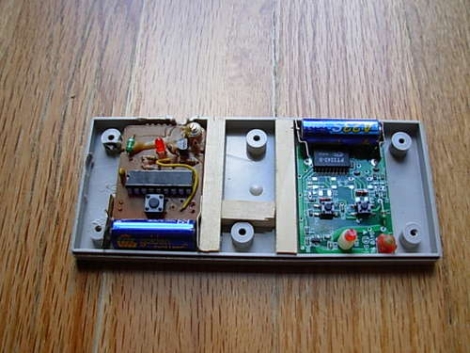
Annoyed that the new lights he bought for his apartment lacked power switches, Instructables user [p.arry.drew] decided to install a pair of wireless light switches. Not content to use the remotes separately, he decided to see if he could cram them both into an old NES controller, making for a nice all-in-one wireless light commander.

He disassembled the light switch remotes, cutting off a bit of the battery contacts to ensure they fit in the game pad. He then pulled apart his NES controller, removing the cord and adding some foam padding to ensure that the buttons fully contacted the wireless switches when pressed. A few bits of wooden dowel were added to keep everything in place, then the controller was reassembled.

His creation makes for a very convenient method of controlling several light switches from once source, plus the packaging is pretty handsome as well. These remote light switching solutions seem to be all the rage lately, so keep them coming!

Read on for a quick video of his remote light switches in action.

Continue reading “NES Game Pad Wireless Light Commander”

Batman Inspired Hidden Light Switch

hidden_switch

[Chris] over at the New Hobbyist sent in his latest creation, a wireless light switch hidden within a statue bust. While shopping around for another project, he came across a wireless relay that can can be used to switch a standard 120v AC load. He bought the part without a project in mind, but inspiration quickly struck. Some of you young’uns might not remember the original Batman television series, but [Chris] certainly does. To access the Bat Cave, Bruce Wayne had to flip a secret switch located inside a bust of William Shakespeare that adorned his desk. While he doesn’t have a secret door to activate, [Chris] couldn’t think of any better way to switch on the lights in his man cave. He found a similar-looking bust of Beethoven and got to chopping his head off.

He fabricated a small mount for a push button, hiding the battery powered remote underneath, and an old 12v wall wart was repurposed to drive the wireless receiver. While not overly complicated, this is definitely a fun project and could make for a neat light switch in a kid’s room. Interested in some more Batman inspired hacks? Be sure to check out this Bat Cave-style entrance switch from a few years back.

Keep reading to see a video of his hidden light switch in action.

Continue reading “Batman Inspired Hidden Light Switch”

Radio-controlled LED Light Show

HL1606_radio_controlled_light_show

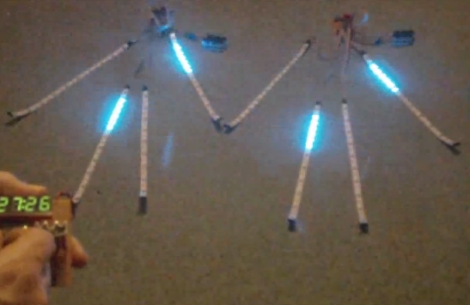
[Alan] was commissioned to make some wearable, radio-controlled LED strips for the Travelling Light Circus. It has taken some time, but he has recently finished some prototypes, and thought it was a good time to do a writeup on the project. The system is managed by a single controller unit, which communicates with any number of LED driver units, each controlling 4 HL1606 LED strips. The light displays are synchronized across all of the LED driver units via a 2.4 GHz radio, with each driver falling into synch almost immediately after being powered on. While some might be turned off to the fact that he uses Arduino Pro Minis to control the LEDs, this is far from a simple project.

[Alan’s] blog contains several posts about this project, with everything documented in detail. He spends quite a bit of time talking about the project’s software, as well as hardware issues he ran into along the way.

His blog is a must read, but even more so, it is a must see. The lighting effects are mesmerizing, as there are a ton of different light patterns these units can generate, so be sure to check out the following video of the lights in action.

Continue reading “Radio-controlled LED Light Show”

Security Audit Kit In A Mouse

Sometimes it helps to have an entire set of tools with you to tackle a problem, and sometimes it helps to take the discreet route. [StenoPlasma] took the latter of these approaches, and stuffed a USB hub, a 16 GB flash drive, and an Atheros based USB wireless adapter into a regular looking USB mouse to make a Linux bootable system in a mouse. Because he chose the Atheros adapter, he is also capable of doing packet injection with tools like Aircrack-ng, which can invaluable in a security audit or (white hat) hacking situation.

This is the only photo we have, so it could be possible that the mouse is no more than a mouse, however we know all of what [StenoPlasma] claims is 100% possible, so we’ll give him the benefit of the doubt, and hope this inspires others to hack up your own mouse kits. Be sure to check out the full parts list after the break.

Continue reading “Security Audit Kit In A Mouse”