FBI Tracking Device Found; Disassembled

[ifixit] has apparently grown tired of tearing apart Apple’s latest gizmos, and their latest display of un-engineering has a decidedly more federal flair. You may have heard about Yasir Afifi’s discovery of a FBI-installed tracking device on his car back in October of last year. Apparently, the feds abandoned a similar device with activist Kathy Thomas. Wired magazine managed to get their hands on it, and gave it to ifixit to take apart. There’ve even posted a video.

The hardware itself isn’t that remarkable, it’s essentially a GPS receiver designed before the turn of the century paired with a short range wireless transceiver. The whole device is powered by a set of D-sized lithium-thionyl chloride batteries which should be enough juice to run the whole setup for another few decades–long enough to outlast any reasonable expectations of privacy, with freedom and justice for all.

Cellphone Battery Mouse Modification

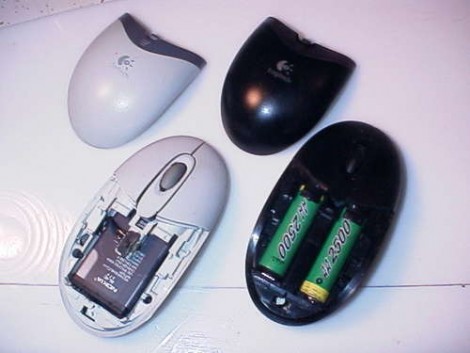
Ever wanted to increase the battery performance in your wireless mouse? [Davetech] shows you the way with this guide for converting a mouse from AA to lithium batteries. We were delighted by his hack-tacular approach that seems to have a nice little work-around at each step in the process. He grinds down the plastic battery housing that is molded into the original mouse body, then uses an old Compact Flash card connector as a set of spring terminals for a Nokia cellphone battery. This battery has more capacity and recharges faster than non-Lithium AA cells. But unfortunately the spring terminals didn’t quite reach the recessed batter contact. No problem, he just builds up solder on the battery to bridge the gap.

[Davetech] manages to fit the entire battery inside the mouse and the pointing-device still works. Your mileage may vary by model (both battery and mouse). It is necessary to take the battery out of the mouse for recharging, but since this only happen about every couple of weeks thanks to the extended capacity it’s not too much of a hassle. Perhaps someone could carry this to the next level by adding a USB port and the necessary charging circuitry?

Reverse Engineering LED Vodka Bottle Displays

wireless_led_marquee

When [Tyler] heard about the LED matrix display that Medea Vodka was building into their bottles, he immediately wanted to get his hands on one. Who could blame him? Someone had finally combined two things we love dearly: booze and LEDs.

He struggled to find a bottle at any of his local stores for the longest time, but was absolutely stoked when he finally came across one of their reps promoting the brand while he was out shopping.

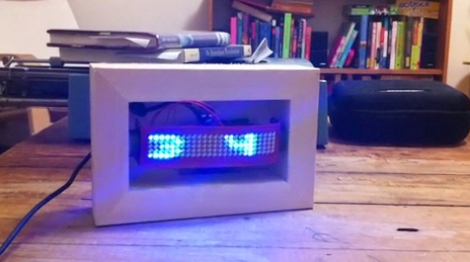
Once he got home, he pulled the display off the bottle and began poking around to see what made it tick. The display is made from a flexible PCB, and attached to the bottle with some clear elastic film. It is powered by two CR2032 batteries and controlled by a PIC16F chip, which pulls stored messages from a small Atmel EEPROM.

Once he figured out how to control the LED matrix, he uploaded his own fonts and added a LINX wireless module to remotely send messages to the board. He mounted it in a wooden frame and now uses it as a simple marquee display.

If you have one of these displays hanging around your house, be sure to swing by his site for schematics of his wireless interface board as well as the code he uses to drive the marquee. You can check out a video of the display in action there as well.

The ElectroAxé Full-Body Percussion Suit

Carnival in Salvador, Brazil is arguably one of the biggest and craziest parties this world has ever known.  With millions in attendance for what is already an incredible audio and visual display, performers are faced with the daunting task of continually bringing something new and fresh to the masses. One could always add more fireworks or visual displays (never a bad thing), but it will only take you so far. [Kyle McDonald] and [Lucas Werthein]’s answer: The ElectroAxé Full-Body Percussion Suit as demonstrated by Carlinhos Brown at Carnival 2011.

When most people hear the word “axe” as related to music they think of an electric guitar. “Axé” however, refers to a unique Afro-Caribbean fusion genre of music that originated in Salvador in the mid 1980’s and is a favorite at Carnival. [Carlinhos Brown] is a popular Brazilian percussionist and was looking for a creative new way to express himself through his song and dance. Instead of being stuck in one place near his instruments or carrying one or two drums around “marching-band style”, he is now able to move around the stage freely – his body has become his instrument.

In order to make the magic happen, [Kyle] and [Lucas] designed custom laser cut and cnc machined drum pads containing piezo sensors and integrated them with a full-body jump suit. When struck, these sensors send a signal to an Arduino with a Sparkfun Midi Shield housed in a custom enclosure on the performer’s waist. From there the MIDI signal is sent wirelessly and then audio is played through the existing sound system – it appears that a CMD WIDI X-8 wireless MIDI system is employed for the actual wireless transmission.

Although details are somewhat scarce, there are plenty of pictures, (more) available.  You really can’t argue with the results as you watch thousands of people jam along.

Come join in the festivities with video after the break!

Continue reading “The ElectroAxé Full-Body Percussion Suit”

RFID-based HTPC Controller Gets A Wireless Refresh

RFiDJ_Refresh

[roteno] recently wrote in to let us know that he has completed work on the RFiDJ Refresh, a follow up to his 2009 project, the RFiDJ.

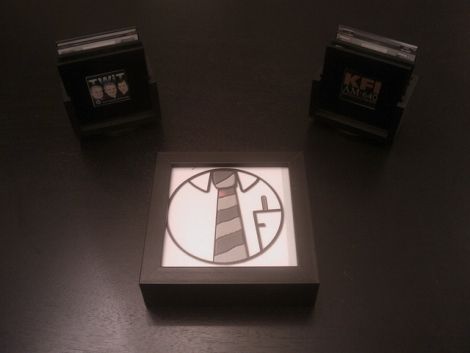
The concept is pretty simple – he has a set of RFID enabled tiles, which contain references to particular online streaming audio stations. He uses these tiles to tune into audio feeds on his HTPC by placing them on a block containing an RFID reader.

His previous implementation had the RFID reader tethered to his HTPC, which didn’t make it all that convenient to use. The newer version utilizes a 433 MHz transmitter/receiver pair in order to communicate with the PC, so it can be used anywhere through out his house. The reader and transmitter were placed in a shadow box picture frame, along with a rechargeable Li-poly battery that powers the whole setup. He also mentions that he has added a tactile interface that allows him to initiate mobile phone calls from the RFiDJ as well.

It’s a nice update to an already great project. We imagine it’s a bit more fun for [roteno] and his guests to tap a coaster on the transmitter box than fumble with a remote to change radio stations on the HTPC, but that’s just us.

Check out the videos below to see his new setup in action.

Continue reading “RFID-based HTPC Controller Gets A Wireless Refresh”

Wireless Weather Station Obsessively Reports The Temperature

obsessive_weather_station

[nuumio] has been hard at work building a Tweeting weather station, which he recently got up and running. The weather station is built from three major components, a Linux PC for data storage and Tweeting, a main weather sensor unit, and a remote unit.

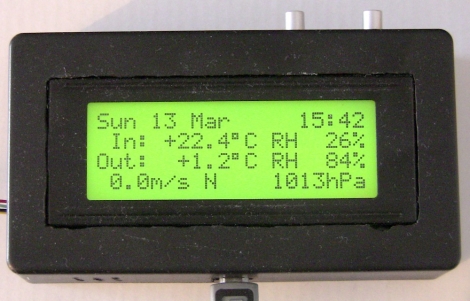
The remote unit sits outside and includes includes both a pressure and humidity/temperature sensor. The sensors are polled every 20 seconds, reporting the data back to the main unit via a 434 MHz RF transceiver. The remote sensor also records the ambient light level and the remaining battery voltage, sending that data to the main unit for good measure.

The main unit sits inside his house and records the same temperature and humidity data as the external unit. The main unit adds its data to the packets sent by the remote unit and transmits them to the PC via USB. The PC calculates the minimum and maximum temperatures for the last 12-hour and 24 -hour periods before sending that data back to the main unit to be displayed on its LCD panel. Every 10 minutes, the computer also posts the weather data on Twitter.

If you are looking to build your own weather station, [nuumio] has provided all of the source code for his project on his web page. However, he does admit that he was too lazy to draw up a schematic, so you are on your own in that department.

USB Dongle Hack Tethers DSLR Cameras At A Fraction Of The Price

wireless_usb_grip

[Neal] wanted to tether his DSLR to his computer, but he wasn’t about to fork out the $1,000 Nikon was asking for their wireless adapter. Instead, he opted to construct his own solution using two separate camera accessories which cost him less than $200 when finished.

The two components he purchased were a wireless USB transmitter/receiver pair and an external battery grip. The battery grip allows him to use a pair of batteries to power his camera, while providing just enough space to wedge in the USB transmitter. He stripped the casing off the transmitter and connected it to a mini USB plug that he wired into the battery grip. He then added a small voltage regulator to step down the Nikon battery voltage from 7.2v to the 5v required by the USB transmitter.

The battery grip and transmitter were then hooked directly into his camera using the weatherproof plug built into the grip. Once he powered on his camera, it was connected to the PC immediately.

It’s amazing how the simplest hacks can save incredible amounts of money.  Nice job!

Be sure to check out the video embedded below to see the wireless adapter in action.

Continue reading “USB Dongle Hack Tethers DSLR Cameras At A Fraction Of The Price”