Wireless Sniffing And Jamming Of Chronos And Iclicker

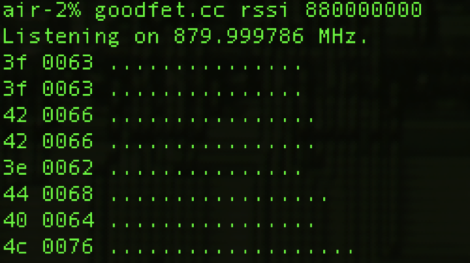
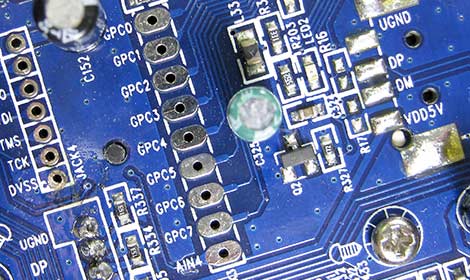
The ubiquitous presence of wireless devices combined with easy access to powerful RF development platforms makes the everyday world around us a wireless hacker’s playground. Yesterday [Travis Goodspeed] posted an article showing how goodfet.cc can be used to sniff wireless traffic and also to jam a given frequency. We’ve previously covered the work of [Travis] in pulling raw data from the IM-ME spectrum analyzer, which also uses goodfet.cc.

The Texas Instruments Chronos watch dev platform contains a C1110 chip, which among other things can provide accelerometer data from the watch to an interested sniffer. The i>clicker classroom response device (which houses a XE1203F chip) is also wide open to this, yielding juicy info about your classmates’ voting behaviour. There is still some work to be done to improve goodfet.cc, and [Travis] pays in beer–not in advance, mind you.

With products like the Chronos representing a move towards personal-area wireless networks, this sort of security hole might eventually have implications to individual privacy of, for example, biometric data–although how that might be exploited is another topic. Related to this idea is that of sniffable RFID card data. How does the increasing adoption of short-range wireless technologies affects us, both for good and bad? We invite you to share your ideas in the comments.

Wireless Doorbell Rings A Real Bell

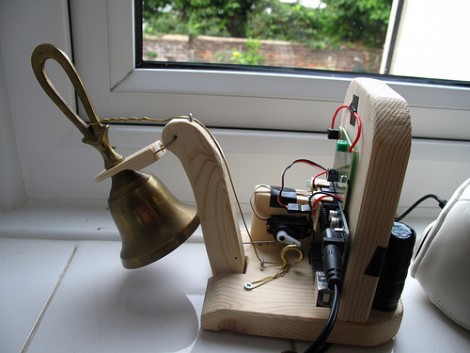
Tired of hearing that flat sounding wireless doorbell when visitors happen to come by? Don’t get rid of it, improve it by adding a real bell. This hack rigs up a small hand bell to the wireless doorbell receiver. It was prototyped using LEGO pieces to shake the sound out of the bell, but the finished version uses a servo motor on a wooden frame. An Arduino monitors the wireless receiver, driving the servo when a transmission from the front door button is received.

Traditionally door bells have actually been chimes that are struck with solenoids. We appreciate this rendition because it adds an element of kinetic art to the home, laying bare the functional hardware instead of hiding it in a box. Don’t miss the demonstration after the break.

Continue reading “Wireless Doorbell Rings A Real Bell”

Wireless Electrocardiography… With IPhone

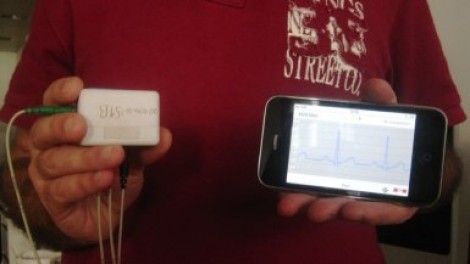
This module is a sensor package for monitoring the electrical activity of the heart. It is the product of an effort to create a Wireless Body Sensor Network node that is dependable while consuming very little electricity, which means a longer battery life. To accomplish this, the microcontroller in charge of the node compresses the data (not usually done with wireless ECG hardware) so that the radio transmissions are as short and infrequent as possible.

[Igor] sent us this tip and had a short question and answer session with one of the developers. It seems they are working with the MSP430 chips right now because of their low power consumption. Unfortunately those chips still draw a high load when transmitting so future revisions will utilize an alternative.

Oh, and why the iPhone? The device that displays the data makes little difference. In this case they’re transmitting via Bluetooth for a real-time display (seen in the video after the break). This could be used for a wide variety of devices, or monitored remotely via the Internet.

Continue reading “Wireless Electrocardiography… With IPhone”

Low-power Wireless Home Automation Sensors

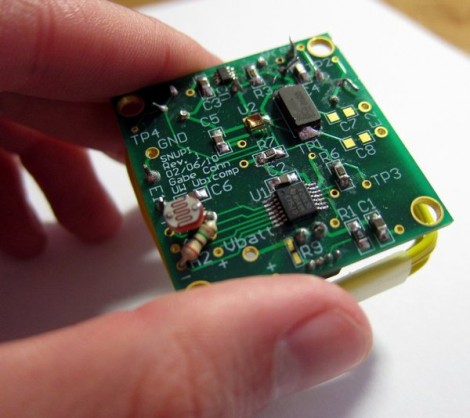
The line between serious research and well-executed hacks has been getting pretty blurry lately. The device above could have been designed in your basement but it actually comes from researchers at the University of Washington. They are working on low-power home automation sensors for monitoring things like humidity, temperature, air quality, and light. The key point in their research has been the use of a home’s electrical system for wireless communication. Operating at 27 MHz has proven quite efficient to the point that one of these modules placed within 10-15 feet of an electrical run can communicate with the rest of the home, powered only by a watch battery projected to last ten years.

That’s kind of exciting, it’s a heck of a lot easier to produce and distribute a set of small boards like this than to run communication wiring throughout the house. Now we just need to pair this with the Air Force’s parasitic power work and there’ll be no need for a battery at all.

[Thanks Sidhant]

Spy Video TRAKR: The Teardown

Last Friday we looked at Wild Planet’s Spy Video TRAKR programmable RC vehicle mostly from an end user perspective. Much of our weekend was spent dismantling and photographing the device’s internal works, and poring over code and documentation, in order to better gauge the TRAKR’s true hackability. Our prior review included some erroneous speculation…we can clarify a number of details now, and forge ahead with entirely new erroneous speculation!

Continue reading “Spy Video TRAKR: The Teardown”

Spy Video TRAKR: First Impressions

At the Bay Area Maker Faire this past May, we had our first glimpse of Wild Planet’s Spy Video TRAKR, a $130 radio-controlled toy with some surprises under the hood.

On the surface, the Spy Video TRAKR — the latest addition to the popular Spy Gear toy line — is an R/C tank with a video camera and night vision, with the added ability to download new “apps” from the internet for extra functions. With a little detective work, one uncovers the TRAKR’s secret double life: it’s also an eminently hackable robotics platform! Prior Spy Gear toys have been popular hack targets, providing inexpensive, mass-produced sources of unusual items such as head-mounted displays. Rather than throw up barriers, Wild Planet has chosen to embrace this secondary market, with plans to release development tools and documentation making it possible to extend the device’s capabilities.

Read on for our image-heavy unboxing and initial impressions.

200 Mile RF Transmitter (and High Altitude Balloon)

If there is one thing we like, it’s a fellow hacker so enthusiastic about his or her work that they write the article practically for us by including as much detail and information as possible.

In this two part hack, [Scott] wrote in to let us know not only about a high school built high altitude balloon, but also his $5 long range RF transmitter. The former is simply GPS and video data logged over the flight, but [Scott’s] specialty comes in the latter. A 74HC240 octal buffer is using to amplify the signal (Morse code) from an ATTiny44a with a 29MHz oscillator, producing a usable signal as far away as 200 miles.

It is low bandwidth, but if you’re looking for a simple transmitter in your project and need something with more power (and a smaller package), this might be the ticket.