Huge Interactive Crossword

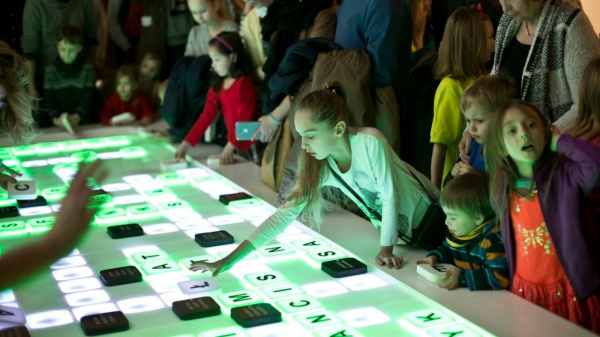
Give kids some responsible and challenging tasks, and you’d be surprised at the results. The “Anything Goes” exhibit at the National Museum in Warsaw was aimed as a museological and educational experiment. A group of 69 children aged 6–14 was divided into teams responsible for preparing the main temporary exhibition at the museum. Over six months, they worked on preparing the exhibition during weekly four-hour meetings. They prepared scripts, provided ideas for multimedia presentations, and curated almost 300 works for display. One of those was [Robert Mordzon]’s Giant Interactive Crossword.

The build is in two parts. The letter tiles, which have embedded RFID tags, obviously look like the easiest part of the build. The table, looking at the video (after the break), probably needed a lot more effort and labour. It is built in two halves to make construction easier. There are a 130 boxes that need to be filled in with the right letters to complete the crossword. Each box contains a bunch of electronics consisting of an Arduino Nano, a RFID Reader and a bunch of sixteen WS2812B LEDs, all assembled on a custom PCB. Do the math, and you’ll figure out that there’s 2080 LEDs, each capable of sipping 60 mA at full brightness. That’s a total current requirement of almost 125 amps at 5 V. Add in all the Arduino’s, and [Robert] needed a beefy 750 W of power, supplied via four switch mode power supplies.

Each Arduino Nano is a slave on the I²C bus. The I²C master is an Arduino Mega 2560, which in turn communicates with a computer over serial. When a box is empty, the LEDs are dim, when a wrong letter is placed, they turn Red, and when the right letter is placed, they turn Green. If a word gets completed, a special word animation is played. This information is also passed on to the computer, which then projects an animation related to the word on a giant wall screen. Upon the crossword getting completed, the table erupts in to a sound (via the computer) and light “disco” show and also reveals the main motto of this section of the exhibit – “Playing the Hero”.
Continue reading “Huge Interactive Crossword”

WS2812B LED Clones: Work Better Than Originals!

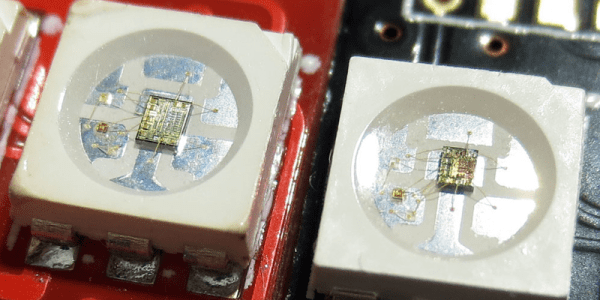
Commodity electronics manufacturing is a tough game. If you come out with a world-beating product, like WorldSemi did with the WS2812B addressable RGB LED “pixel”, you can be pretty sure that you’re going to be cloned in fairly short order. And we’re all used to horror stories of being sold clones instead of what was ordered. But what if the clones were actually an improvement?

[Gonazar] bought some strips of “WS2812” LEDs and prototyped a project. When stepping up to larger production, he thought he’d go directly to WorldSemi. Long story short, the cheaper LED modules that he’d previously bought weren’t from WorldSemi, but were actually SK6812 clones labelled as WS2812Bs. When he switched to the real thing, he discovered that they had some temperature and pressure sensitivities that the clones didn’t. The clones were better!

They weren’t even straight clones. It turns out that they have a much higher PWM frequency, resulting in less flicker at low brightnesses. The distributor came clean, saying that they swapped them out without note because they spoke the same protocol, but were a strict improvement.

Continue reading “WS2812B LED Clones: Work Better Than Originals!”

LED Strip Display Gives You Two Ways To See The Music

What to call this LED strip music visualizer is a puzzler. It lights up and pulsates in time with music similar to the light organs of 1970s psychedelia fame, but it’s more than that. Is it more like the Larson Scanner that graced the front of [David Hasselhoff]’s ride on Knight Rider? A little, but not quite.

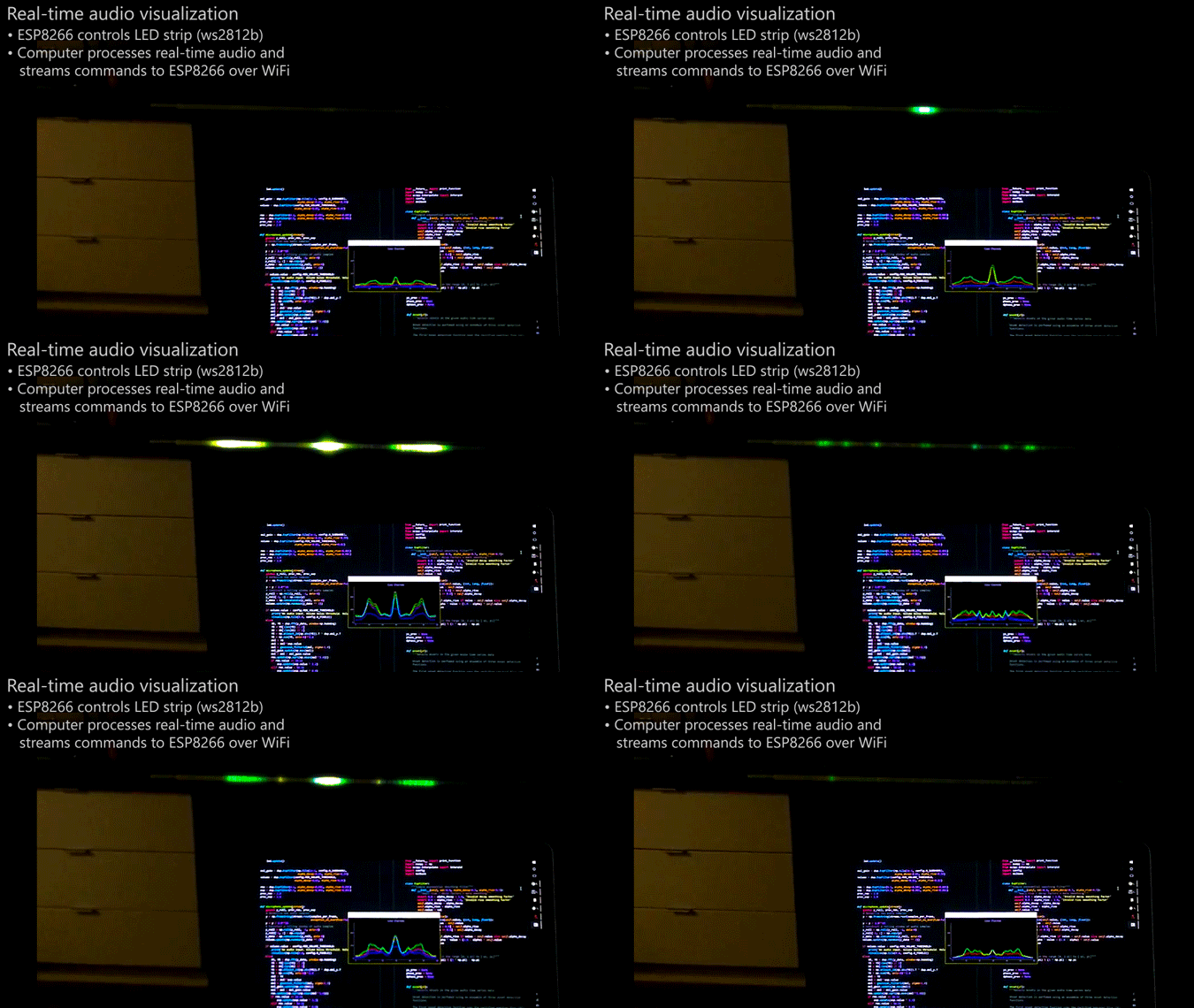
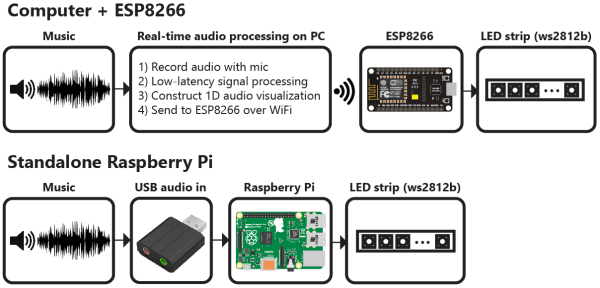
description-croppedWhatever you decide to call this thing, it looks pretty cool, and [Scott Lawson] provides not one but two ways to build it. The business end is a simple strip of WS2812b addressable LEDs. It looks like the first incarnation of the project had an ESP8266 driving the LEDs in response to commands sent to it from a PC running the visualization code, written in Python. That setup keeps the computationally intensive visualization code separate from the display, but limits the display to 256 pixels and probably has to deal with network latency. The Raspberry Pi version both crunches the numbers and drives the display, but the Pi doesn’t have the oomph to run both the LEDs and the GUI, which is pretty interesting to look at by itself. The video below shows the different visualization modes available — we’re partial to the “energy effect” at the end.

Take your pick of hardware and throw a couple of these things together for your next rave. And if you need a little more background on the aforementioned Larson Scanner, we’ve got you covered.

Continue reading “LED Strip Display Gives You Two Ways To See The Music”

Jenkins Lights The Christmas Tree

Jenkins is open-source automation software that tries to automate parts of the software development process. When you submit code, for example, Jenkins will grab it, build the project with it and run any tests on it. If you have a large number of people submitting new code or data, Jenkins will wait and grab a bunch of the submissions to build. Depending on the size of the project, this can take a while, and if there’s a problem, you need to know quickly so that people aren’t waiting on a broken build. Email’s fine for this, but [dkt01] saw one of the desktop LED Christmas tree projects on Hackaday, and integrated it into his Jenkins system.

Like the other projects, WS2812b LED rings are used as the tree, and an Arduino Pro Mini runs the show, with an Ethernet LAN Module to communicate with the Python script that monitors the Jenkins build job. The Python script sends commands to the Arduino, which in turn lights up the LEDs. They light up green on a successful build and red if something fails, but during the build process, the LEDs show the current state of the build, tracking Jenkins’ progress as it builds.

Our previous Jenkins post used a big, red LED light that would light up if the build failed. [dkt01]’s build lets you know if the build is successful or has failed, but the build progress is a great addition.

Continue reading “Jenkins Lights The Christmas Tree”

Colorful, Touch-Sensitive Light Table Is Ready For Gaming

It’s an ambitious build for sure — you don’t start with $500 worth of wood if you don’t intend for the finished product to dazzle. And this 240-pixel touch-sensitive light box coffee table does indeed dazzle.

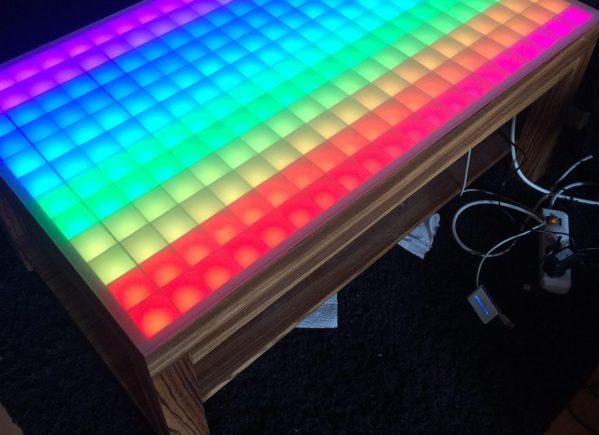
Sometimes when we see such builds as these, fit and finish take a back seat to function. [dasdingo89] bucks that trend with a nicely detailed build, starting with the choice of zebrawood for the table frame. The bold grain and the frosted glass top make for a handsome table, but what lurks beneath the glass is pretty special too. The 240 WS2812 modules live on custom PCBs, each thoughtfully provided with connectors for easy service. There’s also an IR transmitter-receiver pair on each board to detect when something is placed over the pixel. The pixel boards are connected to custom-built shift register boards for the touch sensors, and an Arduino with Bluetooth runs the whole thing. Right now the table just flashes and responds to hand gestures, but you can easily see this forming the basis of a beautiful Tetris or Pong table.

This build reminds us a little of this pressure-sensitive light floor we featured recently, which also has some gaming possibilities. Maybe [dasdingo89] and  [creed_bratton_] should compare notes and see who can come up with the best games for their platform.

[via r/DIY and a tip from emptycanister]

Ceiling Tiles Give It Up For Christmas LED Ornaments

The great thing about holidays is that they always seem to require some shiny things. The modern version of shiny things seems to be LEDs and advances in technology being what they are, we now have amazing programmable LEDs. And programmable LEDs mean animated shiny things! Years ago, [wpqrek] made an LED ornament using discrete components. This year he revisited his ornament and decided to make a new, animated, RGB ornament.

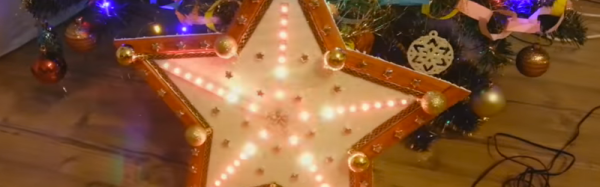
[Wpqrek]’s build is based around five WS2812b strips connected to an Arduino Pro Mini. The ornament itself is a thick styrofoam ceiling tile cut into a star shape with a red-painted wooden frame. Decorated with baubles and stars, the LED strips start in the center and end up at each point in the star. With each strip connected in parallel to the Pro Mini, [wpqrek] used the Arduino Light Animation library to handle the animations.

[Wpqrek] says the result is too big for his tree, so he uses it as a stand-alone ornament. Perhaps using lighter materials would help — or getting a bigger tree! Check out the Arduino lighting controller or the Trompe-l’oeil Menorah for more holiday hacks.

Continue reading “Ceiling Tiles Give It Up For Christmas LED Ornaments”

Light Pipes And LEDs Team Up For A Modern Take On The Nixie Tube

There’s no doubting the popularity of Nixie tubes these days. They lend a retro flair to modern builds and pop up in everything from clocks to weather stations. But they’re not without their problems — the high voltage, the limited tube life, and the fact that you can have them in any color you want as long as it’s orange. Seems like it might be time for a modern spin on the Nixie that uses LEDs and light pipes. Meet Nixie Pipes.

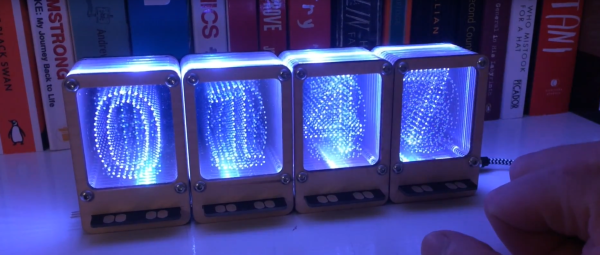
Inspired by an incandescent light-pipe alphanumeric display from a 1970s telephone exchange, [John Whittington]’s design captures the depth and look of a Nixie by using laminated acrylic sheets. Each layer is laser etched with dots in the shape of a character or icon, and when lit from below by a WS2812B LED, the dots pick up the light and display the character in any color. [John]’s modular design allows one master and an arbitrary number of slaves, so large displays can simply be plugged together. [John] is selling a limited run of the Nixie Pipes online, but he’s also open-sourced the project so you can build your own modules.

We really like the modularity and flexibility of Nixie Pipes, and the look is pretty nice too. Chances are good that it won’t appeal to the hardcore Nixie aficionado, though, in which case building your own Nixies might be a good project to tackle.

Continue reading “Light Pipes And LEDs Team Up For A Modern Take On The Nixie Tube”