posted Feb 16th 2010 10:00am by
Caleb Kraft
filed under:
toy hacks

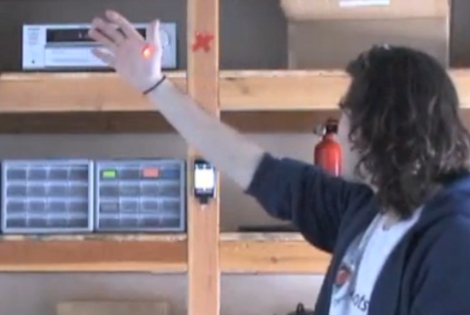
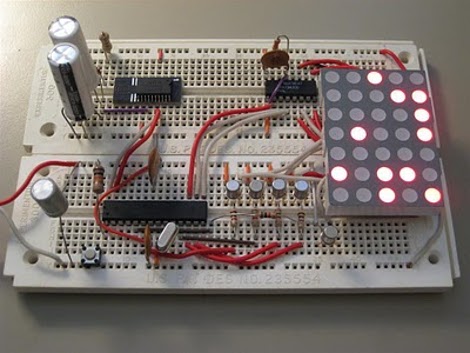
We love arcade games. Who doesn’t? We feel that the “arcade” feeling just can’t be replicated in any other form factor than an arcade cabinet. [Moslevin] must feel the same way too. He has built, what could possibly be the worlds smallest arcade cabinet. Aside from a coin mechanism, it is fully functional. It is an ATMega328p running his own custom software. The games he has available are Tetris, Invader, and Breakout, all coded by himself as well. We’ve seen small arcade cabinets before, but none this small.
posted Feb 16th 2010 9:00am by
Mike Szczys
filed under:
toy hacks

[Brandon Meyer] spared no expense in modding the Catch Phrase game to use custom word lists. The altered version of the game, normal sold for around $25, now comes in at a whopping $230! That’s because the internals were gutted and replaced with an Arduino, 20×2 LCD display, and some other interesting bits. The device now features an SD slot for storing your own lists and a USB port for programming.
At first glance we were hoping some simple EEPROM hacking had unlocked the secrets of the device but that wasn’t he case. We’d love to see some more economical versions of [Brandon's] prototype. Perhaps reusing the original LCD, replacing the Arduino with the ATmega168 that makes up its core, and using a diy SD cradle for a card reader.
So yes, this version is a bit of overkill but still very nicely done!
[Thanks Zoidberg]
posted Feb 16th 2010 7:26am by
Mike Szczys
filed under:
digital cameras hacks,
tool hacks

Who doesn’t need to take pictures of the microscopic bits inside of an integrated circuit? [Mojobojo] made an end-run around the expensive equipment by building a microscopic lens from an old camcorder. He’s using a regular digital camera with the lens set to its largest zoom level. The camera is pointed into the salvaged camcorder lens where the fine tuning is done. His first iteration was just taped to the desk with a small hand flashlight illuminating the subject. He upgraded that setup by building a LEGO enclosure and changing to a much brighter light source. The images he’s getting are quite surprising and this will be very useful during those extreme hacks when you need to tap into an IC’s internal data rails.
[Thanks Julius]
posted Feb 15th 2010 3:06pm by
Mike Szczys
filed under:
lockpicking hacks

[Barry] shared his postulation on how electronic key impressioning works (google cache). You may remember his foil impressioning demo from earlier in the month, but now he’s addressing a piece of news we must have missed. Apparently, a handheld impressioning device is about to hit the market that can tell you the key codes for a lock in a matter of seconds. [Barry's] guessing at how this is done from his experience with a similar device aimed at car locks. When the circuit board seen above is inserted into a lock, it completes a circuit between the lock housing and the wafer. The firmware monitors the conductors on the tip of the PCB to calculate how deeply the cut should be and at what point on the key.
This would be fun to try with a homemade PCB, any idea how to deal with wrapping traces around the edge of the board like that?
posted Feb 15th 2010 2:00pm by
Mike Szczys
filed under:
iphone hacks

[Hcgilje] threw together a tutorial on using serial communications in iPhone applications. It builds upon the DevDot tutorial which was posted back in 2007. A lot has changed since then; the firmware has come a long way and there are several development tools that now make things a bit easier for you. His examples use Interface Builder and openFrameworks to demonstrate GUI control of an LED and a servo motor. Now go out and design your own peripherals for this popular handset.
posted Feb 15th 2010 12:32pm by
Mike Szczys
filed under:
green hacks,
transportation hacks

[Henry Herndon] converted a Mazda Miata to an all-electric vehicle. There’s a ton of great information in his archives, as well as a round-up video that we’ve embedded after the break. It’s interesting to see him implement two different types of Nalgene bottles as coolant reservoirs. The polycarbonate on the first shattered on him but the soft plastic replacement seems to have done the trick. The batteries add a lot of weight to the vehicle and he ends up refitting the suspension to compensate. [Henry] registered the vehicle with the state and now has a street legal EV of his own design.
Also worth a look is his post covering the 2009 Wayland Invitational. There as a large collection of electric vehicle conversions at the get together.
Read the rest of this entry »
posted Feb 15th 2010 11:35am by
Caleb Kraft
filed under:
robots hacks,
toy hacks
Quad copters have been pretty popular for the last few years, but this one is new to us. Take the same basic layout, but bump it to 6 rotors. Then you’ll have
the hexacopter (google
translated). With 6 rotors, built in GPS and stabilization and a camera mounted on the bottom, this thing is pretty well equipped. You can see how agile and stable it is in the video above. We know it isn’t necessarily new, but it is new to us. Of course, you don’t have to stop at 6 rotors. You could always just
continue on to 8.
posted Feb 15th 2010 8:54am by
Caleb Kraft
filed under:
digital cameras hacks,
peripherals hacks,
wearable hacks

[Banfield Design] has put together this instructable on how to upgrade or re build a head mounted display to be more immersive and add features. Though you can already buy glasses style viewers for your media devices, they can use some upgrades. For one, you have to supply your own sound, and putting headphones on, over bulky glasses can be painful on your ears. Another area that could use improvement is the light that comes in around the glasses. The current trend is to make them as small as possible, but that tends to let your peripheral vision see the outside world. [Banfield design] wanted to make them more immersive, so he built them into some ski goggles. This not only helped block the light, but allowed for an over the ear style headphone assembly which is much easier on the ears.
A functional improvement came next, by adding a webcam front and center. He could now switch between a live feed of his environment and whatever other inputs he wanted. This could be really fun with some augmented reality. He has a list of future improvements, but he doesn’t mention adding a second camera for stereoscopic viewing of his surroundings. Why would you do that? because it would make augmented reality much cooler.