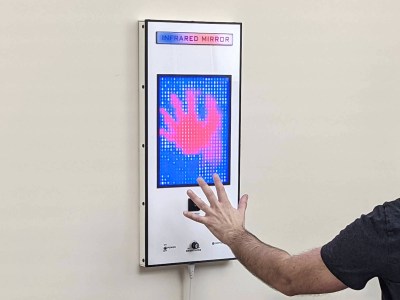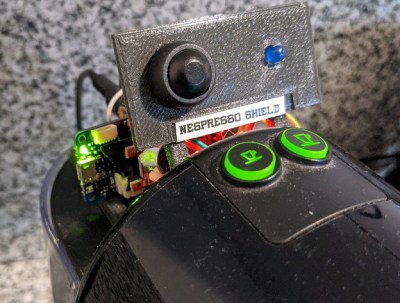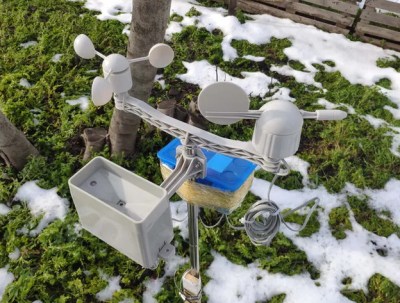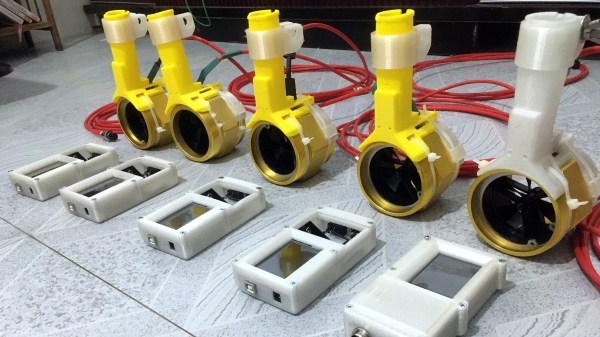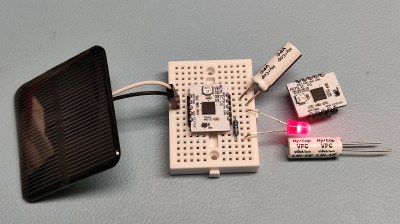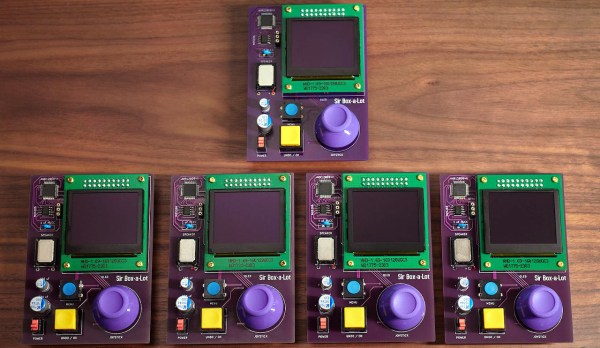
Here’s a collection of simple hacks you can do in between larger projects. After the break we’ll look at converting an iPod from hard drive storage to Compact Flash, build an LED desk lamp using LEGO and USB power for charging, and use an Arduino shield to add network control at the touch of a button.
Friends, pilgrims, send us your hacks. Most especially, your Thanksgiving hacks. We had a wonderful time over the past six weeks collecting and highlighting your Halloween props and now it’s on to the next holiday. Did you build your own deep fried turkey rig with some special features? How about that pie making robot you built for last year’s celebration? Can’t live without your twittering cornucopia? Document it and send it to our tip line! All Thanksgiving themed hacks will be considered but only the well documented and creative entries will be featured.
If you just joined us, here’s a roundup of the Halloween Props we encountered this year:
The Atmega168 at the heart of every Arduino is an eminently capable chip; its ilk have been seen working as a basic web server, playing back digital audio, even generating TV signals. But as projects continue to grow in sophistication, reality rears its ugly head: Arduino can handle any one of these tasks very well, but it often requires squeezing every last instruction cycle or bit of memory in the device. Even the ’368 chip and the Arduino Mega are stopgap measures. Sooner or later, you have to graduate to long trousers—move up to a more capable microcontroller platform—an uncomfortable change usually involving a hefty investment in new hardware and an intimidating learning curve. Leaf Labs’ Maple aims to change all that… Read the rest of this entry »
Here is a classic project used to increase wireless signal strength. Cantennas focus using a waveguide very much like a magnifying glass focuses light. [Robert] made a Natural Light beer cantenna, pictured in the upper left. His approach used three beer cans, a paper towel holder, and a shower curtain rod. On the tipline, he noted a signal boost from 11Mbps to 54Mbps. This is certainly something we can hack together if our room lacks adequate signal. Read about parabolic and seeking versions after the break.
With the 4th of July around the corner, we thought it would be a good idea to give a controller wrap up and show you how to make some ignitors. Last year we covered a microcontroller based fireworks launcher. If you like the idea of a controller but don’t want to run all the wire, we have the wireless fireworks controller. Adding a little twist to the wireless scene are cell phone triggered fireworks. Maybe controllers are not your cup of tea, you could try to microwave your fireworks. After the break we show you how to make ignitors from a diode and a match.
Vacuum formers are still fairly rare in our community, so it was a surprise to see that in the 1960s Mattel marketed one as a toy. It used a hot plate to mold plastic sheets into various shapes. The design was updated by Toymax in the early ’90s to use a light bulb heating element to make car bodies, like some sort of manly Easy-Bake Oven. The home-built machines we’ve seen are a much larger scale. In 2005, we posted [Ralis Kahn]’s version that employed an electric grill as the heating element. [drcrash] has since built on those plans, hoping to develop an even cheaper device.
Every year, as it gets cold, many of us put our faithful two wheeled companion away for the winter. Despite that, there have been a veritable smorgasbord of bicycle related projects posted to instructables this last week. In honor of our human powered transportation, lets take a peak at a few projects.
Bicycle safety is always paramount. They can be fairly difficult to see compared to a car. There are many ways to make them easier to spot, such as wrapping them in reflective material, or adding blinking tail lights. Even if people do see us, they often have no idea where we are planning on going. To remedy this, we can always add turnsignals. It can also be hard to see where you are going at times. Adding a head light, or helmet light can really help. If you’re not a big fan of LEDs and want a little retro flair, you can always add an oil lamp.
For those who live in warmer climates, or just can’t give up their bicycles, you may wish to add some festive decorations. Covering your bike in Christmas lights doesn’t look too difficult, and a CFL lit wheel is a cheap way of adding some cool effects.
We’re barely past Halloween and people are already working on their next LED based holiday decorations. For Hanukkah, Gizmodo pointed out the PCB menorah pictured above. It uses a set of DIP switches to control which LEDs are lit. A couple years ago, Evil Mad Scientist Laboratories put together a tutorial for building a more minimal LED menorah. Each of the nine LEDs are soldered directly to the legs of an ATtiny2313 microcontroller. Every time you power up the device an additional LED is lit. [Ori] liked the project and decided to take a slightly different approach. He used an LM3914 DIP18 LED bar driver. A potentiometer controls how many of the LEDs are illuminated.
With the election coming up in less than a week, voting machine security (or the lack thereof) is critical, especially with the popularity of early voting this year. While we’ve previously discussed voting machine insecurities, it looks like the problems haven’t been fixed, and in some cases, it’s escalated. Voters in states like West Virginia and Tennessee have complained about voting machines “flipping” their votes, even after they were recalibrated as in the video above. Voters have been advised to avoid voting straight Republican or Democratic tickets, to avoid the likelihood of their votes being flipped. What if you actually do want to vote a straight ticket? Video the Vote is an organization that advises documenting as much of your voting process as possible. Other ways you can protect your vote include voting absentee so that a paper trail is available, and refusing to accept provisional ballots, which are often thrown out. After seeing videos of ROM swapping and finding out that the locks can be opened with hotel minibar keys, we’re waiting to see what’s going to fail this year… and voting absentee.
Yesterday, Gizmodo published a roundup of wearable gadgets for people who “don’t mind looking like a tool”. It’s interesting to see what has been deemed commercially viable and put into mass production. The list covers HMDs, embedded WiFi detectors, integrated keyboards, tech jackets, speaker hats, and others. We thought you might find some inspiration from the list for your next project. In the past, we embedded a WiFi detector in a backpack strap for our Engadget how-to. The natural choice for wearable projects is the LilyPad Arduino which was featured most recently in the turn signal jacket.