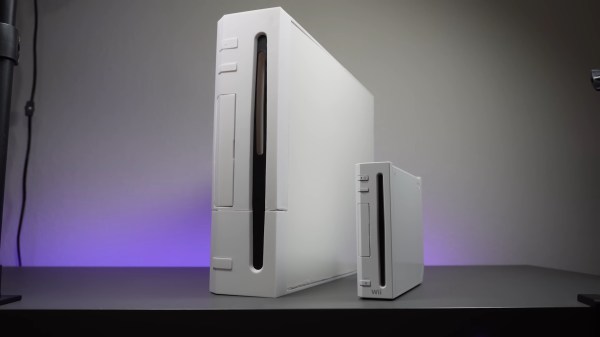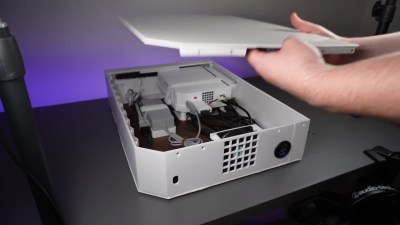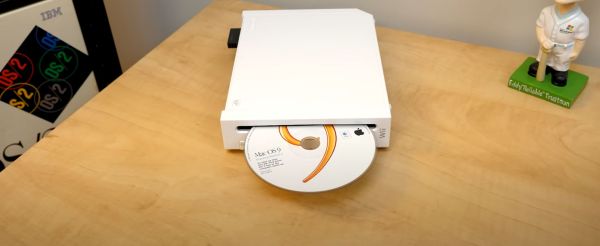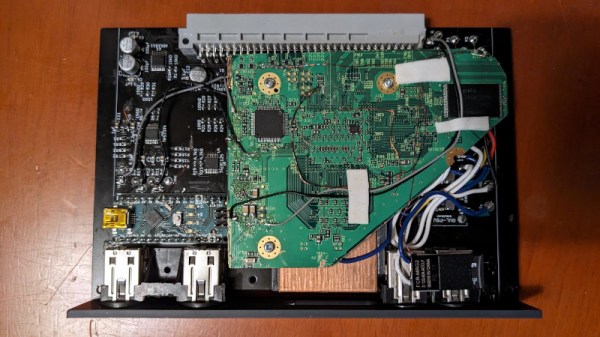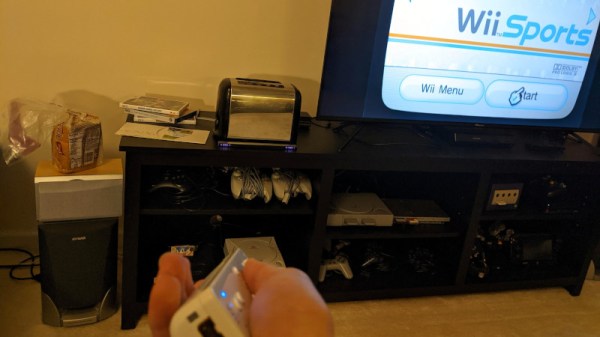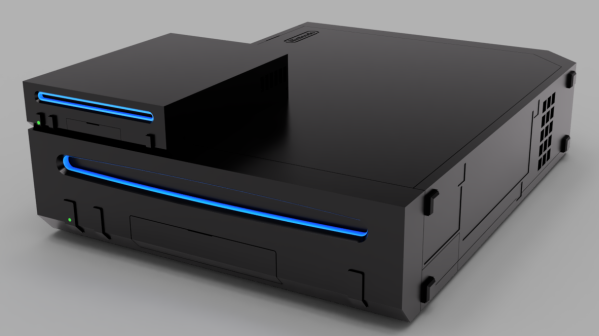
The Wii-Optical-Drive-Emulator (WODE) makes it possible to load Wii and GameCube ISO files from an SD card or USB storage device. This hack uses the ribbon cable for the optical drive to connect to the Wii, requiring no soldering. The WODE is based on an ARM9 processor, runs Linux, and features a backlit LCD screen and 4-way center click joystick. Storage can be hot plugged and then an ISO selected using the stick and LCD display. Selected ISO files appear in the game channel as if an original disc had just been inserted into the drive.
The developers claim that a Wii firmware upgrade will not be able to lock out the WODE. There is also a second ribbon-cable connector to use as a pass-through, giving the option to keep the optical drive hooked up if you so desire. Now the race is on for a replacement case that can house all of this new hardware and still look nice like the original. We wouldn’t be surprised to see a homebrew channel program that allows ISO selection without having to walk over to the console.
The Twilight Princess hack doesn’t work on newer versions of the Nintendo Wii, but thanks to a new exploit for the Wii, homebrew is still possible. Using an SD card and a few files, you can have the homebrew channel up and running in no time. The folks at Lifehacker show us how it’s done. It’s good to see that the Wii modding community is still in full force. Hopefully, this won’t turn into a back and forth battle between modders and Nintendo, like it has with SonyandthePSP.
Yo dawg, we heard you liked accelerometers… Apparently people have been wanting this for a while. We’re not completely sure why, so we’ll wait and see what gets done with it. [Ubiq_01] has connected a WiiMote to his iPhone and is using it to control and OpenGL application. He has released a tutorial (which seems to be down currently) if you want to try to reproduce it yourself.
This little walking robot caught our eye. We’ve seen tons of 4 legged bots, but the design on this probably took more effort than the electronics. The design is radially symmetrical, it can walk in any direction, turn in place, and even walk upside down. The electronics weren’t forgotten though. This little bugger manages to pull a half our of use out of each battery charging. It communicates wirelessly with a custom dual Wiimote Nunchuck setup via XBEE modules. You can find much more technical details in the captions of the pictures. We’re not positive what processing power is hidden in the bot itself, but we know there’s an Arduino in one of the nunchucks. This might be the brains of the operation leaving the hardware on the bot simply to control the servos. We really like the arc-reactor-esque power display.
These 15 ton robotic arms can reach 16 meters. Not content to control them by a simple joystick, the team hacked together WiiMote controls for them. Ok, we get it. Everybody loves the Wii. What is different about using the WiiMote in this scenario? You can see that they are only using the pitch, yaw, and roll. They’re not utilizing the tracking aspects at all. The only difference between the WiiMote and their joystick in this scenario is that the WiiMote connects via bluetooth. Frankly, we just like the fact that people are playing with the robotic arms, WiiMote or not.
Here’s an interesting WiiMote based project. [Mans] is a tennis fan, though a bit out of practice. With the tennis season coming to a rather climactic end, he got excited and wanted to brush up on his skills. He found the toss part of his serve to be very sloppy. Being a hacker, the first thing he thought was that there must be some way of tracking and graphing his toss so that he could improve it in an intelligent and controlled manner. The WiiMote seemed a perfect fit for this. Only a small modification was necessary, an external button wired to the internal “-” button. This switch is active while he’s holding the ball, and inactive when the ball is released. In this manner, he can track and chart his toss to find out exactly where he needs improvement. He uses [Johnny Chung Lee]’s code, with a small but unspecified modification to write the accelerometer data to a text file.
As he points out, this could be very usefull for any repetitive movement. Whith accelerometers getting cheaper and cheaper, there’s nothing stopping you from using multiple ones either. Imagine a golf rig to analyze your swing, Maybe a boxing rig that measured your hip twist and arm extension, or possibly a yoyo glove to tell you if your flick needs some help. Great job [Mans].
[Matt Cutts], head developer for google’s anti spam team, describes how to attach a Wii balance board to a linux computer. He even shows how to make a GUI to show the input. The entire project is done in about 200 lines of python.The process assumes that you can already make a bluetooth connection to a WiiMote, but if you can’t, he’s got instructions for that too.
[knuckles904] was able to use the new Wii MotionPlus with an Arduino. Nintendo has released the WM+ in order to detect the motion of the controller better. The Wiimote only detects acceleration, whereas the WM+ detects rotation along 3 axes. The Arduino communicates with it over I2C, the same protocol that is used with the Nunchuk. To connect the two devices, he used jumper wires, but breakoutboards are also available. He was able to create some example code with help from wiibrew.org. When paired with a Nunchuk, which contains a 3-axis accelerometer, you can have a 6 degrees-of-freedom IMU for under $40, perfect for controllingyour robots or logging data.
[Andy] wrote in to show us how he hacked his Pleo to be controlled by a Wii Nunchuck. He has installed Xbee units for the communication as well as written a “skit” that allows the Pleo to just stand there and wait for commands. He is using an Arduino to interpret the Nunchuck input and send it to the Pleo. It’s a pretty cool proof of concept, but the response time is pretty slow. This might be due to the Arduino’s slower serial communication rate. Yes, we said you might want to refrain from hacking them, due to their impending extinction, but did you expect us to stick to that? If you’re going to dig into one, you may also be interested in how to hack the Pleo for face recognition and remote control.
When [Epokh] sent in this Wii controlled segway style bot, we remembered a post a few months ago where someone made a balancing bot, but hadn’t completed the Wii code. Well, [Epokh] is going to show you how to implement the Wii controls with the Lego NXT system. He’s found the links to all the software you need and broken down the configuration step by step. He’s beenbusy lately, let’s hope he keeps it up.