posted Jun 21st 2010 12:30pm by
Mike Szczys
filed under:
digital audio hacks

[Billy] wanted to use the audio connector on his MacBook Pro for input and output at the same time. He knew it could be done because Apple sells headphones with built-in microphones that work with the computer. He set out to build a breakout box so that he could connect the components of his choice to the single port. Using a scart-RCA adaptor box he scrapped the scart plug and wired the RCA jacks to the Apple headphone wires. He can now patch the pickup of his guitar to the mic connector, send it through the MacBook, and run the output back to his guitar amp.
posted Apr 22nd 2010 8:00am by
Mike Szczys
filed under:
classic hacks,
digital audio hacks

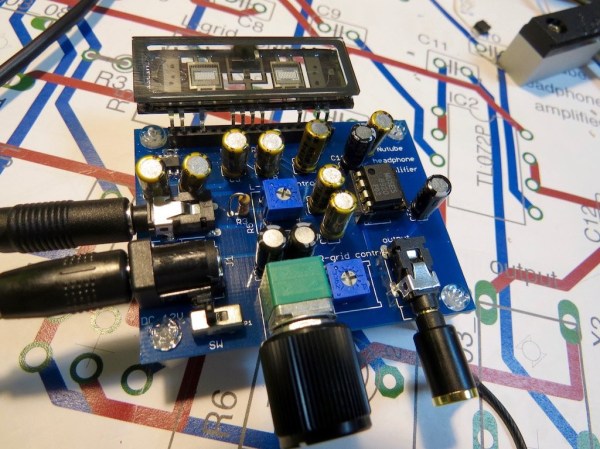
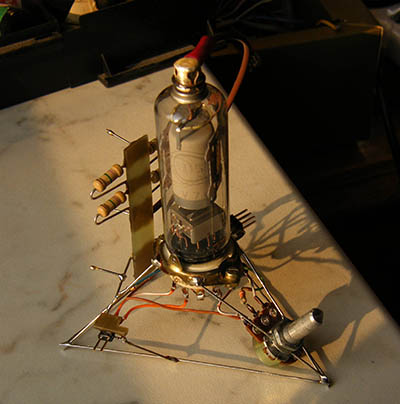
[Alessandro Lambardi] had some vacuum flourescent displays that he pulled from junked VCRs. His latest project is an experiment to use one of the VFDs as a headphone amplifier. This means he’s trying to use them as vacuum triode amplifiers, aka vacuum tubes. He did get it to work but as he suspected, the output is fairly low power. It may be possible to use this setup as a preamp and build an actual tube amp to use along with it.
Update: Thanks to [Fallen] for mentioning that we’ve covered this concept in the past.
[Thanks Muris]
posted Feb 3rd 2010 9:51am by
Mike Szczys
filed under:
digital audio hacks

It’s pretty creative to use a 9v battery as an enclosure. That’s what [Osgeld] did when building this amplifier. There are several advantages; they’re easy to find, it keeps a bit of the dead battery out of the landfill, and this method provides a built-in connector for a 9v power source. In this case the circuit is built around a LM386 audio amplifier. It’s glued to the back of a potentiometer and wired up with the other components for a package smaller than a quarter. A stereo jack reside in the side of the battery case with a cable and alligator clips for connection with a speaker. Now the amp can be quickly connect to any 4-8 ohm speaker.
posted Dec 21st 2009 4:00pm by
Mike Szczys
filed under:
green hacks,
misc hacks

[Hydronic] did some tests to make his own current sensor using a c-clamp wrapped with wire. He tried several different cores including an aluminum carabiner, the C-clamp, and what he calls a u-lock (removable chain link). There is some success here that could be improved with cleaner winding and by adjusting readings based on the length of wire used in the wrapping.
This did make us perk up a bit right off the bat. Reader [Mure], who tipped us off about this, suggested that this could be used to make your own Kill-a-Watt without including it in the circuit. We made the jump to house monitoring. We’d love to have a data tracker for our home circuits to curb wasteful energy use. Perhaps we’ll try to make our own sensors and produce a diy Cent-a-Meter.
posted Oct 7th 2009 2:00pm by
Mike Szczys
filed under:
digital audio hacks

A few weeks ago we saw [Jaroslaw's] universal credit card spoofer. Now he’s sent in a project that incorporates an amplifier into a center speaker for use with an iPod or any device with an audio jack.
The build has two main components; an LM4950 audio amplifier and a center channel speaker he picked up for $3 at Goodwill. The circuit used is straight from the datasheet and he’s provided the four necessary resistor values for you in his writeup. An old set of headphones was butchered for the audio connector and DC power can be provided by any 6-12V source.
The final circuit was built on some protoboard. The speaker housing has plenty of room to fit everything in for a nice finished look. Pretty simple, and except for the IC, this should be an easy salvage project for most folks.
posted Sep 12th 2009 12:44pm by
Mike Szczys
filed under:
home entertainment hacks

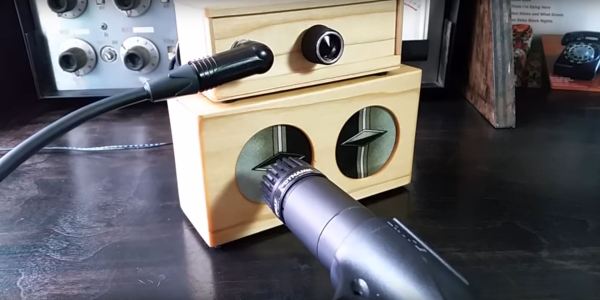
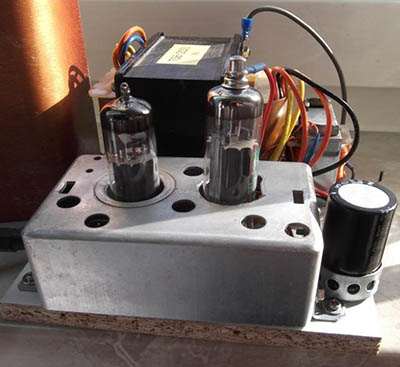
[Niclas] sent us his home made tube amplifier. For the case he used a computer power supply unit, took out the guts and replaced them with the amplifier board. He based this build off of an existing design but took a more minimalist approach. The wooden face plate has an on/off switch, an audio jack, and volume control. Apparently, the tubes are floating loose inside of the case. We’d recommend a more secure mounting method for these delicate parts.
posted Oct 26th 2007 11:00am by
Will O'Brien
filed under:
how-to

It’s been a while since we’ve had a fresh How-To on the Hack-A-Day, and frankly we’ve missed them. To get things rolling, [Eliot] and I wanted to build a good knowledge base to help you hack your own stuff. I know that soldering won’t be new to many of our readers, but everyone has to start sometime. Our hope is simple: that this new series of How-To’s will help inspire new and experienced hackers alike.
Read the rest of this entry »
posted Oct 5th 2007 5:52pm by
fabienneserriere
filed under:
home entertainment hacks,
misc hacks,
portable audio hacks

When you need a rigid, vibration-free chassis for your amplifier, look no further than a roasting pan. I’ve used cast cement for subwoofers, but using a cooking pan bolted to a heavy wooden chopping board is a cheap way to get a rigid surface on which to build audio gear. The amp circuitry used by [Mark] is not complex, but it gets the job done. The “oxygen free copper cable” and “pure silver wire” are not needed, just make sure you have a solid mechanical connection. In other words, just tin your wires, bend small “u” shapes at each end, hook them together, and apply solder to the heated ends. Alternatively, hold the ends of stranded wires parallel to each other and twist the ends together before tinning, then solder. Test everything with a multimeter while moving wire joints to make sure you have no weak connections. Now you won’t waste your money on hyped-up cabling materials.
Thanks to [Gio] (who seems to have some personal audio projects as well) for the tip.