An e-paper information panel

posted Jan 13th 2012 7:20am by
filed under: video hacks

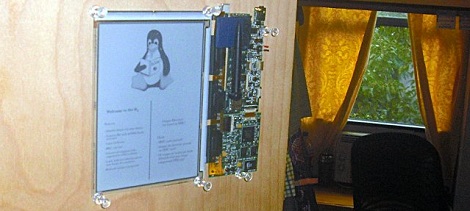
With all the Kindles and Nooks we’re bound to find at yard sales and thrift shops in the coming years, this might be useful. [Chris] made a door-mounted e-paper display to keep himself up to date on recent events.

The hardware comes from an e-paper development kit [Chris] and his friend [Deian] were given a few years back. The dev kit sat in a dusty drawer until [Chris] decided to do something with it. With his door looking like a suitable palette, [Chris] decided to make an information panel that displays the date, his calendar, the weather, and a few RSS feeds.

There was already a Gumstix single board computer attached to the e-paper display, so [Chris] wrote a few scripts on his server and upload information to the paper display. The server renders the display as a PNG image at 800×600 resolution, converts it to PGM and compresses it for the Gumstix. There is a script running on the Gumstix to download the image from the server every five minutes and put it up on the display.

With the awesome readability and low power consumption of e-paper, we’re surprised we haven’t seen a project like this before. Guess we’ll have to wait until Kindles start showing up at flea markets.

Drill-based Kinect camera

posted Jan 6th 2011 12:24pm by
filed under: HackIt, Kinect hacks, peripherals hacks, tool hacks

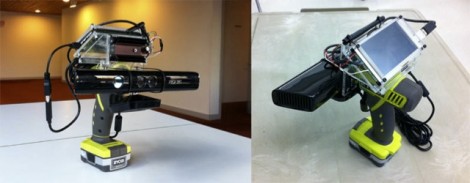
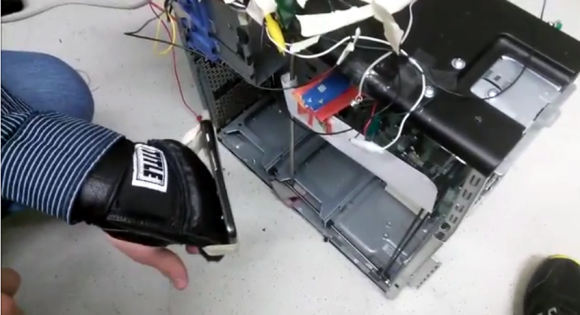
[Brett Graham] and [David Cox] are taking the Kinect out into the world thanks to this handheld hack they call the Drill of Depth. Apparently, the Kinect wants 12V at 1A which is quite easy to provide with a rechargeable power tool like this Ryobi drill. The setup features a 4.3″ touchscreen display, connected to the Gumstix Overo Air that is running Linux. They claim that there’s a “legitimate scientific reason” for building the device but they’re not sharing it yet.

So what would you use this for? We wonder if it would be possible to roll a GPS into the mix, then use post processing from the captured data to recreate the environment in a virtual setting? Imagine if a weekend spent walking around campus and processing the results let you model your University and make it an add-on level for your favorite game. Or perhaps this could be paired with a regular camera to generate high-quality 3D skinning data for Google Earth. That’s what we came up with, what do you think?


Unmanned ocean crossing

posted Sep 24th 2010 12:00pm by
filed under: robots hacks

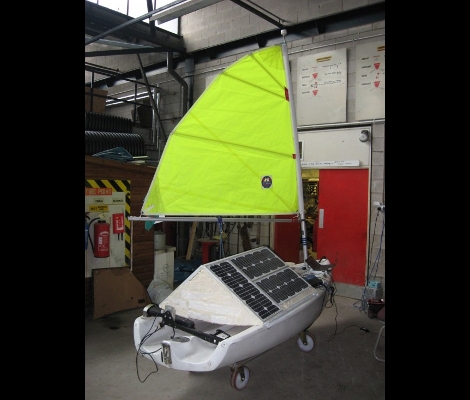
This is the Pinta, an autonomous sailboat built to attempt an ocean crossing from Ireland to Martinique (in the Caribbean). A group of researchers at Aberystwyth University built her as part of the Microtransat Challenge.

To keep tabs on the vessel her creators included an Iridium short burst data modem with a backup system made from a SPOT satellite tracker using a PIC microcontroller to trigger a transmission every six hours. The sailing systems are a conglomeration of a Gumstix board, GPS, a windshield wiper motor to control the sail, and a tiller pilot for steering. A set of solar panels helps to top off the lead-acid batteries that power the system.

Unfortunately the old gal has encountered problems. You can see from the tracking data that, although it sailed 500 km in the last twelve days, she is still just off the coast of Ireland. The primary tracking system has failed, which could signal a system-wide computer failure. We hope the team will eventually recover the vessel as we’re interested in finding out what caused this unfortunate turn of events.

Building Linux images for ARM architectures

posted Sep 17th 2010 9:19am by
filed under: linux hacks

Want to try your hand at building a Linux package for an embedded device? [SnowBot] decided to give it a try and set out to build Ubuntu for a GumStix. The single-board computer will cost you about $150 to get started, plus a way to connect to the device’s serial port. But once you’ve got your hands on it there is a lot of power in a tiny package.

He’s using the RootStock package to assist in the build. This is a suite of tools that generates the root file system that can be loaded onto an SD card for use with the Gumstix. It’s not quite building from the ground up, but there’s already enough hoops to jump through that this package is a welcomed shortcut.

Already rolling your own Linux packages for embedded hardware? We want to hear about it.

Nike + iPod as a tracking device

posted May 13th 2010 8:48am by
filed under: ipod hacks, security hacks

[Thomas] found a paper from 2006 that describes using the Nike + iPod system as inexpensive tracking devices. Yep, it’s old as dirt but we think it’s fascinating reading! [Scott Saponas] and his fellow authors take a hard look at the lack of security in the system in a twelve-page PDF. They cover several different ways to capture and track one of the $29 tags in someone’s shoe, including using the Gumstix reader above, or a slightly modified 3G iPod. If the sensors are not removed or manually switched off when not in use they can be picked up by any RF reader within range. Because the tags are cheap and available, one could be planted on an unsuspecting victim James-Bond-style. Maybe this is what prompted Apple’s half-hearted attempt to restrict hacking the devices to do things like unlock doors.

Of course if you don’t want to do the reading you could download their video presentation or just stream it.


Head-mounted computer with Linux, WiFi

posted Oct 26th 2009 3:20pm by
filed under: classic hacks, linux hacks, wearable hacks

hmdlinux

Most wearable computers we’ve seen feature a head-mounted display tethered to a small PC system in a backpack or worn on a belt. Here’s a slick little system that does away with the cord, fitting the entire system in the glasses.

[Pascal Brisset’s] WXHMD is based on the tiny Gumstix Overo Fire computer-on-module which features a beefy, 3D-capable OMAP processor that runs Linux. The Gumstix is interfaced with a Vuzix VR920 head-mounted display that includes a three-axis accelerometer and compass. Tying these together is a custom video digital-to-analog converter board of [Pascal’s] own design, created using direct-to-PCB inkjet printing techniques. For less than $1,000 total in parts, the result is a spatially aware six ounce computer, with display and battery and all, that fits neatly over the bridge of one’s nose.

It’s a fantastic hack and a nicely documented project, though even the device’s creator himself questions whether having a pair of microwave transceivers and a LiPo battery strapped directly over one’s eyes and brain is such a good idea.

[thanks w3pt]

Augmented Network Interfaces

posted Apr 25th 2009 6:33pm by
filed under: pcs hacks

agarwal-nsdi09-somniloquypdf-page-7-of-16

Here’s an interesting bit of research to come out of Microsoft and UCSD. The Somniloquy project is a new type of network interface. It’s a USB device that allows a computer to continue network communications after being put to sleep. By offloading these tasks, machines that would normally stay awake for RDP and file transfers are only powered up when absolutely necessary. The device uses a Gumstix board like the one used in the Tor hardware adapter. The device pictured above has two USB interfaces, but the second is just for debugging and not needed for proper operation. The board runs BSD and creates a USBNet bridge to the Vista host. When the host daemon detects the computer going to sleep, it hands off active communication to the gumstix. They developed “stub” applications to handle the various types of communication. For downloads, they used wget to download only the portion of the data that was still left. For bittorrent, they customized the command line client ctorrent to manage the download. Both programs wake up the PC upon completion and transfer the file off of the SD card.

[via Engadget]

Tor hardware privacy adapter

posted Dec 21st 2008 4:33pm by
filed under: peripherals hacks, security hacks

hardwaretor

The Janus team have published a preview of their new Privacy Adapter. It’s a small two port router. You just plug it in-line between your computer/switch and your internet connection. It will then anonymize all of you traffic via the Tor network. You can also use it with OpenVPN. The hardware appears to be a Gumstix computer mounted to a daughtercard with two ethernet ports. It will have a web configuration just like a standard router. This looks like a great plug-n-play privacy device. The only improvement we would suggest is adding auto-detect so a crossover cable isn’t required.

Janus is responsible for JanusVM, a virtual machine designed to protect your privacy with technologies like Tor and OpenVPN.

[via @hdmoore]


Hack a Day serves up fresh hacks each day, every day from around the web as well as hacking related news.

Send us your hacks


Hacks

Resources