Boost your garden’s output using ultrasonic mist

posted Aug 11th 2011 12:01pm by
filed under: home hacks

ultrasonic_aeroponic_growing_rig

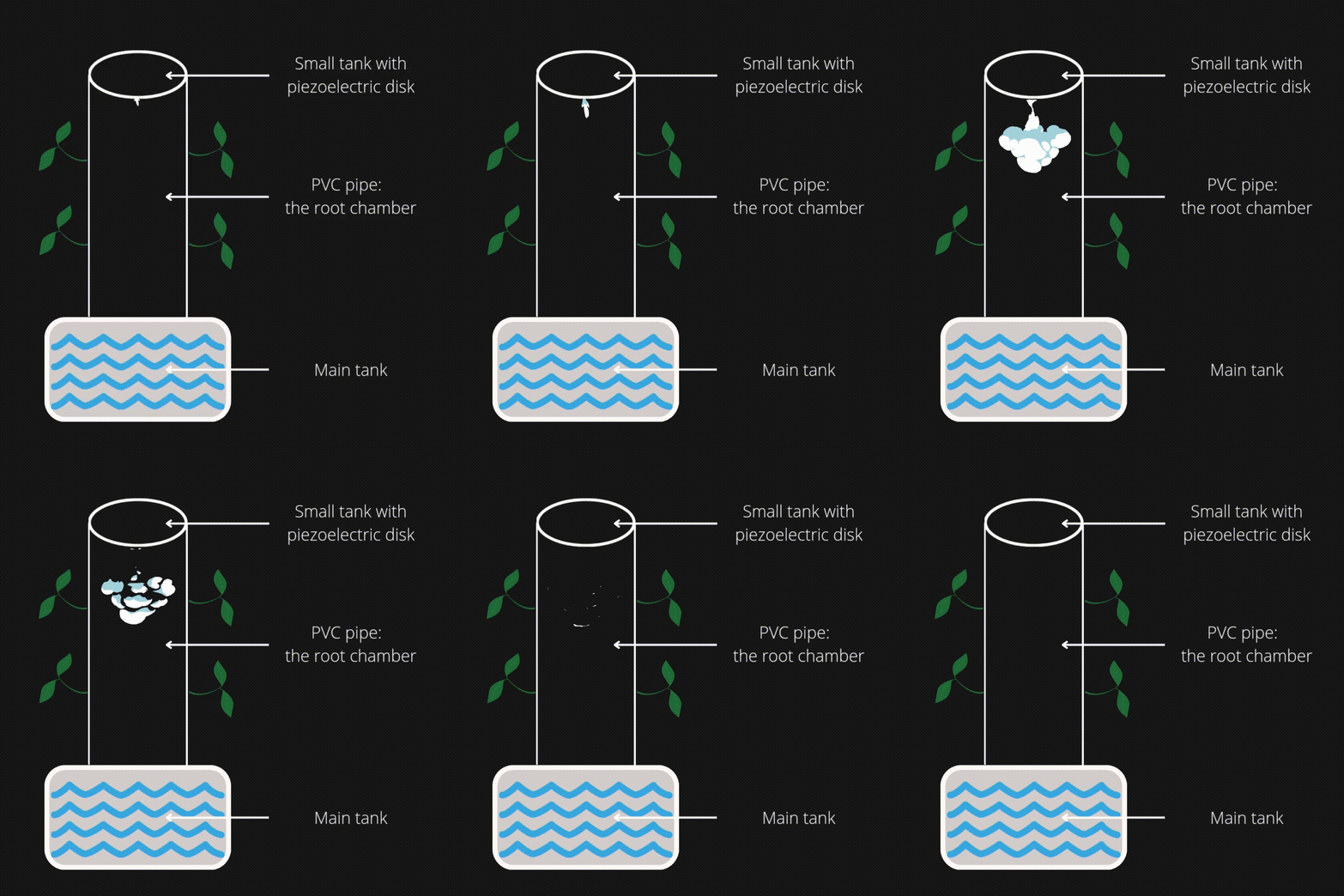
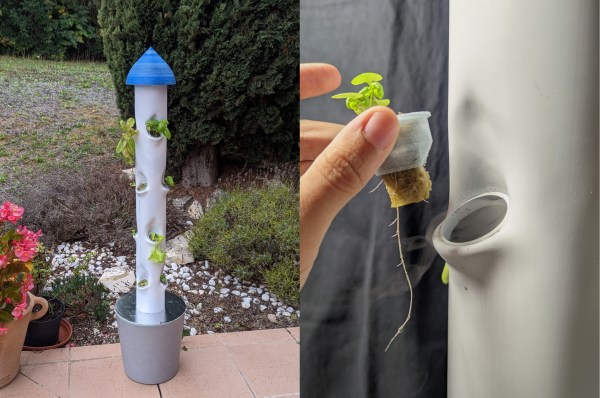
If you enjoy gardening, it’s never too early to start thinking about next year’s growing season. [Jared Bouck] over at InventGeek loves his tomatoes, but the slow grow rates of his dirt-bound plants were less than impressive. To get things moving faster, he created a low-cost aeroponics system that uses ultrasonic mist to produce some pretty impressive results.

The construction process of this ultrasonic aeroponics rig looks dead simple, and [Jared] said that he had everything assembled in about half an hour. A cheap ultrasonic mister was mounted in the bottom of a plastic tub, and holes were cut in the tub’s lid to make room for his growing baskets. Tomato seedlings were wrapped in rock wool and placed in a clay growing medium, suspended over the water bath. The mister was turned on, and after just a few days, the results were obvious.

In the last step of his tutorial, he compares his aeroponically grown plant to one grown in soil – the difference is unbelievable. Considering how reasonably priced his setup is, it seems like a no-brainer to start growing your entire vegetable garden this way.

Harvesting ultrasonic sensors

posted Feb 3rd 2011 2:04pm by
filed under: robots hacks, transportation hacks

With many modern cars coming equipped with an array of ultrasonic sensors mounted in the bumpers, it stands to reason that many junk yards have them too. [jimk3038] points out that, unless they’re crushed, they’re probably good. The list of features on these is pretty long, including being short proof, water proof,  EMF proof and fast. These tough little suckers can be used in a multitude of projects and can have a range of roughly 2 meters.  [jimk3038] documents in great detail how to use these things as well as offering some sample code to get you started. Why didn’t we think of this?


DIY Ultrasonic range finder for $5

posted Jan 24th 2011 8:51am by
filed under: arduino hacks

After finding some ultrasonic transducers online for a dollar each [Kerry Wong] decided to create an ultrasonic range finder. The result is much like parallax’s PING))) sensor but much cheaper. His post is not only a good way to save some money, but also does a good job of explaining how ultrasonic sensors work.  The transmit circuit is essentially an H-bridge, much like what you would use to control a motor. To listen to the returning echo he uses a pair of high gain/low noise op-amps to filter and amplify the signal.  The board he uses to test the range finder (not included in the cost) is an ATMega328 running the Arduino boot loader.  He also provides lots of example code to boot.

Touch screen using range sensors

posted Jul 7th 2010 2:00pm by
filed under: multitouch hacks

This touch screen relies on measurements from two range finders to track your finger as you press buttons. [James Alliban] put this together as his first Arduino project. We’re familiar with [James'] background because of his informative augmented reality business card. As the Arduino picks up data from the range finder it sends it to a Flash script that is running on the PC.

As we watched the video after the break a lot of questions came to mind. What kind of angle do these Ping sensors have? Will there be interference problems if they were placed perpendicular with each other? Would you get more accurate data if they were not both on the top of the screen? For now this is just a preliminary experiment, but we like the concept and may give it a try ourselves.

Read the rest of this entry »

All terrain Roomba

posted Mar 23rd 2010 10:48am by
filed under: robots hacks

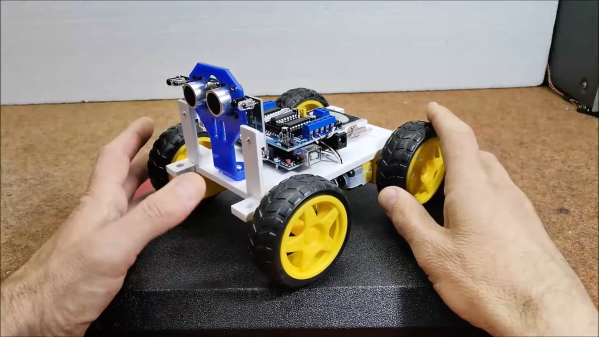
This little rover gets around on rough terrain pretty well. [Dean Segovis] built it using parts from a Roomba. The Roomba uses wheels in conjunction with gearboxes that handle a lot of the dirty work in getting this prototype going. [Dean] grabbed four of them, as well as the motor controller board and batter, and installed them on this Rocker-bogie suspension. In the video after the break he mentions that this would be quite a good climber if the batter were relocated to the center of the body. An ultrasonic sensor adds obstacle avoidance with and Arduino taking care of the processing. We can’t wait to see future versions of the Roomba’s rough-and-tumble outdoor cousin.

Read the rest of this entry »


Ultrasonically controlled instrument

posted Dec 26th 2009 1:00pm by
filed under: digital audio hacks, robots hacks

[Rui] is working on a sequencer to control his robotic gamelan. The software maps out the controllers that operate the musical robot, which play the traditional Indonesian instruments.

The controls use ultrasonic distance sensors that detect the proximity of the musician’s hands. This data is collected by an Arduino and sent to a computer for use with the sequencer. The controller body is an upside down salad bowl from Ikea; cheap, available, and creative!

[via @littlebirdceo]

Sunday software sound hacks

posted Dec 6th 2009 3:34pm by
filed under: digital audio hacks

[Ico Doornekamp] sent us his ultrasonic-entirely code based-thermin project in response to yesterdays Virtual theremin. By using the programming environment Pure Data, he is able to transform his laptop into a dual input device (while only using a single microphone) without modification. By being so open-ended theoretically anyone can have a theremin within a few moments of downloading, but he does mention it might not work on all hardware.

Also in relation to yesterday’s use of a Wii remote [blobKat] let us know about his thesis project, performance based music making. After studying the connection between musicians and their use of laptops decided that they would want more interaction and movement in their music creation. He combined gesture recognition and synth based movement with Wii remotes to achieve his ends. The video above is an explanation and example of his efforts.

Rotating radar visualization

posted Nov 16th 2009 5:00pm by
filed under: arduino hacks

We ask, who wouldn’t want a rotating motion and distance tracking radar? Sure in today’s day and age anyone could purchase a wide-angle sonar or IR solution that achieves the same goal, but [LuckyLarry] took it old school and made his own rotating radar. He used an Arduino, servo, and ultrasonic sensor as a base to gather data, and the open source programming language Processing to draw the data on the screen. He says it’s a little inaccurate currently, but will try out some other sensors in the future.


Hack a Day serves up fresh hacks each day, every day from around the web as well as hacking related news.

Send us your hacks


Hacks

Resources